Looking for Tomato Acidity: Home Canning Tomatoes Safely - Understand Tomatoes Low Acid or High Acid in 2025? Scroll down this page and follow the links. And if you bring home some fruit or vegetables and want to can, freeze, make jam, salsa or pickles, see this page for simple, reliable, illustrated canning, freezing or preserving directions. There are plenty of other related resources, click on the resources dropdown above. If you are having a hard time finding canning lids, I've used these, and they're a great price & ship in 2 days.
If you have questions or feedback, please let me know! There are affiliate links on this page. Read our disclosure policy to learn more.
Tomato Acidity: Home Canning Tomatoes Safely - Understand Tomatoes Low Acid or High Acid
Tomato Acidity: Home Canning Tomatoes Safely - Understand Tomatoes Low Acid or High Acid
Are tomatoes low acid or high acid (acidic)? In short, they borderline, and whether they are acidic or not, for the purposes of home canning, depends upon the variety. In practice, it is a moot point: as long as you add a small amount of lemon juice (it won't affect the taste) to each jar, it will always be acidic enough to be safe! Don't miss: Answers to common tomato canning problems
You may also find this master list of tomato varieties helpful.
Tomato Acidity Explained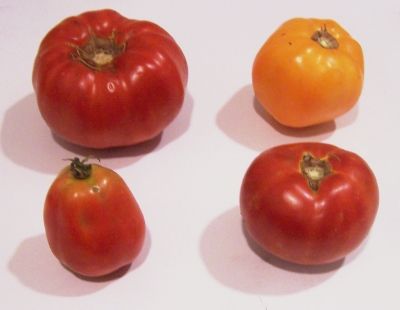
Tomatoes borderline acidic, and it depends on the variety. Some are more or less acidic than others.
The USDA says:
Although tomatoes usually are considered an acid food, some are now known to have pH values slightly above 4.6. Figs also have pH values slightly above 4.6. Therefore, if they are to be canned as acid foods, these products must be acidified to a pH of 4.6 or lower with lemon juice or citric acid. Properly acidified tomatoes and figs are acid foods and can be safely processed in a boiling-water canner.
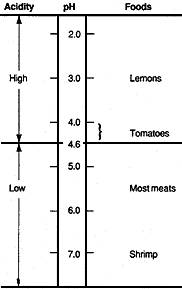
The University of Minnesota has a page dedicated to home canning tomatoes and says:
Researchers at USDA and at the University of Minnesota have found that most unde rripe to ripe, cooked tomatoes have a pH below 4.6. Unfortunately, a few varieties may have a pH above or close to 4.6, which puts them right at the edge of the safety range. These include
- Ace,
- Ace 55VF,
- Beefmaster Hybrid,
- Big Early Hybrid,
- Big Girl,
- Big Set,
- Burpee VF Hybrid,
- Cal Ace,
- Delicious,
- Fireball,
- Garden State,
- Royal Chico,
- San Marzano. and
- there may be others!
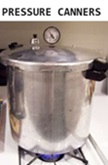
Some of these are grown for commercial purposes and are not found in home gardens. However, safely canning these varieties requires additional acid for water bath processing or a pressure canning process similar to low acid vegetables.
With regard to the subject of "low acid" tomatoes, see this page.
USDA Acidification Methods
To ensure safe acidity in whole, crushed, or juiced tomatoes, add 2 tablespoons of bottled lemon juice or 1/2 teaspoon of citric acid per quart of tomatoes. For pints, use 1 tablespoon bottled lemon juice or 1/4 teaspoon citric acid. Acid can be added directly to the jars before filling with the product. Add sugar to offset acid taste, if desired. Four tablespoons of a 5 percent acidity vinegar per quart may be used instead of lemon juice or citric acid. However, vinegar may cause undesirable flavor changes.
Background Information: Ensuring Safe Canned Foods
Growth of the bacterium
Clostridium botulinum in canned food may cause botulism; a deadly form of
food poisoning. These bacteria exist either as spores or as vegetative
cells. The spores, which are comparable to plant seeds, can survive
harmlessly in soil and water for many years. When ideal conditions exist for
growth, the spores produce vegetative cells which multiply rapidly and may
produce a deadly toxin within 3 to 4 days of growth in an environment
consisting of:
* a moist, low-acid food
* a temperature between
40° and 120°F
* less than 2 percent oxygen
Botulinum spores are on
most fresh food surfaces. Because they grow only in the absence of air, they
are harmless on fresh foods.
Most bacteria, yeasts, and molds are
difficult to remove from food surfaces. Washing fresh food reduces their
numbers only slightly. Peeling root crops, underground stem crops, and
tomatoes reduces their numbers greatly. Blanching also helps, but the vital
controls are the method of canning and making sure the recommended
research-based process times found in the USDA's Complete Guide to Home
Canning are used.
The processing times in this book ensure
destruction of the largest expected number of heat-resistant microorganisms
in home-canned foods. Properly sanitized canned food will be free of
spoilage if lids seal and jars are stored below 95°F. Storing jars at 50° to
70°F enhances retention of quality.
Food acidity and processing methods
Whether food
should be processed in a Pressure Canner or boiling-water canner to control
botulinum bacteria depends on the acidity of the food. Acidity may be
natural, as in most fruits, or added, as in pickled food. Low-acid canned
foods are not acidic enough to prevent the growth of these bacteria. Acid
foods contain enough acid to block their growth, or destroy them more
rapidly when heated. The term "pH" is a measure of acidity; the lower its
value, the more acid the food. The acidity level in foods can be increased
by adding lemon juice, citric acid, or vinegar.
Low-acid foods have
pH values higher than 4.6. They include red meats, seafood, poultry, milk,
and all fresh vegetables except for most tomatoes. Most mixtures of low-acid
and acid foods also have pH values above 4.6 unless their recipes include
enough lemon juice, citric acid, or vinegar to make them acid foods. Acid
foods have a pH of 4.6 or lower. They include fruits, pickles, sauerkraut,
jams, jellies, marmalades, and fruit butters.
Although tomatoes
usually are considered an acid food, some are now known to have pH values
slightly above 4.6. Figs also have pH values slightly above 4.6. Therefore,
if they are to be canned as acid foods, these products must be acidified to
a pH of 4.6 or lower with lemon juice or citric acid. Properly acidified
tomatoes and figs are acid foods and can be safely processed in a
boiling-water canner.
Temperatures for Food Preservation
Botulinum spores are very hard to destroy at
boiling-water temperatures; the higher the canner temperature, the more
easily they are destroyed. Therefore, all low-acid foods should be
sanitized at temperatures of 240° to 250°F, attainable with pressure
canners operated at 10 to 15 PSIG. PSIG means pounds per square inch of
pressure as measured by gauge. The more familiar "PSI" designation is used
hereafter in this publication (the Complete Guide to Home Canning). At
temperatures of 240° to 250°F, the time needed to destroy bacteria in
low-acid canned food ranges from 20 to 100 minutes.
The exact time
depends on the kind of food being canned, the way it is packed into jars,
and the size of jars. The time needed to safely process low-acid foods in a
boiling-water canner ranges from 7 to 11 hours; the time needed to process
acid foods in boiling water varies from 5 to 85 minutes. Keep in mind that
each recipe is tested individually, so always follow the times
and methods in the recipe.
Picking Tips
[General picking tips and a guide to each fruit and vegetable] [How
much do I need to pick?
(Yields - how much raw makes how much cooked or frozen)] [Selecting
the right varieties to pick] [All
about apple varieties - which to pick and why!] [Picking tips for Vegetables]
[ Strawberry picking tips]
[ Blueberries picking tips]
Illustrated Canning, Freezing, Jam Instructions and Recipes
[ Easy Home Canning Directions] [FAQs - Answers to common questions and problems] [Recommended books about home canning, jam making, drying and preserving!] [Free canning publications to download and print]

Looking for canning equipment and supplies?
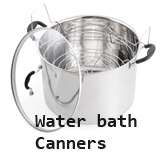
Water bath canner with a jar rack
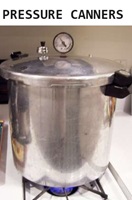
Pressure canners for gas, electric and induction stoves: Presto 23Qt or T-fal 22Qt
Canning scoop (this one is PERFECT)
Ball Blue book (most recent version)
Jars: 8oz canning jars for jams
Find Other types of farms:
Farm markets and roadside stands
Road trips and camping resources
Local Honey, apiaries, beekeepers
Consumer fraud and scams information
Home canning supplies at the best prices on the internet!
Maple Syrup Farms, sugarworks, maple syrup festivals
Environmental information and resources
Farms For Your Event for birthday parties, weddings, receptions, business meetings, retreats, etc.
Festivals - local fruit and vegetable festivals
Get the
most recent version of
the Ball Blue Book