Blueberry Picking Tips, Canning Directions and Facts about Blueberries
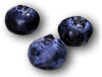 Blueberry Facts, Picking Tips, Canning Directions
and Recipes
Blueberry Facts, Picking Tips, Canning Directions
and Recipes
Crops are great this year, all over - no late frost!
Blueberries are one of the easiest fruit to prepare and serve. There's no peeling, pitting, coring or cutting. They have few natural pests, (other than birds), so pesticides are generally unnecessary! This year's crop is fantastic (see related news story), thanks both to the weather and to more farms planting more blueberry bushes due to increased consumer demand over the past few years as more studies proclaim the anti-oxidant and other health properties of blueberries.
Click here to find a local Blueberry Festival (usually held between April and July).
If you are looking for information about a similar berry, the saskatoon (also called the June berry or Serviceberry) see this page about saskatoons.
 Picking
tips:
Picking
tips:
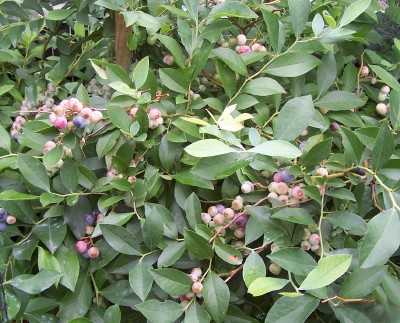
Select plump, full blueberries with a light gray-blue color. A berry with any hint of red isn't fully ripened. For a complete list of blueberry varieties, see this page.
Ripening AFTER picking?
First, it is key to know that once picked, blueberries will NOT become any sweeter, nor will the flavor improve. The only change that occurs is the color. They will APPEAR to ripen, but it is only a color change, from white to green to rose to red to pale blue to fully blue. So, white and green colored blueberries will not "ripen" after they are picked; while blueberries that have already turned purple, red or blue-ish usually DO change color after they are picked (if they are kept at room temperature to "ripen").
As the blueberries ripen ON THE BUSH, the flavor goes from tasteless to bitter to tasteless tart to tart blueberry flavor to sweet blueberry flavor.
Grocery stores sell blueberries that are tart, not sweet because they had them picked unripe by machine so they are very firm and can handled being bumped around in shipping. They may look good, but are not as tasty as those picked when actually ripe.
So, the key is, PICK ONLY RIPE BERRIES!
How to pick blueberries
Since blueberries hang on the bushes in bunches a but like grapes do, the easiest and fastest way to pick them is hold your bucket under them in one hand and with your other hand, cup a ripe bunch and gently rub them with your fingers. The ripe berries will drop into your bucket, while the unripe ones will remain attached to the bush.
When the bushes are at peak, I can easily pick 2 gallons per hour (if I'm not being distracted by the kids and the sun isn't too hot!). A newbie might do 1 gallon per hour.and at the beginning or end of the season it takes more time as the berries are not as plentiful nor concentrated in clusters.
Tips for storing blueberries after harvesting:
- Once picked, don't place the berries, still warm from the sun, in a closed bag or container. Leave the container open so moisture doesn't form in the container.
- Don't wash berries until just before using, to prevent berries from becoming mushy.
- Chill berries soon after picking to increase shelf life. Store your fresh blueberries in the refrigerator as soon as you get them home, without washing them, in a covered bowl or storage container. If refrigerated, fresh-picked blueberries will keep 10 to 14 days.
- Freeze berries in freezer containers without washing to keep the skins from toughening. Place berries one layer deep. Freeze, then pour the frozen berries into freezer containers. Because unwashed blueberries freeze individually, they can be easily poured from containers in desired amounts. Remember both frozen and fresh berries should be rinsed and drained just before serving. Just before using, wash the berries in cold water.
Blueberry Measurements and Conversions
Keep in mind that blueberries vary considerably in density and moisture content, so these ranges are approximates.
-
1 gallon of blueberries weighs about 7.5 lbs or (4 liters of blueberries is about 3.5 kg)
-
1 pint of fresh blueberries weights about 3/4 of a pound. (1 liter of blueberries is about 700 grams)
-
1 pound of fresh blueberries is usually between about 2 and 3 cups of berries.
-
It takes about 4 cups (about of blueberries to make a blueberry pie (see this fantastic and easy blueberry pie recipe)
-
A normal batch of blueberry preserves, jam or jelly requires 5 pints of berries.
-
Blueberries do come in a variety of sizes from small (190-250 berries per cup) to extra large (<90 berries per cup).
Where are blueberries grown (commercially)?
As much as you may wish to drive out on summer Saturday to pick blueberries, not all areas can grow them commercially. 38 states grow blueberries commercially, but 10 of these states dominate and produce more than 98% of U.S. commercial production: California, Florida, Georgia, Indiana, Michigan, Mississippi, New Jersey, North Carolina, Oregon and Washington. British Columbia in Canada also produces highbush blueberries.
Here are the most recent statistics of the 13 largest blueberry growing states, in order, in 1000's of pounds of annual blueberry production (from the USDA)
- Washington 103,950 lbs
- Oregon 96,900
- Georgia 84,000
- Michigan 73,100
- California 62,150 M
- North Carolina 49,500
- New Jersey 48,600
- Florida 24,800
- Mississippi 5,800
- New York 1,720
- Indiana 1,600
- Arkansas 520
- Alabama 500
Blueberries by another name - Similar berries
While blueberries are native to North America, there are other very similar berries in other countries and even in North America. Here are some that are similar and can generally be substitutes in cooking, baking, pies, etc:
- Saskatoons - common to western Canada and the northwest of the U.S . Larger, a bit less sweet; almost identical to a Huckleberry.
- Bilberries - smaller cousins of the blueberry in Europe
- Huckleberries - larger blue berries, a bit less sweet, common to the northern US and Canada
- Whorlberry or whortleberry grown in the United Kingdom. Much like a bilberry.
- Blaeberry in Scotland and Ireland, smaller, intense flavor; like a bilberry.
Blueberry Varieties
Blueberry Facts
- Blueberries are ranked No. 1 in antioxidant activity compared with 40 other commercially available fruits and vegetables. That means a serving of blueberries has more of the antioxidant power you need to fight aging, cancer and heart disease.
- Put this in your pipe! Indians in the Northwest Territory smoked wild blueberries to preserve them for the winter. (Bet you didn't know that!)
- Want to grow your own blueberries? Here's an article about how to: Growing Blueberries in the Home Garden, HYG-1422-98
- Weights and measures: 1 cup of blueberries normally weighs about 143 grams, which about 1/3 of a pound, so 1 pound of blueberries is almost 3 cup's worth. Of course, this can vary considerably based on the variety, weather conditions and degree of ripeness. Typically, many recipes call for 3 to 4 cups of blueberries for a 9 inch pie.
-
Nutrition and miscellaneous facts: 1 cup (143 grams) of blueberries
is 84 calories (technically, kcal). Blueberries contain no cholesterol or
fat and are also low in calories. Blueberries are high in dietary fiber,
Vitamin A and niacin. They contain iron and other trace minerals and are a
fair source of Vitamin C. Blueberries have a diverse range of
micronutrients, with notably high levels (relative to respective Dietary
Reference Intakes) of the essential dietary mineral manganese, vitamin B6,
vitamin C, vitamin K and dietary fiber (table below). One serving provides a
relatively low glycemic load score of 4 out of 100 per day.
Especially in wild species, blueberries contain anthocyanins, other antioxidant pigments and various phytochemicals possibly having a role in reducing risks of some diseases, including inflammation and different cancers. Blueberries may have anti-disease effects, too. Researchers have shown that blueberry anthocyanins, proanthocyanidins, resveratrol, flavonols, and tannins inhibit mechanisms of cancer cell development and inflammation in vitro. Similar to red grape, some blueberry species contain in their skins significant levels of resveratrol, a phytochemical with increasing evidence as an anti-cancer compound.[source: Wikipedia]
Blueberry nutritional information
One serving size of fresh blueberries is equal to one cup, or 140 grams. This contains 80 calories, with no fat, cholesterol or sodium. One serving also contains 5 grams of dietary fiber, 19 grams of total carbohydrates, and 1 gram of protein.
Blueberry nutritional values, raw
Nutritional value per 100 g (3.5 oz)
Energy 60 kcal 240 kJ
| Carbohydrates | 14.5 g |
|---|---|
| - Dietary fiber 2.4 g | |
| Fat | 0.3 g |
| Protein | 0.7 g |
| Thiamin (Vit. B1) 0.04 mg | 3% |
| Riboflavin (Vit. B2) 0.04 mg | 3% |
| Niacin (Vit. B3) 0.42 mg | 3% |
| Pantothenic acid (B5) 0.1 mg | 2% |
| Vitamin B6 0.1 mg | 8% |
| Vitamin C 10 mg | 17% |
| Vitamin E 0.6 mg | 4% |
| Calcium 6 mg | 1% |
| Iron 0.3 mg | 2% |
| Magnesium 6 mg | 2% |
| Phosphorus 12 mg | 2% |
| Potassium 77 mg | 2% |
| Zinc 0.2 mg | 2% |
| manganese 0.3 mg | 20% |
| vitamin K 19 mcg | 24% |
Source: USDA Nutrient database
Recipes
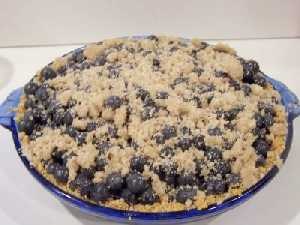
- The world's best Blueberry pie, recipe and directions and illustrated!
- Blueberry buckle coffee cake: illustrated directions for this great crumb-topping blueberry coffee cake
- Other easy directions to make blueberry desserts: cobblers, etc.
Canning, freezing and other blueberry recipes:
- How to Freeze Blueberries
- How to Can Blueberries
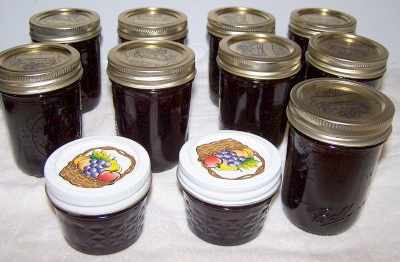
- How to Make Homemade Blueberry Jam
- How to make blueberry jelly
- How to make and can blueberry
syrup (it works for strawberries, raspberries and blackberries, too)
- blueberry pie filling to use later,
- blueberry butter
Baking tips
If you have trouble with blueberries settling to the bottom of muffins and blueberry breads, try one or more of these tips:
- Coat them with flour before adding to the batter. Just gently shake the blueberries in a bag (plastic or paper) with 1/2 cup of flour, then dump them mix in a sieve to remove excess flour.
- It may just be that your batter is too thin. try making the batter a little thicker!
- Fill the muffin cups or baking pan up to 1/4 full with batter (which hasn't had blueberries added to it yet); then stir the blueberries into the remaining batter, and continue to fill the muffin cups or bread pan. The blueberries will start off higher in the mix!
Blueberry Festivals
The US Highbush Blueberry Council hasn't updated their blueberry festivals page in 2 years, so I researched, added to, updated it, and put the current information on a new page - click here for the blueberry festivals page.
Blueberry Questions and Answers
Q. How do I remove blueberry stains on clothes?
Rinse fresh stains immediately in cold water. Soak any more difficult stains in a solution of 1 Tbsp. vinegar in 1 quart (or 1 liter) of warm water.
Tide Laundry Detergent recommends soaking the stained article for up to 30 minutes in 1 gallon of water with 1/2 scoop dry Tide with Bleach or 1/2 measuring ladle of liquid Tide with bleach. in a plastic bucket. Keep the clothing submerged by placing a white towel on top of it. Discard the soaking solution prior to laundering.
Q. We would like to purchase some blueberry plants and plant them this November. Where can we purchase some nice size plants ?
A. There are 4 options:
Being shallow rooted, blueberry bushes are constantly sending shoots off the side roots. These well started planted shoots can be dug with a generous portion of root and replanted. Just be sure: get plenty of root, mulch and fertilize annually and water sufficiently, especially the first year. Replant in late fall or early winter. Cut off about 1/3 of the shoot so the root system matches the top. Find a friend with a blueberry patch and help yourself!
1. Local nursery
2. Mail order
3. Big box store (Home Depot, Lowes, Wal-Mart)
4. Free shoots dug from a neighbors plants
I've been very disappointed with the blueberry bushes I ordered from mail order nurseries; the plants were tiny (6 inches or so). The ones at my local Wal-Mart usually looked pretty pathetic. In my experience, Lowes and Home Depot usually have big (2 ft tall) healthy plants that are suited to your local climate. Beware mislabeled plants - I've purchased plants from big box stores which were not the variety on the label, although that was peaches and apples, not blueberries.The local nurseries often have nice stock, but my local nursery's prices were pretty high, unless I wait for an end of season sale.. I've been happy with the one's at Lowe's and Home Depot!
Q. My Mom always told me to put my freshly picked blueberries into a bowl of water. She said the ones that float have bugs in them or are bad. How can I tell if this is true?
A. That's just an old wives' tale. Some float because they are less dense, which may be due to a variety of causes, only rarely because a bug is inside. The only pest I've heard of getting inside a blueberry is the blueberry maggot, larvae of Spotted Wing Drosophila, which affects some plants in the north eastern US and parts of Canada.
Here are the methods to detect the presence of the pest in blueberries, according to the Ontario Ministry of Agriculture
Methods for Detecting Blueberry Maggot Larvae in Blueberry Fruit
Hot Water Test
- Place 1 litre (2 pints) of berries in pot.
- Nearly cover the berries with water.
- Bring berries and water to a frothy boil and boil for at least 1 minute.
- Empty berries into a 4-mesh-per-inch screen.
- Gently crush berries in screen with the back of a spoon.
- Rinse berries with cold running water and collect water and solids in a pan with a black bottom.
- Allow the debris to settle and Decant floating solids and most of the water.
- Repeat washing and Decanting until water is clear.
- White maggots will be visible against the black bottom of the pan.
Brown Sugar Test
Sugar concentration = 2 lbs (1 kg) brown sugar per 1.2 gallons (5 litres) of water.
- Place 1 litre (2 pints) of berries in a 4-litre (1 gallon) container.
- Gently crush berries in container.
- Add sugar concentrate to 3 cm above crushed berries.
- Agitate crushed berries in sugar solution.
- Allow maggots to float to surface.


Looking for canning equipment and supplies?
Water bath canner with a jar rack
Pressure canners for gas, electric and induction stoves: Presto 23Qt or T-fal 22Qt
Canning scoop (this one is PERFECT)
Ball Blue book (most recent version)
Jars: 8oz canning jars for jams
Find Other types of farms:
Farm markets and roadside stands
Road trips and camping resources
Local Honey, apiaries, beekeepers
Consumer fraud and scams information
Home canning supplies at the best prices on the internet!
Maple Syrup Farms, sugarworks, maple syrup festivals
Environmental information and resources
Farms For Your Event for birthday parties, weddings, receptions, business meetings, retreats, etc.
Festivals - local fruit and vegetable festivals
Get the
most recent version of
the Ball Blue Book