Looking for How to Make Home Canned Green Beans or Yellow Beans - Easily! With Step-by-step Photos, Recipe, Directions, Ingredients and Costs in 2024? Scroll down this page and follow the links. And if you bring home some fruit or vegetables and want to can, freeze, make jam, salsa or pickles, see this page for simple, reliable, illustrated canning, freezing or preserving directions. There are plenty of other related resources, click on the resources dropdown above. If you are having a hard time finding canning lids, I've used these, and they're a great price & ship in 2 days.
If you have questions or feedback, please let me know! There are affiliate links on this page. Read our disclosure policy to learn more.
How to Make Home Canned Green Beans or Yellow Beans - Easily! With Step-by-step Photos, Recipe, Directions, Ingredients and Costs
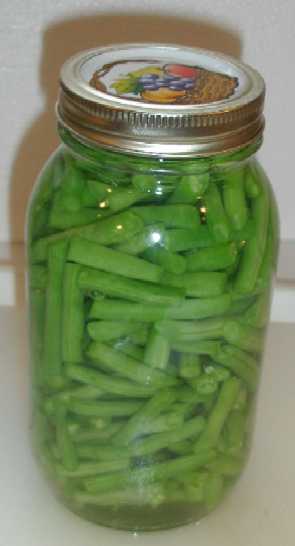 How to Make Homemade Canned Green or Yellow Beans (also Lima Beans, Broadbeans,
Snap Beans, Pole Beans, Runner Beans, etc.)
How to Make Homemade Canned Green or Yellow Beans (also Lima Beans, Broadbeans,
Snap Beans, Pole Beans, Runner Beans, etc.)
You
think making and canning your own green or yellow beans is difficult or
expensive? Not at all! The only trick is, you really do need a
pressure canner. Every university food science department and the government
will tell you that it just is not safe to use the water bath bath method; it
takes the higher temperatures of the pressure canner to kill the botulism
bacteria.
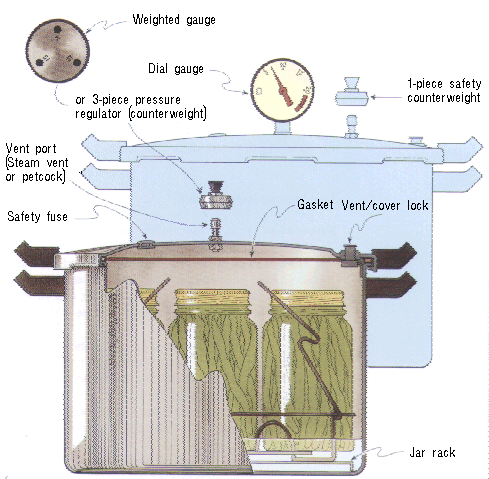
See this FAQ for details: Can I use a water-bath canner instead of a Pressure Canner for low acid foods like green beans?
BUT, with a Pressure Canner it's easy. And although a Pressure Canner costs $100 to $200 (see this page for pressure canners models, makes and prices), they last a lifetime, and your children and grandchildren may be using it. You can also find free information from the USDA in this PDF file (it will take a while to load!) about selecting and using canners here!
So, here's how to can green beans, yellow beans, snap beans, pole beans, runner beans, broadbeans,! After this, I'll just refer to the beans as "green beans". but the same instructions works for the other types of beans. The directions are complete with instructions in easy steps and illustrated. In the winter when you open a jar, the green beans will taste MUCH better than any store-bought canned green beans (although I think frozen beans will taste ten times better than canned).
Prepared this way, the jars have a shelf life of about 12 months, and aside from storing in a cool, dark place, require no special attention. If you'd rather freeze your beans, see my page on how to freeze green beans. Even easier than canning and they will taste just like fresh; but it does take up space in the freezer.
Directions for Making Canned Green Beans
Ingredients
- Green beans or similar (lima beans, runner beans, etc). About 2 pounds per quart jar you want to make (see step 1)
- Salt (some people add 1 teaspoon of salt to each jar when they fill it - I don't - it is not needed for safety reasons; just for salt-aholics)
Equipment
- 1 Pressure Canner (a large pressure pot with a lifting rack to sanitize the jars after filling (about $75 to $200 at mall kitchen stores and "big box" stores, but it is cheaper online; see this page for more information). For low acid foods (most vegetables, you can't use an open water bath canner, it has to be a pressure canner to get the high temperatures to kill the bacteria. If you plan on canning every year, they're worth the investment.
- Jar grabber (to pick up the hot jars)
- Jar funnel ($4 at mall kitchen stores and local "big box" stores, but it's
usually cheaper online from our affiliates)
- At least 1 large pot
- Large spoons and ladles,
- A bean "frencher" (lengthwise slicer) really helps, too. See this page for several models.
- Canning jars (often called Ball jars, Mason jars or Kerr jars) (Publix, Kroger, other grocery stores and some "big box" stores carry them - now about $12 per dozen quart jars (up 50% in 2 years!) including the lids and rings)
- Salt (optional - I don't use any)
Recipe and Directions
Step 1 - Selecting the green beans
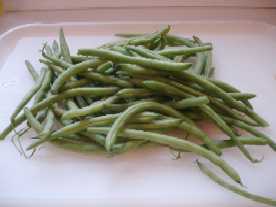
The most important step! You need green beans that are FRESH and crisp. Limp, old beans will make nasty tasting canned beans. Guests will probably throw them at you.. Select filled but tender, firm, crisp beans. Remove and discard any soft, diseased, spotted and rusty pods.
How many green beans and where to get them
You can grow your own, pick your own, or buy them at the grocery store. About 14 pounds of beans makes 7 quart jars; or 9 pounds is needed per 9 pints. A bushel, which produces anywhere from 13 to 20 quarts, weighs 30 pounds. That works out to an average of 2 pounds of beans per finished quart jar.
Step 2 - Prepare the jars and pressure canner
Wash the jars and lids
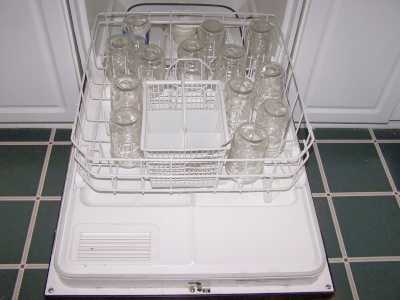
This is a good time to get the jars ready! The dishwasher is fine for the jars; especially if it has a "sanitize" cycle. Otherwise put the jars in boiling water for 10 minutes. I just put the lids in a small pot of almost boiling water for 5 minutes, and use the magnetic "lid lifter wand" (available from target, other big box stores, and often grocery stores; and available online - see this page) to pull them out.
Get a large pot of water boiling
We will use this water to pour over the beans and fill each jar with liquid, after we've packed them full of beans. I use the largest pot I have, so that there is plenty of clean, boiling water ready when I need it.
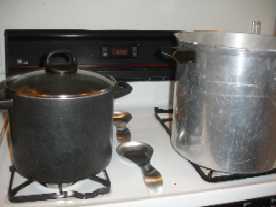
Get the pressure canner heating up
Rinse out your pressure canner, put the rack plate in the bottom, and fill it to a depth of 4 inches with hot tap water. (of course, follow the instruction that came with the canner, if they are different). Put it on the stove over low heat, with the lid OFF of it, just to get it heating up for later on.
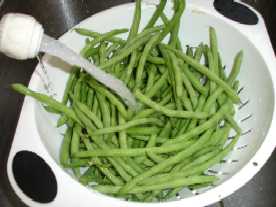 Step
3 -Wash the green beans!
Step
3 -Wash the green beans!
I'm sure you can figure out how to rinse the green beans in plain cold or lukewarm water.
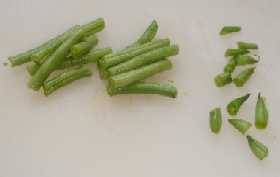
Step 4 - Trim the ends and cut into smaller pieces
Just take a sharp knife and cut of both ends (about 1/4 of an i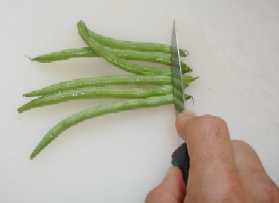 nch,
or half the width of an average woman's little finger). Then cut
them into pieces of the size you prefer, usually about 1 inch long.
nch,
or half the width of an average woman's little finger). Then cut
them into pieces of the size you prefer, usually about 1 inch long.
Of course, if your prefer French cut green beans, you can cut the beans lengthwise instead, or you can use a "bean Frencher" (No, that does not make the beans want to wear a beret, "mime" or surrender quickly, it's just the name.. ). The "Frencher" enables you to prepare a huge quantity of beans quickly!
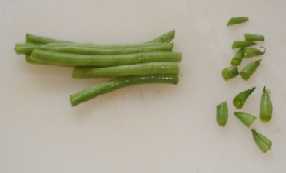
A bean "frencher" (lengthwise slicer) really helps, too. See this page for several models.

See here for related tools, equipment, supplies on Amazon
See here for related tools, equipment, supplies on Amazon
See here for related tools, equipment, supplies on Amazon
 Step
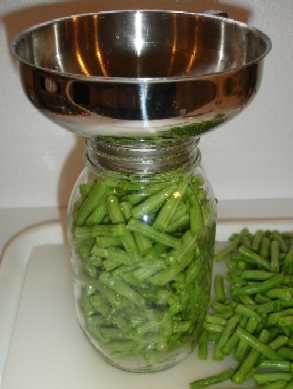
5 - Packing the beans in the canning jars
Step
5 - Packing the beans in the canning jars
This is called "raw packing" because we don't cook the beans before packing them into the jars. Pack the jars fairly tightly, but be sure to leave 1 inch of space at the TOP of the jar. That is called "headspace" and is needed for expansion during heading.
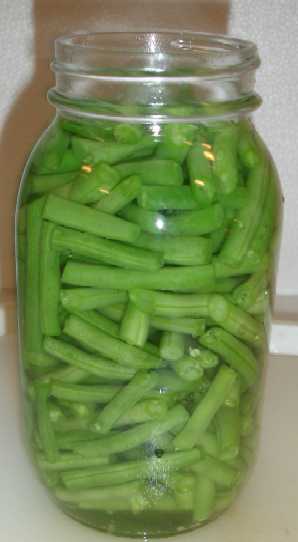
Step 6 - Pour boiling water into each packed jar
Use a ladle or pyrex measuring cup to carefully fill each packed jar
with water from pot of boiling water. Fill to within 1 inch of the top.
The beans should be covered and there should still be 1 inch of airspace
left in the top of each jar. Be careful not to burn yourself, (or anyone
else - children should be kept back during this step!)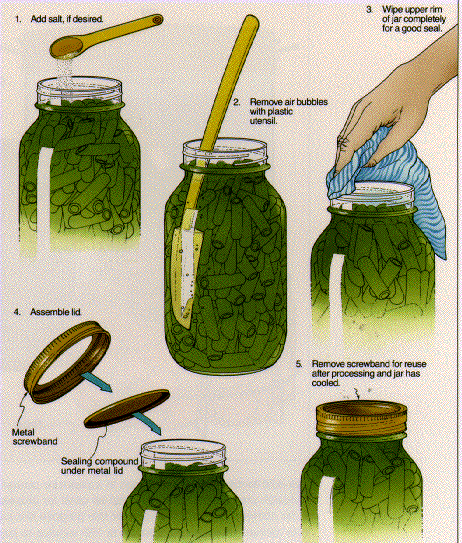
Step
7 - Put the lids and rings on
Put the lids on each jar and seal them by putting a ring on and screwing it down snugly (but not with all your might, just "snug").
Step 8 - Put the jars in the canner and the lid on the canner (but still vented)
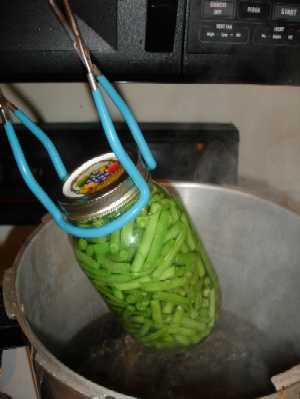 Using
the jar tongs, put the jars on the rack in the canner. By now the
water level has probably boiled down to 3 inches. If it is lower
than that, add more hot tap water to the canner. When all the jars that
the canner will hold are in, put on the lid and twist it into place, but
leave the weight off (or valve open, if you have that type of pressure
canner).
Using
the jar tongs, put the jars on the rack in the canner. By now the
water level has probably boiled down to 3 inches. If it is lower
than that, add more hot tap water to the canner. When all the jars that
the canner will hold are in, put on the lid and twist it into place, but
leave the weight off (or valve open, if you have that type of pressure
canner).
 Step
9 - Let the canner vent steam for 10 minutes
Step
9 - Let the canner vent steam for 10 minutes
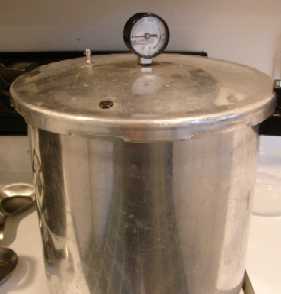
Put the heat on high and let the steam escape through the vent for 10 minutes to purge the airspace inside the canner.
 Step
10 - Put the weight on and let the pressure build
Step
10 - Put the weight on and let the pressure build
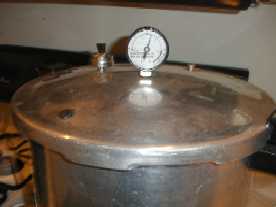
After 10 minutes of venting, put the weight on and close any openings to allow the pressure to build to 11 pounds.
Step 11 - Process for 25 minutes
Once the gauge hits 10 pounds, start your timer going - for 25 minutes. Adjust the heat, as needed, to maintain 10 pounds of pressure.
Note: the chart at right will help you determine the right processing time and pressure, if you have a different type of canner, or are above sea level.
It is important to learn how to operate your pressure canner by reading the owner's manual that came with your particular canner. If you cannot find your owner's manual, you can obtain find one online: Here is where to find some common manufacturer's manuals:
or by contacting the company that made your canner. Give the model number to the manufacturer, and they will send you the right manual. Click here for more information about pressure canners and a variety of models you can order.
|
Recommended process time for green beans in a weighted-gauge pressure canner. |
|||
| Canner Pressure (PSI) at Altitudes: | |||
| Jar Size | Process Time | 0 - 1,000 ft | Above 1,000 ft |
| Pints | 20 min | 10 lb | 15 lb |
| Quarts | 25 | 10 | 15 |
|
Recommended process time for Green Beans in a dial-gauge pressure canner. |
|||||
| Canner Pressure (PSI) at Various Altitudes | |||||
| Jar Size | Process Time | 0 - 2,000 ft | 2,001 - 4,000 ft | 4,001 - 6,000 ft | 6,001 - 8,000 ft |
| Pints | 20 min | 11 lb | 12 lb | 13 lb | 14 lb |
| Quarts | 25 | 11 | 12 | 13 | 14 |
Step 12 - Turn off the heat and let it cool down
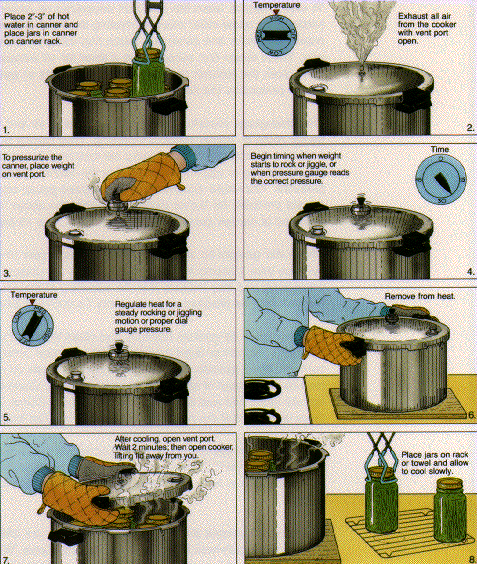
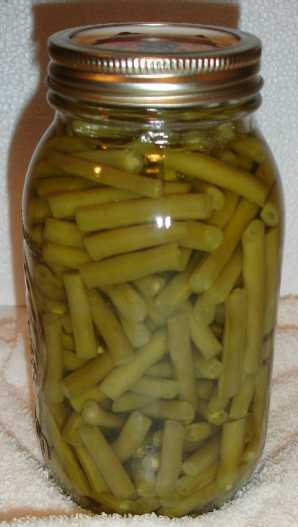
When the processing time from the chart above is up, turn off the heat, and allow the pressure canner to cool and the pressure to drop to zero before opening the canner. Let the jars cool without being jostled. After the pressure drops to zero (usually, you can tell but the "click" sound of the safety release vents opening, as well as but the gauge. Let the pressure in the canner drop to zero by itself. This may take 45 minutes in a 16-quart canner filled with jars and almost an hour in a 22-quart canner. If the vent is opened before the pressure drops to zero OR if the cooling is rushed by running cold water over the canner, liquid will be lost from the jars. Too rapid cooling causes loss of liquid in the jars!
 Step
13 - Remove the jars
Step
13 - Remove the jars
Lift the jars out of the water and let them cool on a wooden cutting board or a towel, without touching or bumping them in a draft-free place (usually takes overnight), here they won't be bumped. You can then remove the rings if you like, but if you leave them on, at least loosen them quite a bit, so they don't rust in place due to trapped moisture. Once the jars are cool, you can check that they are sealed verifying that the lid has been sucked down. Just press in the center, gently, with your finger. If it pops up and down (often making a popping sound), it is not sealed. If you put the jar in the refrigerator right away, you can still use it. Some people replace the lid and reprocess the jar, then that's a bit iffy. If you heat the contents back up, re-jar them (with a new lid) and the full time in the canner, it's usually ok. You're done!
Other Equipment:
From left to right: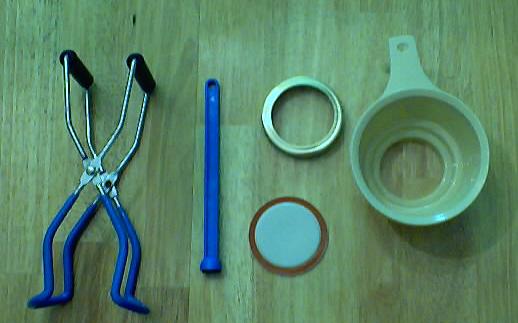
- Jar lifting tongs to pick up hot jars
- Lid lifter - to remove lids from the pot of boiling water (sterilizing )
- Lids- disposable - you may only use them once
- Ring - holds the lids on the jar until after the jars cool - then you remove them, save them and reuse them
- Canning Jar funnel - to fill the jars
Frequently Asked Questions
Q. Is it safe to can green beans in a traditional water bath canner? If so how long do you do process them?
A. The answer, quite simply is no. Quoting from the Ohio State University Extension's Fact Sheet:
"Pressure canning is the only safe method for home canning vegetables. Clostridium botulinum is the bacterium that causes botulism food poisoning in low-acid foods, such as vegetables. The bacterial spores are destroyed only when the vegetables are processed in a Pressure Canner at 240 degrees Fahrenheit (F) for the correct amount of time.Clostridium botulinum is the bacterium commonly found in vegetables and meats. It is harmless until it finds itself in a moist, low-acid, oxygen-free environment or a partial vacuum. Under these conditions, the bacterium can grow and produce toxins dangerous to people and animals.
Do not process (low acid) vegetables using the boiling water bath because the botulinum bacteria can survive that method.
Can fruits and vegetables be canned without heating if aspirin is used? No. Aspirin should not be used in canning. It cannot be relied on to prevent spoilage or to give satisfactory products. Adequate heat treatment is the only safe procedure.Is it safe to can green beans in a boiling water bath if vinegar is used? No. Recommended processing methods must be used to assure safety. Recommended processing times cannot be shortened if vinegar is used in canning fresh vegetables. (This does not refer to pickled vegetables.)
Salt and sugar are not preservatives for vegetables: they are added to stabilize and improve flavor, but will not prevent spoilage.
Salicylic acid is also NOT a preservative. The University of Illinois reports:
Using Aspirin for Canning
Several years ago, a recipe circulated using aspirin to acidify tomatoes and green beans for canning. Aspirin is not recommended for canning. While it contains salicylic acid, it does not sufficiently acidify tomatoes or green beans for safe hot water bath canning. Green beans are low acid foods and may only be processed safely in a pressure canner. Lemon juice or vinegar is recommended to acidify tomato products for safe water bath processing.
Think of it like smoking. We all know someone who smoke their entire life and lived to be 90. But the cemeteries are filled with the vast majority who didn't. You will hear people say "my grandmother did it that way for 20 years". But of course, the people who died from food poisoning aren't around and often didn't have descendants to tell their tale...
Pressure canners!If you want to can low-acid foods such as red meats, sea food, poultry, milk, and all fresh vegetables with the exception of most tomatoes, you will need a Pressure Canner. These foods fit into the low acid group since they have an acidity, or pH level, of 4.6 or greater. The temperature which must be reached and maintained (for a specified amount of time) to kill the bacteria is 240 F. Pressure canning is the only canning method recommended safe by the U.S.D.A. for low-acid foods such as vegetables, meats, and fish. Ordinary water bath canners can only reach 212 F and cannot to kill the types of bacteria that will grow in low acid foods. This temperature can be reached only by creating steam under pressure as achieved in quality pressure canners. There are several manufacturers of pressure canners. The two leading ones are Presto and All American (Wisconsin Aluminum). They are more expensive than water bath canners, but extremely well built - I bought mine in 1988 and it still looks and works like new! |
|
|
Presto 01781 23-Quart Pressure Cooker/CannerThis is usually one of the best-priced pressure canners. They are reliable and inexpensive. I've had mine for 40 years. There is also a 16 quart version for even less. Click on the links at left or above for more info and current pricing. |
|
|
Shown at left is the Presto 23 quart pressure canner. Features below and
click here for more information or to purchase from Target.
 See the seller's website for more information, features, pricing and user reviews! |
| See here for related tools, equipment, supplies on Amazon See here for related tools, equipment, supplies on Amazon |
All American Pressure Canner and Cooker #921See the seller's website for more information, features, pricing and user reviews! |
See here for related tools, equipment, supplies on Amazon
See here for related tools, equipment, supplies on Amazon
In the UK, use this link: | |