How to Make Homemade Blueberry Jam - Easily! With Step-by-step Photos, Recipe, Directions, Ingredients and Costs
How to Make Homemade Blueberry Jam - Easily!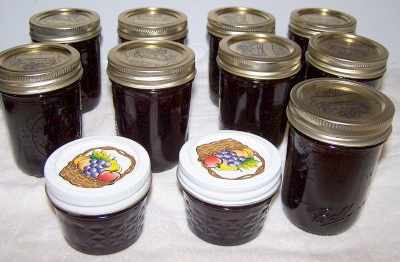
Click here for a PDF print version!
Making and canning your own blueberry jam is so easy. And this blueberry jam is incredible. Even if you are a fan of strawberry, triple-berry, blackberry, or whatever, and don't like fresh blueberries, you MUST try this! Here's how to do it, in 12 simple steps and completely illustrated. You can also use this recipe to make a blueberry spread (see step 5).For more information about blueberries, see Blueberry Picking Tips
For other types (strawberry, blackberry, peach, raspberry, etc.) of jam click here, and for easy applesauce or apple butter directions, click on these links. And here are simple directions to make blueberry desserts: cobbler, coffee cakes / buckles and pie!
Ingredients
- Blueberries - 10 cups, or 2.25 liters, about 3.5 lbs, almost
1.75 kg) preferably fresh, but frozen (without syrup works, too)
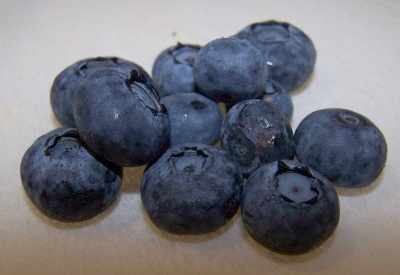
- Lemon juice - either fresh squeezed or bottled. 1/4 cup.
- Water - 1/2 cup
- Sugar - See step 6. My favorite approach is to use the no-sugar needed pectin, but still add about 4.5 cups of dry, granulated (table) sugar. It is possible to make low-sugar, fruit juice-sweetened, or Stevia (in a prepared form like Truvia, it measures same as sugar; if you use another form, you will need do your own conversion) - or Splenda, if you prefer, -sweetened blueberry jam; I'll point out the differences below.
- Pectin - 1 package (box usually) or if you get it in bulk, 8 Tablespoons, see the directions below for specifics - (it's a natural product, made from apples and available at grocery stores (season - spring through late summer) and local "big box" stores. It usually goes for about $2.00 to $2.50 per box. You will get best results with no-sugar needed pectin, whether you choose to add sugar or not! See here for more information about how to choose the type of pectin to use.
Equipment
- Jar funnel ($5 at Target, other big box stores, and often grocery stores; and available online - see this page) or order it as part of the kit with the Jar grabber .
- Jar grabber (to pick up the hot jars)- Big box stores and
grocery stores sometimes carry them; and it is available online - see
this page. It's a tremendously useful to put jars in the canner
and take the hot jars out (without scalding yourself!). The kit sold
below has everything you need, and at a pretty good price:
- At least 1 large pot; I prefer 16 to 20 quart Nonstick ceramic coated pots for easy cleanup.
- Large spoons and ladles,
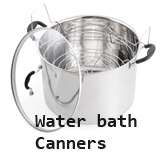
- 1 Water Bath Canner (a huge pot to sanitize the jars after filling (about $30 to $35 at mall kitchen stores, sometimes at big box stores and grocery stores.). Note: we sell canners and supplies here, too - at excellent prices - and it helps support this web site!
- Half pint canning jars (Grocery stores, like Publix, Kroger, Safeway carry them, as do some big box stores - about $7 per dozen 8 ounce jars including the lids and rings)
- Lids - thin, flat, round metal lids with a gum binder that seals them against the top of the jar. They may only be used once.
- Rings - metal bands that secure the lids to the jars. They may be reused many times.
Optional stuff:
- Foley Food Mill - not necessary; useful if you want to remove seeds (from blackberries) or make applesauce.
- Lid lifter (has a magnet to pick the lids out of the almost-boiling water where you sanitize them. ($4 at big box stores or it comes in the kit at left)
Blueberry Jam-making Directions
This example shows you how to make blueberry jam! The yield from this recipe is about 10 eight-ounce jars (which is the same as 5 pints).
Step 1 - Pick the blueberries! (or buy them already picked)
It's fun to go pick your own and you can obviously get better quality ones!
I prefer to grow my own; which is really easy - but that does take
some space and time.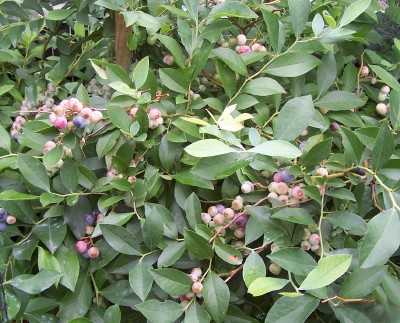
As mentioned in the Ingredients section; you may use frozen blueberries (those without syrup or added sugar); which is especially useful if you want to make some jam in December to give away at Christmas!
At left are blueberries (in my yard, actually; they make a great hedge or landscaping bush) almost ripe! If you want to pick your own, here is a list and links to the pick your own farms.
Step 2 - How much fruit?
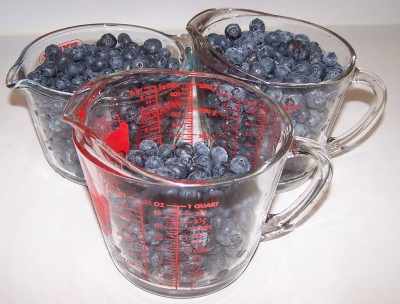 Jam
can ONLY be made in rather small batches - about 6 cups of prepared
berries at a time - like the directions on the pectin say, DO NOT increase
the recipes or the jam won't "set" (jell, thicken). It takes about 9 or 10
cups of raw, unprepared blueberries per batch.
Jam
can ONLY be made in rather small batches - about 6 cups of prepared
berries at a time - like the directions on the pectin say, DO NOT increase
the recipes or the jam won't "set" (jell, thicken). It takes about 9 or 10
cups of raw, unprepared blueberries per batch.
Step 3 - Wash the jars and lids
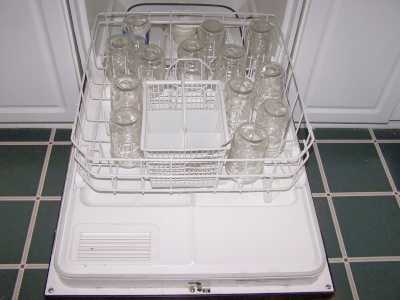
Now's a good time to get the jars ready, so you won't be rushed later. The dishwasher is fine for the jars; especially if it has a "sanitize" cycle, the water bath processing will sanitize them as well as the contents! If you don't have a dishwasher with a sanitize cycle, you can wash the containers in hot, soapy water and rinse, then sanitize the jars by boiling them 10 minutes, and keep the jars in hot water until they are used.
 NOTE: If a canning recipe calls for 10 minutes or more of process time in the canner, then the jars do not need to be "sanitized" before filling them.
But really, sanitizing them first is just good hygeine and common sense! See this page for more detail about cleaning and sanitizing jars and lids.
NOTE: If a canning recipe calls for 10 minutes or more of process time in the canner, then the jars do not need to be "sanitized" before filling them.
But really, sanitizing them first is just good hygeine and common sense! See this page for more detail about cleaning and sanitizing jars and lids.
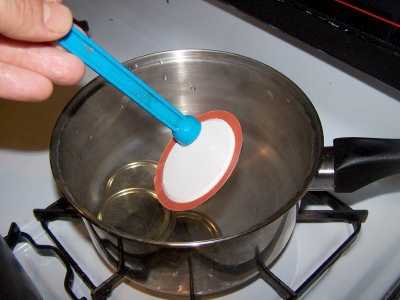
Put the lids into a pan of hot, but not quite boiling water (that's what the manufacturer's recommend) for 10 minutes, and use the magnetic "lid lifter wand" to pull them out.
Leave the jars in the dishwasher on "heated dry" until you are ready to use them. Keeping them hot will prevent the jars from breaking when you fill them with the hot jam.
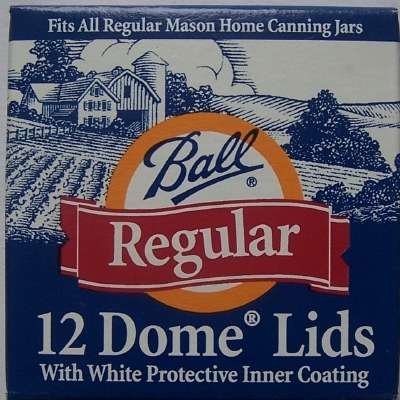
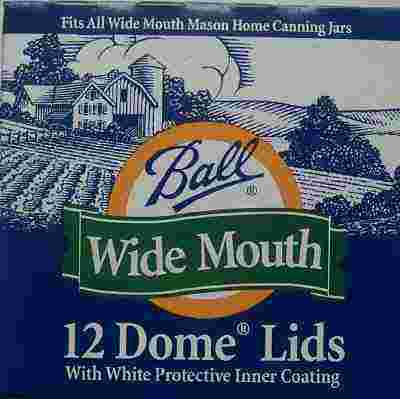
Need lids, rings and replacement jars?
Get them all here, delivered:
 Lids: put the very hot (but not quite boiling; around 180 F, steaming
water is fine)
Lids: put the very hot (but not quite boiling; around 180 F, steaming
water is fine)
water for at least several minutes; to soften up the
gummed surface and clean the lids. I just leave them in there, with
the heat on very low, until I need them!
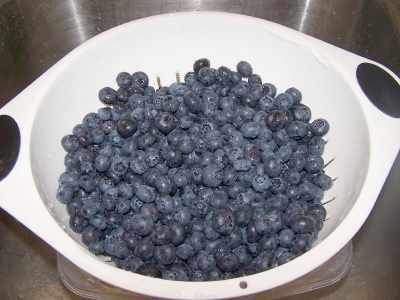
Step 4 -Wash the berries and sort!
I'm sure you can figure out how to wash the fruit in a colander of plain cold water.
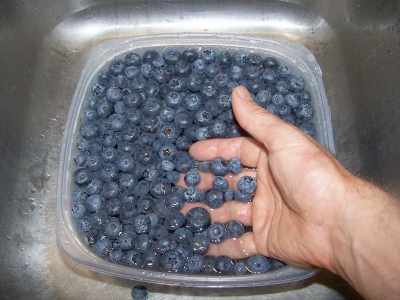 Then
you need to pick out and remove any bits of stems, leaves and soft or
mushy berries. It is easiest to do this in a large bowl of water and
gently run your hands through the berries as they float. With your
fingers slightly apart, you will easily feel any soft or mushy berries get
caught in your fingers.
Then
you need to pick out and remove any bits of stems, leaves and soft or
mushy berries. It is easiest to do this in a large bowl of water and
gently run your hands through the berries as they float. With your
fingers slightly apart, you will easily feel any soft or mushy berries get
caught in your fingers.
Then just drain off the water!
Step 5 - Crush the berries
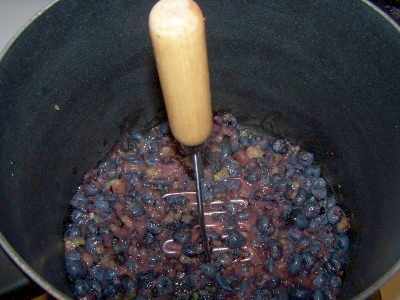 You
can go wild, be a conquering Genghis Khan crushing the peasants.. watch them
flee. Well, if they're not fleeing, the berries sure do manage to roll
everywhere. You won't find them until the next time you clean behind
your refrigerator!
You
can go wild, be a conquering Genghis Khan crushing the peasants.. watch them
flee. Well, if they're not fleeing, the berries sure do manage to roll
everywhere. You won't find them until the next time you clean behind
your refrigerator!
Anyway, to crush them, you can either do one layer at
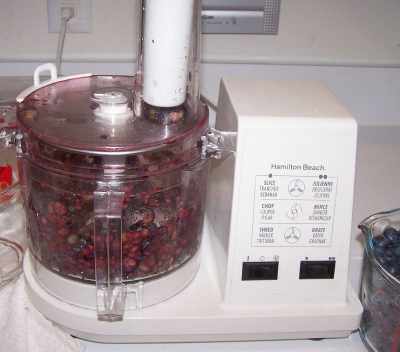 a
time in a pan or bowl, using a potato masher..
a
time in a pan or bowl, using a potato masher..
OR you can be lazy like me and use the slice mode on your food processor.
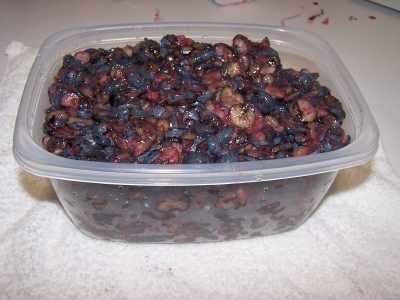
Either way, if you start with 10 cups of berries, you will end up with about 6 to 7 cups of crushed blueberries. Don't go all anal-retentive and worry that you only had 6.2567 cups of crushed berries.... Just take your OCD meds and the jam will turn out fine!
Note: if you want to make a smooth blueberry spread; instead of mushing or crushing the blueberries, just run the blueberries through a blender until you get a smooth consistency.
Step 6 - Measure out the sweetener
Depending upon which type of jam you're making (sugar, no-sugar, Stevia (but you will have to experiment with amount, each brand of Stevia is a different concentration), or Splenda, or a mix of sugar and Stevia (or Splenda) or fruit juice) you will need to use a different amount of sugar and type of pectin. The precise measurements are found in directions inside each and every box of pectin sold (every brand, Ball, Kerr, Mrs. Wages, etc. has directions inside). I don't recommend using Stevia (in a prepared form like Truvia, it measures same as sugar; if you use another form, you will need do your own conversion) - or Splenda, if you prefer, by itself - plain old sugar makes a big difference in the color and taste. Unless you're diabetic, for best results, try the low or lower sugar formula below.
| Type of jam |
Type of pectin to buy |
Sweetener |
| regular | no-sugar or regular | 7 cups of sugar |
| low sugar | no-sugar | 4.5 cups of sugar |
| lower sugar | no-sugar | 2 cups sugar and 2 cups Splenda (or about 1/3 that if you use Stevia, which is my preference) |
| no sugar | no-sugar | 4 cups Splenda (or about 1/3 that if you use Stevia, which is my preference) |
| natural | no-sugar | 3 cups fruit juice (grape, peach, apple or mixed) |
Step 7 - Mix the dry pectin with about 1/4 cup of sugar or other sweetener
Keep this separate from the rest of the sugar. If you are not using
sugar, you will just have to stir more vigorously to prevent the pectin from
clumping.
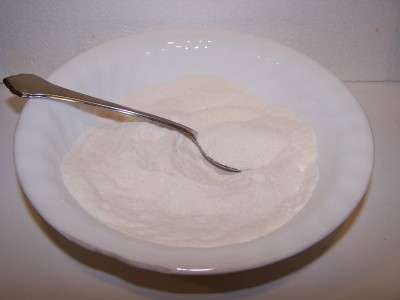
Notes about pectin: I usually add about 25% - 30% more pectin (just open another pack and add a little) or else the jam is runnier than I like. With a little practice, you will find out exactly how much pectin to get the thickness you like.
For more about the types of pectin sold, see this page!
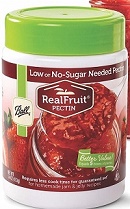
Is your jam too runny? Pectin enables you to turn out perfectly set jam
every time. Made from natural apples, there are also natural no-sugar
pectins that allow you to reduce the sugar you add by half or even eliminate
sugar!
Get canning jars, rings, lids and pectin deliverd:
Step 8 - Mix the blueberries with the pectin and cook to a full boil
 Stir
the pectin, lemon juice and water into the blueberries and put the mix in
a big pot on the stove over medium to high heat (stir often enough to
prevent burning). It should take about 5 to 10 minutes to get it to a full
boil (the kind that cannot be stirred away).
Stir
the pectin, lemon juice and water into the blueberries and put the mix in
a big pot on the stove over medium to high heat (stir often enough to
prevent burning). It should take about 5 to 10 minutes to get it to a full
boil (the kind that cannot be stirred away).
Step 9 - Add the remaining sugar and bring to a boil
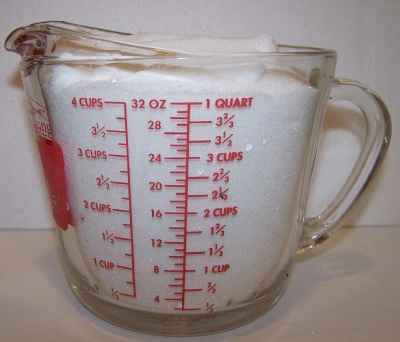 When
the berry-pectin mix has reached a full boil, add the rest of the sugar
(see step 6) or other sweetener, and then bring it back to a boil
and boil hard for 1 minute.
When
the berry-pectin mix has reached a full boil, add the rest of the sugar
(see step 6) or other sweetener, and then bring it back to a boil
and boil hard for 1 minute.
Step 10 - Testing for "jell" (thickness)
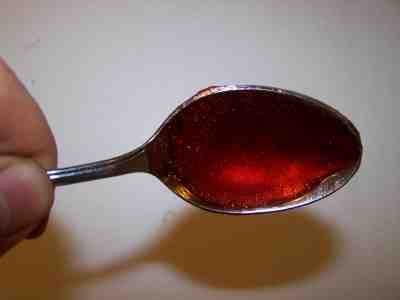 I
keep a metal tablespoon sitting in a glass of ice water, then take a half
spoonful of the mix and let it cool to room temperature on the spoon. If
it thickens up to the consistency I like, then I know the jam is ready. If
not, I mix in a little more pectin (about 1/s to 1/2 of another package)
and bring it to a boil again for 1 minute.
I
keep a metal tablespoon sitting in a glass of ice water, then take a half
spoonful of the mix and let it cool to room temperature on the spoon. If
it thickens up to the consistency I like, then I know the jam is ready. If
not, I mix in a little more pectin (about 1/s to 1/2 of another package)
and bring it to a boil again for 1 minute.
Step 10 - Fill the jars and put the lid and rings on
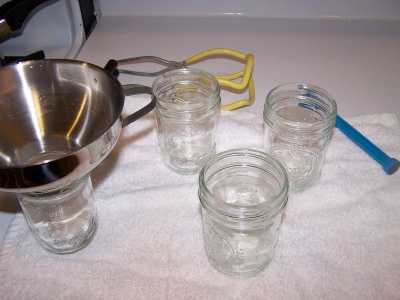 Fill
them to within 1/4-inch of the top, wipe any spilled jam off the top, seat
the lid and tighten the ring around them. Then put the filled jars into the canner!
Fill
them to within 1/4-inch of the top, wipe any spilled jam off the top, seat
the lid and tighten the ring around them. Then put the filled jars into the canner!
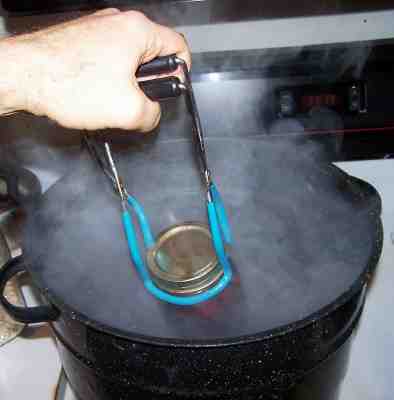
This is where the jar tongs and lid lifter come in really handy!
Step 11 - Process the jars in the boiling water bath
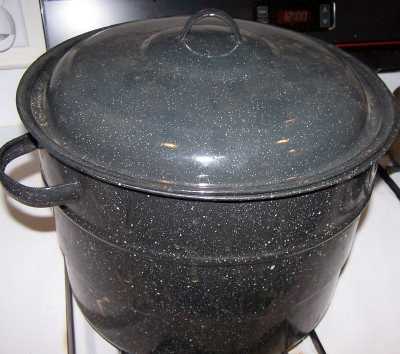 Keep
the jars covered with at least 2 inches of water. Keep the water
boiling. In general, boil them for 5 minutes. I say "in general"
because you have to process (boil) them longer at higher altitudes than
sea level, or if you use larger jars, or if you did not sanitize the
jars and lids right before using them. The directions inside every
box of pectin will tell you exactly. The directions on the pectin
tend to be pretty conservative. Clemson University says you only
need to process them for 5 minutes. I usually hedge my bets and
start pulling them out after 7 minutes, and the last jars were probably
in for 10. I rarely have a jar spoil, so it must work.
Keep
the jars covered with at least 2 inches of water. Keep the water
boiling. In general, boil them for 5 minutes. I say "in general"
because you have to process (boil) them longer at higher altitudes than
sea level, or if you use larger jars, or if you did not sanitize the
jars and lids right before using them. The directions inside every
box of pectin will tell you exactly. The directions on the pectin
tend to be pretty conservative. Clemson University says you only
need to process them for 5 minutes. I usually hedge my bets and
start pulling them out after 7 minutes, and the last jars were probably
in for 10. I rarely have a jar spoil, so it must work.
Note: Some people don't even boil the jars; they just ladle it hot into hot jars, put the lids and rings on and invert them, but putting the jars in the boiling water bath REALLY helps to reduce spoilage! To me, it makes little sense to put all the working into making the jam and then not to process the jars to be sure they don't spoil!
Step 12 - Remove and cool the jars - Done!
Lift
the jars out of the water and let them cool without touching or bumping
them in a draft-free place (usually takes overnight) You can then remove
the rings if you like, but if you leave them on, at least loosen them
quite a bit, so they don't rust in place due to trapped moisture. Once
the jars are cool, you can check that they are sealed verifying that the
lid has been sucked down. Just press in the center, gently, with your
finger. If it pops up and down (often making a popping sound), it is not
sealed. If you put the jar in the refrigerator right away, you can still
use it. Some people replace the lid and reprocess the jar, then that's a
bit iffy. If you heat the contents back up, re-jar them (with a new lid)
and the full time in the canner, it's usually ok.
Once cooled, they're ready to store. I find they last up to 12 months. But after about 6 to 8 months, they get darker in color and start to get runny. They still are safe to eat, but the flavor and texture aren't as good. So eat them in the first 6 months after you prepare them!
Other Equipment:From left to right:
|
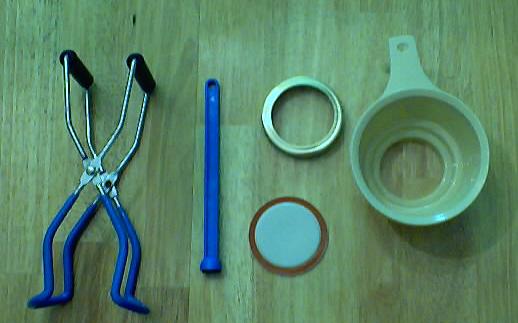 You can get all of the tools in a kit here: See here for related tools, equipment, supplies on Amazon |
Summary - Cost of Making Homemade Blueberry Jam - makes 10 jars, 8 oz each** |
||||
| Item | Quantity | Cost in 2025 | Source | Subtotal |
| Blueberries | 1 gallon | $11.00/gallon | Pick your own | $11.00 |
| Canning jars (8 oz size), includes lids and rings | 10 jars | $11/dozen 8 oz jars or $0.92/jar |
Grocery stores, like Public, Kroger, Safeway and sometimes, Big Lots, local hardware stores and big box stores | $7.00 |
| Sugar | 5 cups | $3.00 | Grocery stores, like Public, Kroger, Safeway and sometimes, Big Lots, local hardware stores and big box stores | $3.00 |
| Pectin (low sugar, dry) | 1 and a quarter boxes | $3.00 per box | Grocery stores, like Public, Kroger, Safeway and sometimes, Big Lots, local hardware stores and big box stores | $4.00 |
| Total | $25.00 total or about $2.50 per 8 oz jar |
|||
|
* - This assumes you already have the pots, pans, ladles,, and reusable equipment. Note that you can reuse the jars, and that reduces the cost! Just buy new lids (the rings are reusable, but the flat lids are not)! |
||||
Comments and Feedback
- A visitor writes on July 14, 2013: "Just wanted to say thanks for your great website! I just made some sugar free blueberry jam using your instructions and it is delicious! I hate cooking but I enjoyed making jam and plan on doing much more canning. Thanks again. tg"
Answers to Common Questions
Looking for canning equipment and supplies?Water bath canner with a jar rack Pressure canners for gas, electric and induction stoves: Presto 23Qt or T-fal 22Qt Canning scoop (this one is PERFECT) Ball Blue book (most recent version) Jars: 8oz canning jars for jams
Find Other types of farms:Farm markets and roadside stands Road trips and camping resources Local Honey, apiaries, beekeepers Consumer fraud and scams information Home canning supplies at the best prices on the internet! Maple Syrup Farms, sugarworks, maple syrup festivals Environmental information and resources Farms For Your Event for birthday parties, weddings, receptions, business meetings, retreats, etc. Festivals - local fruit and vegetable festivals
|