
Looking for How to Can Tomatoes, using a Pressure Canner - Easily! With Step-by-step Photos, Recipe, Directions, Ingredients and Costs in 2024? Scroll down this page and follow the links. And if you bring home some fruit or vegetables and want to can, freeze, make jam, salsa or pickles, see this page for simple, reliable, illustrated canning, freezing or preserving directions. There are plenty of other related resources, click on the resources dropdown above. If you are having a hard time finding canning lids, I've used these, and they're a great price & ship in 2 days.
If you have questions or feedback, please let me know! There are affiliate links on this page. Read our disclosure policy to learn more.
How to Can Tomatoes, using a Pressure Canner - Easily! With Step-by-step Photos, Recipe, Directions, Ingredients and Costs
Making and Canning Fresh Tomatoes with a Pressure Canner!
Making and canning your own tomatoes with a Pressure Canner is something families remember years later. Home-canned tomatoes have been a tradition for many generations. In the middle of the winter, you can use the tomatoes to make a fresh spaghetti sauce, lasagna, chili, or other tomato-based meals for that fresh garden taste. If you have a water bath canner, you may want to see the water bath canning tomatoes page for those directions instead!
Here's how to do it, in easy steps and completely illustrated. This method is so easy, ANYONE can do this! It's a great thing to do with your kids!
Ingredients
Yield: about 7 quarts
- Tomatoes - about 20 lbs to make 7 quarts (7 large tomatoes will fill one quart jar.)
- lemon juice - fresh or bottled (about 1/2 cup)
Equipment
- 1 Pressure Canner (a huge pressure pot to sanitize the jars after filling (about $80 to $200. Note: we sell many sizes and types of pressure canners for all types of stoves and needs - see pressure canners).
- Pint or quart canning jars (Ball or Kerr jars can be found at Publix, Kroger, Safeway and local "big box" stores - about $13 per dozen 8-ounce jars, more for quilted design or larger jars, including the lids and rings). Quart jars are more economical!
- 1 quart tomato juice (or plain water)
- Large spoons and ladles,
- Lids - thin, flat, round metal lids with a gum binder that seals them against the top of the jar. They may only be used once.
- Rings - metal bands that secure the lids to the jars. They may be reused many times.
- Jar grabber (to pick up the hot jars)
- Lid lifter (I like the lid rack that holds 12 lids or you can pull them out one at a time with the lid-lifter that has a magnet from the almost-boiling water where you sanitize them. ($4 at mall kitchen stores and local "big box" stores, but it's usually cheaper online from our affiliates)
- 1 large pot (to scald the tomatoes, step 3) and 1 medium sized pot to heat the tomato juice or water to add to the jars (step 6) and 1 small pot to sanitize the lids.
- Jar funnel ($3-Grocery stores, like Publix, Kroger and Safeway and local "big box" stores; sometimes even hardware stores)
Process - How to Make Home Canned Tomatoes from Fresh Tomatoes Using a Pressure Canner
 Step
1 - Selecting the tomatoes
Step
1 - Selecting the tomatoes
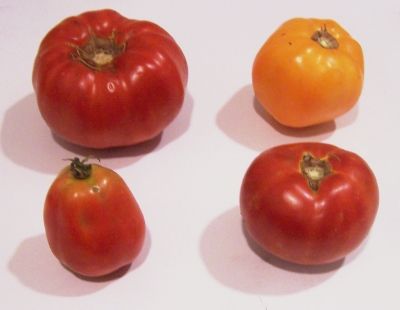
It's fun to go pick your own and you can obviously get better quality tomatoes!
At right is a picture of tomatoes from my garden - they are so much better than anything from the grocery store. And if you don't have enough, a pick-your-own farm is the pace to go! At right are 4 common varieties that will work:
| Top left: Beefsteak | Top right: Lemon Boy, yellow |
| Bottom left: Roma, paste-type | Bottom right: Better Boy |
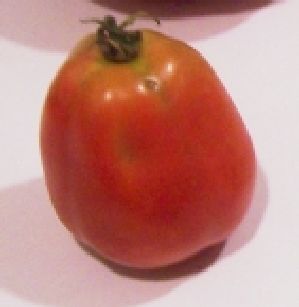 The
picture at right shows the best variety of tomato to use: Roma; also called
paste tomatoes. They have fewer sides, thicker, meatier walls, and
less water.
And that means thicker sauce in less cooking time!
The
picture at right shows the best variety of tomato to use: Roma; also called
paste tomatoes. They have fewer sides, thicker, meatier walls, and
less water.
And that means thicker sauce in less cooking time!
Also, you don't want mushy, bruised or rotten tomatoes!
And for those of you with an abundance of green tomatoes, the USDA says that since green tomatoes are more acidic than ripened fruit, they can be canned safely with any of the standard tomato directions. I prefer to store them in the basement, where they slowly ripen, but if you have a use later for canned green tomatoes, go for it.
Step 2 - Get the jars and lids sanitizing
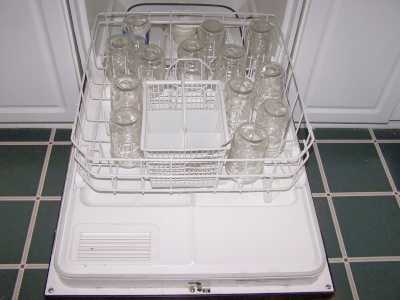 The
dishwasher is fine for the jars; especially if it has a "sanitize" cycle.
I get that going while I'm preparing everything else, so it's done by the
time I'm ready to fill the jars. If you don't have a dishwasher,
submerge the jars in a large pot (the canner itself) of water and bring it
to a boil.
The
dishwasher is fine for the jars; especially if it has a "sanitize" cycle.
I get that going while I'm preparing everything else, so it's done by the
time I'm ready to fill the jars. If you don't have a dishwasher,
submerge the jars in a large pot (the canner itself) of water and bring it
to a boil.
Be sure to let it go through the rinse cycle to get rid of any soap!
Get the canner heating up
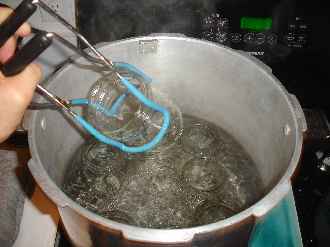 Fill
the canner about 1/2 full of water and start it heating (with the lid loosely
on). That's more water than you will need, but we don't want the canner to
boil dry!
Fill
the canner about 1/2 full of water and start it heating (with the lid loosely
on). That's more water than you will need, but we don't want the canner to
boil dry!
Get a the medium pot of water or tomato juice heating
This is also a good time to get your 1 quart of tomato juice and/or water boiling (you will use it to fill any air spaces in the jars in step 6).
Start the water for the lids
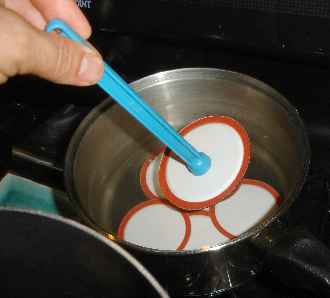
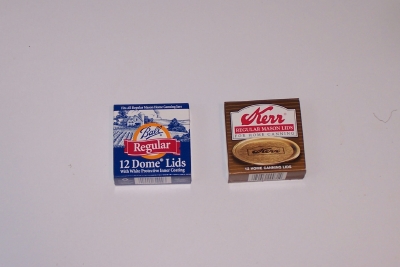 Put
the lids into a pan of hot, but not quite boiling water for at least several minutes.
Note: everything gets sanitized in the water bath (step 7) anyway, so this just
helps to ensure there is no spoilage later!)
Put
the lids into a pan of hot, but not quite boiling water for at least several minutes.
Note: everything gets sanitized in the water bath (step 7) anyway, so this just
helps to ensure there is no spoilage later!)
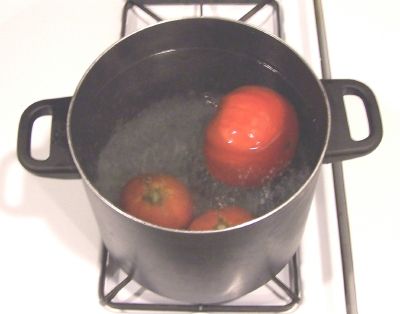 Step
3 - Removing the tomato skins
Step
3 - Removing the tomato skins
Here's a trick you may not know: put the tomatoes, a few at a time in a large pot of boiling water for no more than 1 minute (30 - 45 seconds is usually enough)
then....
Plunge them into a waiting bowl of ice water.
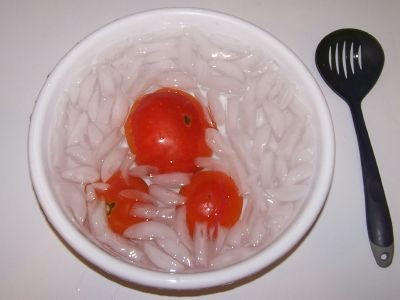 This
makes the skins slide right off of the tomatoes! If you leave the
skins in, they become tough and chewy in the sauce, not very pleasant.
This
makes the skins slide right off of the tomatoes! If you leave the
skins in, they become tough and chewy in the sauce, not very pleasant.
 Step
4 - Removing the skins, bruises and tough parts
Step
4 - Removing the skins, bruises and tough parts
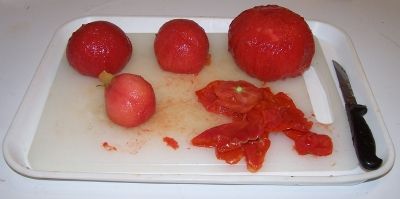
The skins should practically slide off the tomatoes. then you can cut the tomatoes in quarters and remove the tough part around the stem and any bruised or soft parts.
Step 5 - Fill the jars with the whole or cut tomatoes
 Fill
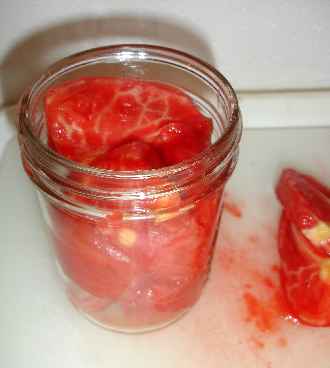
them to within 1/4-inch of the top with the tomatoes.
Fill
them to within 1/4-inch of the top with the tomatoes.
Be sure the contact surfaces (top of the jar and underside of the ring) are clean to get a good seal!
Step 6 - Add 2 Tablespoons of lemon juice and liquid
 After
you fill each jar with tomatoes, add 2 tablespoons of lemon juice per quart jar,
1 per pint jar. This helps to reduce the odds of spoilage and to retain
color and flavor. Then fill to 1/2 inch of the top with either boiling water or
boiling tomato juice.
After
you fill each jar with tomatoes, add 2 tablespoons of lemon juice per quart jar,
1 per pint jar. This helps to reduce the odds of spoilage and to retain
color and flavor. Then fill to 1/2 inch of the top with either boiling water or
boiling tomato juice.
Step 7 - Free any trapped air bubbles
 Using
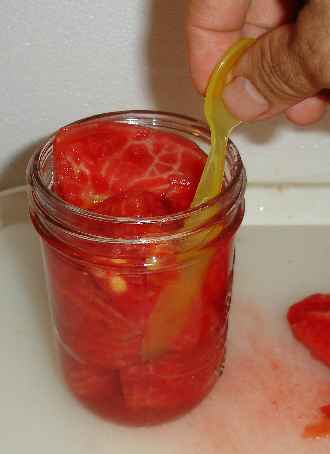
a flat plastic or wood utensil (like a plastic spoon, up side down) free trapped
air bubbles by gently sliding it up and down around the inside edge.
Using
a flat plastic or wood utensil (like a plastic spoon, up side down) free trapped
air bubbles by gently sliding it up and down around the inside edge.
Step 8 - Put the lids and rings on
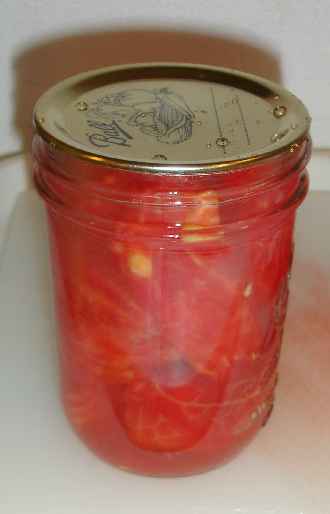 Just
screw them on snugly, not too tight. If the is any tomato on the surface
of the lip of the jar, wipe it off first with a clean dry cloth or paper towel.
Just
screw them on snugly, not too tight. If the is any tomato on the surface
of the lip of the jar, wipe it off first with a clean dry cloth or paper towel.
Step 9 - Put the jars in the pressure canner
 Put
them in the pressure canner and put the lid on. Do not put the
weight on yet. There should be about 3 inches of boiling water in bottom
of the canner, or as specified by your pressure canner's directions.. If
there is too much water in it, just pour some out.
Put
them in the pressure canner and put the lid on. Do not put the
weight on yet. There should be about 3 inches of boiling water in bottom
of the canner, or as specified by your pressure canner's directions.. If
there is too much water in it, just pour some out.
Step 10 - Vent the Canner
 Let
the canner vent steam for 10 minutes. Keep the water boiling. Note in the photo
at right that the weight is not on, although the lid is crewed down tight
Steam will vent out of the weight hole.
Let
the canner vent steam for 10 minutes. Keep the water boiling. Note in the photo
at right that the weight is not on, although the lid is crewed down tight
Steam will vent out of the weight hole.
Step 11 - Seal and process
 After
venting, put
After
venting, put
 the
weight on (or close the valve) and let it heat up and build pressure to the
pressure for your type of pressure canner in the tables below. With a dial-type
(the type I have, I use 11 lbs as it is quicker. Process the jars in a press
bath for 10 or 15 minutes as appropriate from the table below. Remember to
adjust the time if you are at a different altitude other than sea level! Notice
in the photo at left, the weight is on and the safety valve (bottom right has
popped up and the pressure is just starting to build. the photo at right
shows the pressure up to 11 lbs. When it reaches 11 lbs, turn the heat
down and adjust it up or down, as needed, to maintain 11 lbs.
the
weight on (or close the valve) and let it heat up and build pressure to the
pressure for your type of pressure canner in the tables below. With a dial-type
(the type I have, I use 11 lbs as it is quicker. Process the jars in a press
bath for 10 or 15 minutes as appropriate from the table below. Remember to
adjust the time if you are at a different altitude other than sea level! Notice
in the photo at left, the weight is on and the safety valve (bottom right has
popped up and the pressure is just starting to build. the photo at right
shows the pressure up to 11 lbs. When it reaches 11 lbs, turn the heat
down and adjust it up or down, as needed, to maintain 11 lbs.
|
Recommended process time for water-packed Whole or Halved Tomatoes in a dial-gauge pressure canner |
|||||
|
|
Canner Gauge Pressure (PSI) at Altitudes above Sea Level of |
||||
|
Jar Size |
Process Time |
0 - 2,000 ft |
2,001 - 4,000 ft |
4,001 - 6,000 ft |
6,001 - 8,000 ft |
|
Pints or Quarts |
15 min |
6 lb |
7 lb |
8 lb |
9 lb |
|
10 |
11 |
12 |
13 |
14 |
|
| Recommended process time for water-packed Whole or Halved Tomatoes in a weighted-gauge pressure canner. | |||
|
|
Canner Gauge Pressure (PSI) at Altitudes |
||
|
Jar Size |
Process Time |
0 - 1,000 ft |
Above 1,000 ft |
|
Pints or |
15 min |
5 lb |
10 lb |
 The
photo at left shows the pressure canner operating and processing the
tomatoes (although the gauge shows it is not up to full pressure, 11 lbs
yet).
The
photo at left shows the pressure canner operating and processing the
tomatoes (although the gauge shows it is not up to full pressure, 11 lbs
yet).
Step 12 - Done
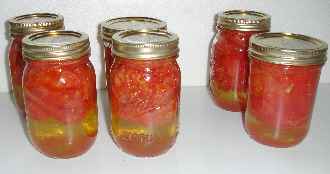 Lift
the jars out of the water and let them cool without touching or bumping
them in a draft-free place (usually takes overnight) You can then
remove the rings if you like, but if you leave them on, at least loosen
them quite a bit, so they don't rust in place due to trapped moisture.
Once the jars are cool, you can check that they are sealed verifying
that the lid has been sucked down. Just press in the center, gently,
with your finger. If it pops up and down (often making a popping sound),
it is not sealed. If you put the jar in the refrigerator right away, you
can still use it. Some people replace the lid and reprocess the jar,
then that's a bit iffy. If you heat the contents back up, re-jar them
(with a new lid) and the full time in the canner, it's usually ok.
Don't worry if you see the tomatoes floating above a layer of liquid;
that's normal. Tomatoes have a lot of water in them and it
separates a bit. If I had packed the tomatoes in the jars a bit
tighter or squeezed for of the free liquid out of them before packing
them in the jars, the water layer would be reduced.
Lift
the jars out of the water and let them cool without touching or bumping
them in a draft-free place (usually takes overnight) You can then
remove the rings if you like, but if you leave them on, at least loosen
them quite a bit, so they don't rust in place due to trapped moisture.
Once the jars are cool, you can check that they are sealed verifying
that the lid has been sucked down. Just press in the center, gently,
with your finger. If it pops up and down (often making a popping sound),
it is not sealed. If you put the jar in the refrigerator right away, you
can still use it. Some people replace the lid and reprocess the jar,
then that's a bit iffy. If you heat the contents back up, re-jar them
(with a new lid) and the full time in the canner, it's usually ok.
Don't worry if you see the tomatoes floating above a layer of liquid;
that's normal. Tomatoes have a lot of water in them and it
separates a bit. If I had packed the tomatoes in the jars a bit
tighter or squeezed for of the free liquid out of them before packing
them in the jars, the water layer would be reduced.
Now, just store them in a cool, dark place and use them as needed over the next year!
Frequently Asked Questions about Canning Tomatoes
Why do my tomatoes separate from the liquid?
A frequent problem is the separation of water from the tomatoes. Why does the water separate from the solids in tomatoes?
Scenario 1 - liquid at the top and solids at the bottom
Home canned tomatoes, tomato juice, and tomato sauces with liquid at the top and solids at the bottom is quite normal. It only reflects that the juice was made prior to heating. For example, the tomatoes were chopped, run through the steamer, sieve, or food mill while still raw and prior to heating.
As soon as they are chopped or crushed, enzymes start to break down the pectin that helps to hold tomato cells together. The enzyme that causes separation is activated by exposure to air and inactivated by heat. In commercial production, tomatoes are flash heated nearly to boiling in a matter of seconds, using equipment not available to consumers. Because the pectin holding tomato cells together is not exposed to air when cold, it remains intact, and a thick bodied, homogeneous juice is produced.
The solution is to leave tomatoes whole or in large chunks (do not chop). Heat before chopping or juicing to minimize the separation.
The best way to do that at home is to heat quartered tomatoes quickly to boiling temperatures WHILE crushing. You can also heat the blanched, peeled whole tomatoes in the microwave, then crush them!
Make sure the mixture boils constantly and vigorously while you add the remaining tomatoes. Simmer 5 minutes after all tomatoes are added, before juicing. If you are not concerned about juice separating, simply slice or quarter tomatoes into a large saucepan. Crush, heat and simmer for 5 minutes before juicing.
Scenario 2 - liquid at the bottom and solids at the top (note the photo is step 10)
What about the reverse: liquid at the bottom and solids at the top? That indicates too much preheating (more than 5 minutes). Pectin breaks down when it is overheated; then separation results. If separation occurs, just shake the jar before opening or Decant the water off.
References: Ohio State University
After I removed the jars of tomatoes from the canner, the jars had lost a lot of liquid and were about half-empty. What happened? Are they safe?
There are several possible causes:
- The food was not heated prior to filling (Raw pack method) -
- The food was packed too tightly in the jars
- Air bubbles were not removed prior to sealing the lids and rings on the jars
- The pressure canner was cooled too quickly
- Starchy foods, such as corn, peas or lima beans, absorbed all the liquid. Use more liquid with these starchy vegetables.
- The jars were filled too full.
- Fluctuating pressure in the pressure canner. Let pressure return to zero gradually, avoiding the sudden release of pressure through the vent. Do not hasten the cooling with cold water.
As long as the jars remained sealed, they will be ok, but they should be checked more frequently and used up first!
Other Equipment:
From left to right: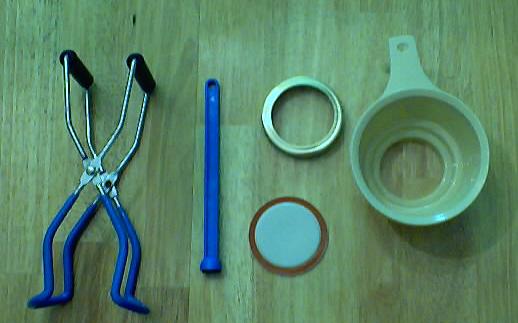
- Jar lifting tongs to pick up hot jars
- Lid lifter - to remove lids from the pot of boiling water (sterilizing )
- Lids- disposable - you may only use them once
- Ring - holds the lids on the jar until after the jars cool - then you remove them, save them and reuse them
- Canning Jar funnel - to fill the jars
| See here for related tools, equipment, supplies on Amazon See here for related tools, equipment, supplies on Amazon See here for related tools, equipment, supplies on Amazon 
|
Home Canning KitsThis is the same type of standard canner that my grandmother used
to make everything from applesauce to jams and jellies to tomato and
spaghetti sauce. This complete kit includes everything you need and lasts
for years: the canner, jar rack, Jar grabber tongs, lid lifting wand, a
plastic funnel, labels, bubble freer, and the bible of canning, the Ball
Blue Book. It's much cheaper than buying the items separately. You will never need anything else except jars & lids! To see more canners, of different styles, makes and prices, click here!For
more information and current pricing: |
Summary - Cost of Making Homemade Canned Tomatoes - makes 7 quart jars, 32 oz each* |
||||
| Item | Quantity | Cost in 2024 | Source | Subtotal |
| Tomatoes | 20 - 25 lbs (to make about 16 cups of prepared tomato) | free from the garden, or $0.50 cents at a PYO | Garden | $0.00 |
| Canning jars (quart size, wide mouth), includes lids and rings | 7 jars | $8.00/dozen | Grocery stores, like Publix, Kroger and Safeway and local "big box" stores; sometimes Big Lots and even hardware stores | $4.50 |
| Lemon juice | 14 Tablespoons | $0.50 | Grocery store | $0.50 |
| Total | $5.00 total or about $0.72 per jar INCLUDING the jars - which you can reuse! |
|||
|
* - This assumes you already have the pots, pans, ladles,, and reusable
equipment. Note that you can reuse the jars! Many products are sold in
jars that will take the lids and rings for canning. For example,
Classico Spaghetti sauce is in quart sized jars that work with Ball and
Kerr lids and rings. Note that the Classico's manufacturer does not
recommend reuse of their jars:
see what they have to say on this page.
|
||||
Answers to Common Questions
What did I do wrong if my jars spoil?
Tomatoes are a borderline acid / low acid fruit (see this page about tomato acidity for more information) - adding lemon juice helps, processing at least 35 minutes in the water bath canner, or better still, using a Pressure Canner almost eliminates spoilage. If you don't have a pressure canner, you must boost the acid level of the sauce, by adding 2 tablespoons of lemon juice or 1/2 teaspoon of citric acid per quart of sauce.
The question everyone asks: Can you add meat?
With a water bath canner, absolutely, definitely NOT. The temperatures do not get high enough to kill the type of bacteria that can attack meat and make you sick, or even kill you. However, with a Pressure Canner, it IS possible. I have complete directions here! I don't do it, simply because... have you ever tasted canned meat? Yes, it is called SPAM. My recommendation is to can without the meat and add fresh browned ground meat or meatballs when you use the sauce!
I have read in other homemade spaghetti sauce recipes that you need to cook the mixture for at least 4-5 hours. Is this necessary?
I suppose if you really want to make sure that absolutely no vitamins
survive, you could cook it that long! :) The only reason people used to tomato
sauce that long was the Roma paste-type tomatoes, with thicker walls, meatier
with fewer seeds and less water didn't exist, so they had to cook it for hours
to get rid of water and thicken it. And of course, modern sauce mixes that
contain a little bit of corn starch as a thickener, also help shorten the time.
And for those who want to go strictly organic and au naturale, my method of
squeezing out the excess water and seeds eliminates much of the excess juice
(which you can save as tomato juice for drinking) and lets you start with a
thicker tomato pulp which means much shorter cooking time!

Looking for canning equipment and supplies?
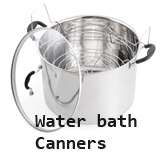
Water bath canner with a jar rack
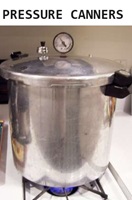
Pressure canners for gas, electric and induction stoves: Presto 23Qt or T-fal 22Qt
Canning scoop (this one is PERFECT)
Ball Blue book (most recent version)
Find Other types of farms:
- Easter egg hunts
- Children's consignment sales
- Farm markets and roadside stands
- Road trips and camping resources
- Local Honey, apiaries, beekeepers
- Local Meat, Milk and Eggs
- Consumer fraud and scams information
- Home canning supplies at the best prices on the internet!
- Maple Syrup Farms, sugarworks, maple syrup festivals
- Environmental information and resources
- Farms For Your Event for birthday parties, weddings, receptions, business meetings, retreats, etc.
- Festivals - local fruit and vegetable festivals
- Pumpkin patches and corn mazes
- Christmas Tree Farms and lots
Get the
most recent version of
the Ball Blue Book
Get the
most recent version of
the Ball Blue Book of Home Canning
Find other types of farms:
- Easter egg hunts
- Children's consignment sales
- Farm markets and roadside stands
- Local Honey
- Local Meat, Milk and Eggs
- Road trip and camping
- Pumpkin patches and corn mazes
- Christmas Tree Farms and lots
- Maple Syrup farms and sugarworks
Highly rated canning supplies:
- Regular Mouth Canning Lids with food-grade with BPA Free Silicone seals for Ball, Kerr Jars for Canning
- Canning accessories kit: funnel, jar tongs, lid lifter, etc
- Food Dehydrator, 400W Electric with 8 Trays, 48 hour Timer and Temperature Control 95-176℉, BPA-Free
- Water Bath Canner, 21 Qts with lid, Jar Rack, Speckled Black, cans 7 quart jars, 9 pint jars or 13 half-pint jars
- Air Fryer: Instant Pot Instant Vortex Plus XL 8QT Clear Windows, Custom Programming, 8-in-1 Functions that Crisps, Broils, Roasts, Dehydrates, Bakes, Reheats
- Pressure canner: All American 921, 21.5qt Pressure Cooker/Canner, never needs gaskets, Great for Gas, Electric or Flat Top Stoves - Made in the USA
- The Backyard Homestead:a guide to homesteading , on 1/4 acre, how to raise grains and vegetables; raise animals for meat, eggs, and dairy; and keep honey bees
- Smart silent HEPA Air Purifiers for Home, Large Rooms for Allergies, Smoke, Pets. Eliminates 99.97% of Dust, Pet Hair, Odors