Peach facts and picking tips
Peach and Nectarine Facts, Picking Tips and Recipes
 In
the U.S., Peaches typically peak during late June through July in the South, and
July and August in the North. In order to produce good local peaches, producers
depend on ideal spring and early summer weather conditions, and no late frosts.
If you want to know
which are the best varieties of
peaches for home canning, see this page!
In
the U.S., Peaches typically peak during late June through July in the South, and
July and August in the North. In order to produce good local peaches, producers
depend on ideal spring and early summer weather conditions, and no late frosts.
If you want to know
which are the best varieties of
peaches for home canning, see this page!
Before you leave to go to the farm:
- Always call before you go to the farm - Peaches are affected by weather (both rain and cooler temperature) more than most crops. And when they are in season, a large turnout can pick a field clean before noon, so CALL first!
-
 Leave
early. On weekends, then fields may be picked clean by NOON!
Leave
early. On weekends, then fields may be picked clean by NOON! -
Most growers furnish picking containers designed for peaches, but they may
charge you for them; be sure to call before you go to see if you need to
bring
containers.
If you use your own containers, remember that heaping Peaches more than 14 inches deep will bruise the fruit on the bottom. Plastic dishpans, metal oven pans with 3 inch tall sides and large pots make good containers. -
 Bring
something to drink and a few snacks; you'd be surprised how you can work up
a thirst and appetite! And don't forget hats and sunscreen for the sun. Bugs
usually aren't a problem, but some deet might be good to bring along if it
has been rainy.
Bring
something to drink and a few snacks; you'd be surprised how you can work up
a thirst and appetite! And don't forget hats and sunscreen for the sun. Bugs
usually aren't a problem, but some deet might be good to bring along if it
has been rainy. - You might want to ask whether the peaches are! There are two major types of peaches: "Freestone" and. "Clingstone". Freestone peaches and nectarines have flesh that slips easily away from the pit. Clingstones are a REAL pain, because the fruit tenaciously clings to the stone or pit! Most peach varieties grown today are freestone and are usually available (depending upon your location) from June through September. Some nectarines are freestone and some are clingstone. Freestone nectarines are available in June and July. Most plum varieties are clingstone.
When you get home
- Spread the fruit out on towels or newspapers and separate any mushy or damaged fruit to use immediately.
- Put a couple of days supply into the fridge, wash and cut the others and freeze them up!
- Even under ideal conditions peaches will only keep for a week in a refrigerator, so for best flavor and texture, use them as soon as possible after purchase
- Now, get ready to make Peach jam or canned peaches - It is VERY easy -
especially with our free
- peach jam instructions - they're illustrated and easy and our page on
- how to make home canned peaches from fresh!
- Or see here to freeze peaches instead!
- make your own home canned peach pie filling to use in the winter - Here's a great and easy peach pie
recipe
or peach-blueberry pie or how about
- peach salsa?
- Peach chutney
- Spiced peaches
- peach butter
- Peach honey
- pickled peaches
- peach syrup
- peach juice - Here are some great and easy peach desert recipes, like easy peach cobbler.
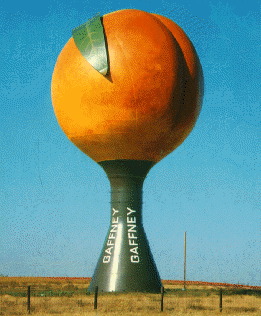
- If you want more information about the Giant Peach water tower in Gaffney, SC, click here.
How to tell if the peaches are ripe!
- Attached to the tree: Peaches are best picked when the fruit separates easily from the twigs. If it is hard to pull off the tree, it isn't ripe! Peaches will not ripen further once removed from the tree (they only "soften")
- Color: Green is definitely unripe, but you can't use red color as an indicator of how ripe a peach is. Different peach varieties have differing amounts of red blush in their natural coloring. Pick them when the ground color changes from green to yellow, orange, red (or a combination). The skin of yellow-fleshed varieties ripens to an orange tint, while the skin of white-fleshed varieties changes from greenish- to yellow-white.
- Softness: unless you like your peaches very firm, pick your peaches with just a little "give" when gently pressed. Peaches at this stage are great for eating, freezing, and baking. Peaches won't ripen very much after picking!
- Odor: It should smell sweet and ripe!
Tips on How to Pick Peaches
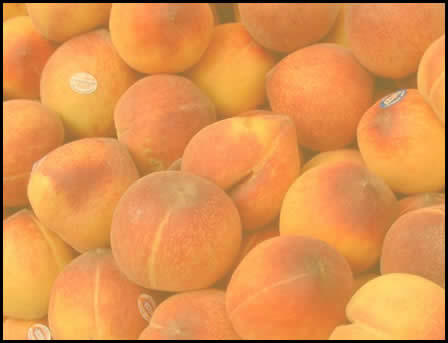 A
peach is softer than most fruit, so it is important to pick a peach gently, with
little pressure. Using the sides of your fingers rather your fingertips helps to
avoid bruising. Grab the peach firmly and pull it straight off the branch.
DON'T drop the peach into the basket, but set it in gently!
A
peach is softer than most fruit, so it is important to pick a peach gently, with
little pressure. Using the sides of your fingers rather your fingertips helps to
avoid bruising. Grab the peach firmly and pull it straight off the branch.
DON'T drop the peach into the basket, but set it in gently!
Marks on the Peachs: Bugs (particularly squash bugs and stink bugs) bite fruit during development and this results in some imperfections in the peach. This is especially the case with organically raised fruit. These look like dents in the peaches if the peaches were bitten by a bug when they were young. This causes a spot that does not grow properly and makes a wrinkle in the peach. There's nothing wrong with these peaches. They may look funny, but they will taste just as good as blemish-free peaches, and it's better not to have the pesticides!
How much do you need?
Raw measures:
- About 2 medium peaches = 1 cup sliced peaches.
- About 4 medium peaches = 1 cup pureed peach.
- About 3 medium peaches = 1 pound of peaches
Process yields (Raw amounts to processed amounts)
- 2 to 21/2 pounds of fresh peaches yields 1 quart canned
- 1 lb of fresh peaches typically yields 3 cups of peeled, sliced peaches or 2 cups or puree.
- It takes about 5 good sizes peaches or nectarines (or about 10 plums) to fill one quart jar of canned peaches.
- An average of 171/2 pounds of fresh peaches are needed per canner load of 7 quarts;
- An average of 11 pounds is needed per canner load of 9 pints.
- 1 bushel = 48 to 50 pounds, yields approximately 18 to 25 quart jars.
And a visitor contributes this: 6-7 peaches makes about 4 cups puree, so 2-3 peaches make about 2 cups puree. 1 peach equals about 1 cup puree.
| Peaches—Average retail price per pound and per cup equivalent, 2020 | |||||||
| Form | Average retail price | Preparation yield factor | Size of a cup equivalent | Average price per cup equivalent | |||
| Fresh1 | $1.72 | per pound | 0.96 | 0.342 | pounds | $0.61 | |
| Canned | |||||||
| Packed in juice2 | $2.02 | per pound | 1 | 0.540 | pounds | $1.09 | |
| Packed in syrup or water3 | $1.81 | per pound | 0.65 | 0.441 | pounds | $1.23 | |
| Frozen | $3.39 | per pound | 1 | 0.331 | pounds | $1.12 | |
| 1The USDA National Nutrient Database for Standard Reference (SR) reports that the inedible pit of a peach accounts for 4 percent of the retail weight, implying a preparation yield of 96 percent, when eaten raw. | |||||||
| 2Consumers are assumed to eat the solid fruit and drink the juice. All contents of the can are edible and count towards an individual's recommended fruit consumption. | |||||||
| 3The syrup (or water) is discarded prior to consumption. Based on the Food Patterns Equivalents Database (FPED), ERS assumes that 65 percent of the can's gross weight is solid and 35 percent is liquid. The FPED cup equivalent weight for canned fruit is the weight of the solids and not of the liquid medium in which it is packed. The preparation yield factor for canned peaches in the above table does not account for any further preparation that occurs prior to consumption. | |||||||
| Source: USDA, Economic Research Service calculations from 2020 Circana (formerly Information Resources, Inc. [IRI]) OmniMarket Core Outlets (formerly InfoScan) data; the USDA National Nutrient Database for Standard Reference (SR), Legacy Release; and the Food Patterns Equivalents Database (FPED) 2017–18 as well as the FPED's accompanying Methodology and User Guide. | |||||||
---
Peach pit tips
It's best to remove peach pits before you cook the peaches. Cherry, peach, and apricot pits also contain amygdalin; the latter two, in potentially harmful amounts. Fortunately, peach and apricot pits are sufficiently large and hard that few people intentionally swallow or chew them. (The unapproved anti-cancer drug is a semisynthetic derivative of amygdalin; a cheaper version of Laetrile is a semisynthetic derivative of amygdalin; a cheaper version of laetrile produced in Mexico came from crushed apricot pits.) See this page for more information.
Nutritional Information
peaches
Delicious and Nutritious
a delicious
&
natural
treat10g 0 g 0 m 0 mg 1.5 g 47RE
- peaches are virtually fat free. A medium size peach contains less than one gram of fat.
- peaches are naturally sodium free.
- peaches have no cholesterol.
- peaches are a low calorie snack. A medium size peach contains only 40 calories.
- peaches contain vitamin A which helps us see in dim light.
- peaches are considered a good source of fiber. The skin of a peach provides both roughage and fiber.
Temporary Storage Tips
- Ripe peaches have a creamy or golden undertone and "peachy-sweet" fragrance.
- Peaches should be refrigerated and used within a few days.
- Putting peaches and nectarines in a loosely closed paper bag at room temperature for a day or two can help soften firm fruit - but they won't become sweeter or ripen further - that stopped when they were removed from th etree.
- For best flavor, allow the fruit to ripen fully on the tree.
- Store at 33°F to 40°F and high humidity (a vegetable drawer in the fridge).
Preserving the fruit
- For canning directions,
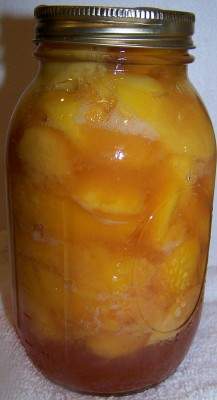 See
my page on how to make home
canned peaches from fresh! It is really SO easy!
See
my page on how to make home
canned peaches from fresh! It is really SO easy! - Freezing Peaches
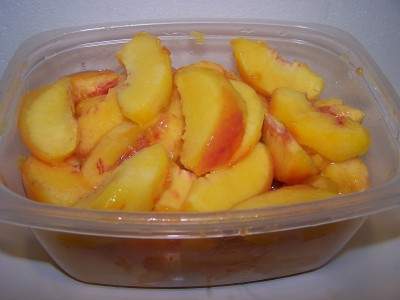 See
my page on how to freeze
peaches, plums, nectarines, figs and cherries. Even easier than canning
and they will taste just like fresh.. but it does take up space in the
freezer.
See
my page on how to freeze
peaches, plums, nectarines, figs and cherries. Even easier than canning
and they will taste just like fresh.. but it does take up space in the
freezer.
Question: Which is better, to can or freeze peaches?
Answer: In my experience, going back 50 years to my childhood, when my mother also canned and froze peaches, we both found that frozen were superior in color and flavor to canned peaches. It all depends upon whether you have room in your freezer.
- Peach butter
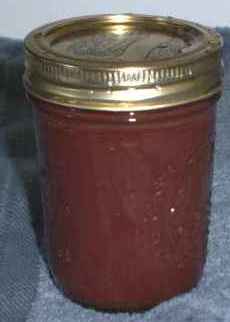 If
you like apple butter and you like peaches, you will LOVE this
easy peach butter recipe,
complete with canning instructions, so you can make them now and give them
away at Christmas time!
If
you like apple butter and you like peaches, you will LOVE this
easy peach butter recipe,
complete with canning instructions, so you can make them now and give them
away at Christmas time! - Peach jam - it is out of this world and SO easy.
- How to make peach chutney
- Spiced Peaches
A traditional Southern favorite, canned spiced peaches! - Peach Cobbler
This recipe is easy and DELICIOUS!!! - Even more peach and nectarine recipes: Peach Honey, Marmalade, Conserves, Peach Pickles and Oscar Relish
Substituting Frozen or Canned Peaches for Fresh
In most recipes, frozen or canned peaches can be substituted for fresh peaches. The frozen and canned peaches have already been sweetened; therefore, the amount of sugar called for in a recipe will have to be adjusted. Also, the peaches should usually be drained before using.
For the kids!
How to plant a peach pit (also works with nectarines and apricots). If you save a peach pit you can grow your own fruit tree.
- Clean the pit and store it in the refrigerator in a plastic bag until September or October.
- Place the pit about five inches beneath the soil surface.
- In the spring, your tree will start to grow and should be visible by July!
- Keep the tree watered and fertilized (fruit tree spikes from Lowes, HomeDepot, etc.) and you will have fruit in 2-3 years!


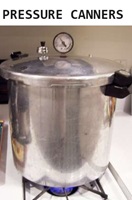
Looking for canning equipment and supplies?
Water bath canner with a jar rack
Pressure canners for gas, electric and induction stoves: Presto 23Qt or T-fal 22Qt
Canning scoop (this one is PERFECT)
Ball Blue book (most recent version)
Jars: 8oz canning jars for jams
Find Other types of farms:
Farm markets and roadside stands
Road trips and camping resources
Local Honey, apiaries, beekeepers
Consumer fraud and scams information
Home canning supplies at the best prices on the internet!
Maple Syrup Farms, sugarworks, maple syrup festivals
Environmental information and resources
Farms For Your Event for birthday parties, weddings, receptions, business meetings, retreats, etc.
Festivals - local fruit and vegetable festivals
Get the
most recent version of
the Ball Blue Book