Looking for Blackberry Jelly: How to Make Homemade Blackberry Jelly - Easily! in 2025? Scroll down this page and follow the links. And if you bring home some fruit or vegetables and want to can, freeze, make jam, salsa or pickles, see this page for simple, reliable, illustrated canning, freezing or preserving directions. There are plenty of other related resources, click on the resources dropdown above. If you are having a hard time finding canning lids, I've used these, and they're a great price & ship in 2 days.
If you have questions or feedback, please let me know! There are affiliate links on this page. Read our disclosure policy to learn more.
Blackberry Jelly: How to Make Homemade Blackberry Jelly - Easily!
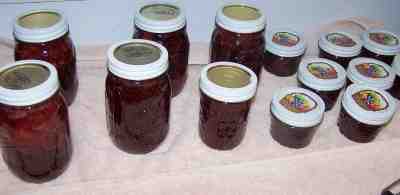
 Blackberry Jelly: How to Make and Can Blackberry Jelly
Yield: 7 to 9 eight-ounce jars
Making and canning your own blackberry jelly is also quite easy. Just scroll down this page to see how to do it, in easy steps and completely illustrated. These directions work equally well for dewberries (which are closely related), bramble berries, wild blackberries, raspberries, boysenberries, gooseberry, loganberry, tayberry, youngberry, etc.; by themselves or mixed berry jelly. Any variations will be spelled out in the directions inside the pectin.- I've got some other pages for specific types of jelly and butters, too, see this page
- For more information about strawberries, see blackberry picking tips .
Ingredients
- Fruit - about 8 cups of whole berries, preferably fresh, but bottled juice (without added sugar) or frozen whole fruit (without syrup) works, too.
- Pectin - 1 package (box usually) or if you get it in bulk, 8 Tablespoons, see the directions below for specifics - (it's a natural product, made from apples and available at grocery stores (season - spring through late summer) and local "big box" stores. It usually goes for about $2.00 to $2.50 per box. You will get best results with no-sugar needed pectin, whether you choose to add sugar or not! See here for more information about how to choose the type of pectin to use.
- Sugar - About 4.5 cups of dry, granulated (table) sugar. For the no-sugar recipe, click here
Equipment
- At least 1 large pot; I prefer 16 to 20 quart Nonstick ceramic coated pots for easy cleanup.
- Large spoons and ladles,
- 1 Water Bath Canner (a huge pot to sanitize the jars after filling (about $30 to $35 at mall kitchen stores, sometimes at big box stores and grocery stores.). Note: we sell canners and supplies here, too - at excellent prices - and it helps support this web site!
- Half pint canning jars (Grocery stores, like Publix, Kroger, Safeway carry them, as do some big box stores - about $7 per dozen 8 ounce jars including the lids and rings)
- Lids - thin, flat, round metal lids with a gum binder that seals them against the top of the jar. They may only be used once.
- Rings - metal bands that secure the lids to the jars. They may be reused many times.
- Jelly strainer or a juicer, or cheesecloth as a fallback
- Jar funnel ($5 at Target, other big box stores, and often grocery stores; and available online - see this page) or order it as part of the kit with the Jar grabber .
- Jar grabber (to pick up the hot jars)- Big box stores and grocery stores sometimes carry them; and it is available online - see this page. It's a tremendously useful to put jars in the canner and take the hot jars out (without scalding yourself!). The kit sold below has everything you need, and at a pretty good price:
Optional stuff:
- Foley Food Mill - not necessary; useful if you want to remove seeds (from blackberries) or make applesauce.
- Lid lifter (has a magnet to pick the lids out of the almost-boiling water where you sanitize them. ($4 at big box stores or it comes in the kit at left)
Jelly-making Directions
This example shows you how to make either Blackberry Jelly, but you can use other types of berries, or mix them. You can use this recipe to make any type of jelly; where there is a difference, I will point it out! The yield from this recipe is about 8 eight-ounce jars (which is the same as 4 pints).
Step 1 - Pick the berries! (or buy them already picked)
It's fun to go pick your own and you can obviously get better quality ones!
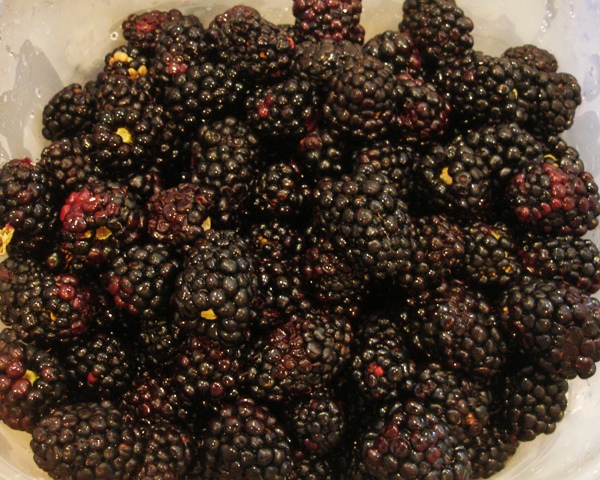
At right is a picture I took of wild blackberries - they are plentiful in late June throughout Georgia. I usually look in rural north Georgia.
I prefer to grow my own; which is really easy - but that does take some space and time.
 As mentioned in the Ingredients section; you may use frozen berries (those without syrup or added sugar); which is especially useful if you want to make some
jelly in December to give away at Christmas!
As mentioned in the Ingredients section; you may use frozen berries (those without syrup or added sugar); which is especially useful if you want to make some
jelly in December to give away at Christmas!
AAbove and at left are blackberries that I picked at a pick-your-own farm. If you want to pick your own, here is a list and links to the pick your own farms.
How many blackberries?
Jelly can ONLY be made in rather small batches - about 6 cups of mushed, deseeded at a time - like the directions on the pectin say, DO NOT increase the recipes or the jelly won't "set" (jell, thicken). (WHY? Alton Brown on the Food Channel says pectin can overcook easily and lose its thickening properties. It is easier and faster to get an even heat distribution in smaller batches. It takes about 8 or 9 cups of raw, unprepared berries per batch. For triple berry jelly, I use 4 cups of mushed (slightly crushed) strawberries, 1 cup of raspberries and 1 cup of blackberries. Keep in mind, you can start with juice - either by making your own with an electric juicer or by buying bottled berry juice (without added sugar)
Step 2 - Wash the jars and lids
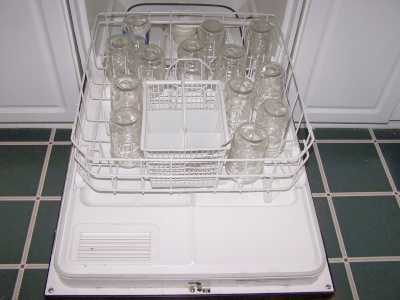 Now's a good time to get the jars ready, so you won't be rushed later. The dishwasher is fine for the jars; especially if it has a "sanitize" cycle, the water bath processing will sanitize them as well as the contents! If you don't have a dishwasher with a sanitize cycle, you can wash the containers in hot, soapy water and rinse, then sanitize the jars by boiling them 10 minutes, and keep the jars in hot water until they are used.
NOTE: If a canning recipe calls for 10 minutes or more of process time in the canner, then the jars do not need to be "sanitized" before filling them. But really, sanitizing them first is just good hygeine and common sense! See this page for more detail about cleaning and sanitizing jars and lids.
Put the lids into a pan of hot, but not quite boiling water (that's what the manufacturer's recommend) for 10 minutes, and use the magnetic "lid lifter wand" to pull them out. Leave the jars in the dishwasher on "heated dry" until you are ready to use them. Keeping them hot will prevent the jars from breaking when you fill them with the hot jelly.
Step 3 -Wash and hull the blackberries!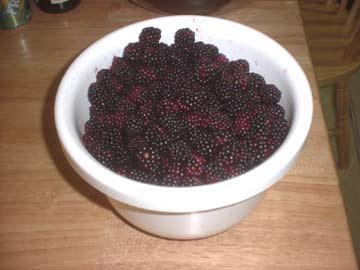
I'm sure you can figure out how to wash the fruit in plain cold water.
Then just pick off any stems and leaves.
Step 4a - Deseed the blackberries (optional)
II prefer seedless blackberry jelly; that's pretty much inherent in the
definition of jelly. The easiest way to do this is
to use an electric juicer, if you have one. Otherwise a food mill; either a Foley food mill (a manual hand crank device,) or a Villaware (manual or motorized) or a Roma mill. I find the seeds separate more
easily if I heat the blackberries up until almost boiling, in a pan with about 1
cup of added apple juice.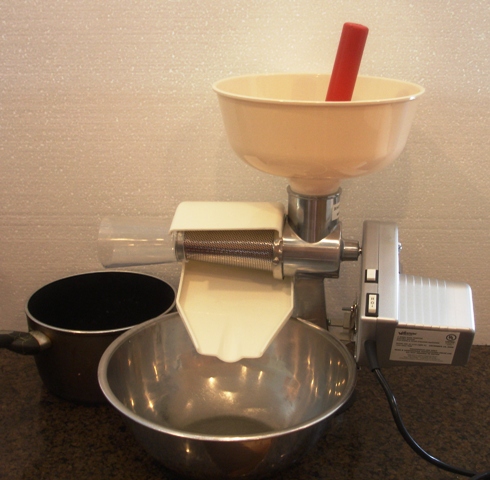
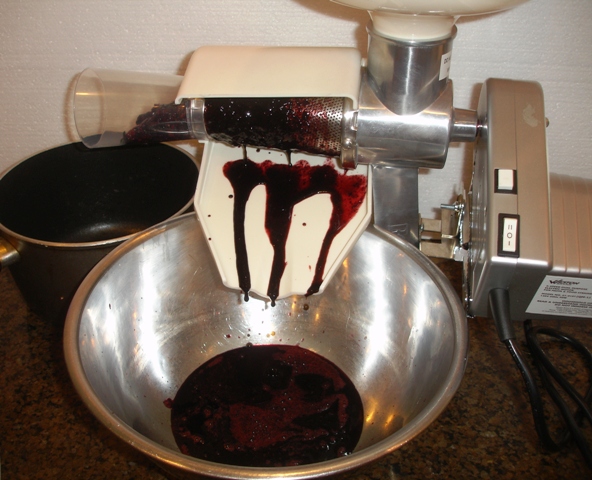
As you can see, it is really effective at removing just the seeds:
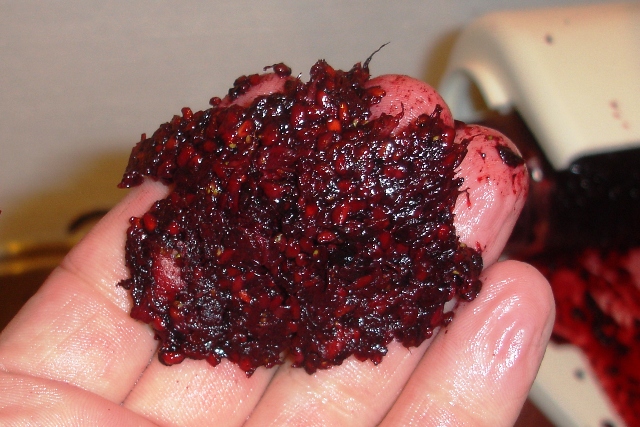
See here for related tools, equipment, supplies on Amazon See here for related tools, equipment, supplies on Amazon See here for related tools, equipment, supplies on Amazon
Here's how the Foley food mill (below) works. They cost about $30.
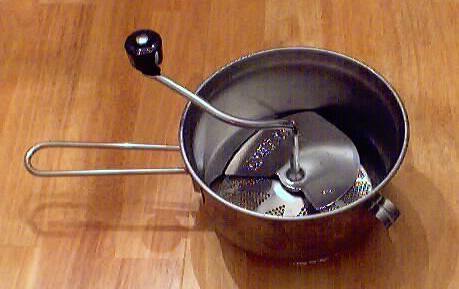
It works well for blackberries, not so well for raspberries, and no one tries to remove strawberry seeds (they're so small). I suppose you could train monkeys to pick them out, but they'd probably form a trade labor union. But I digress..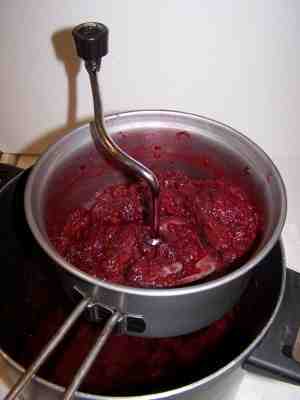
Step 4 b - Mush the berries - if you did not deseed them
If you decided not to remove the seeds, then you just mush the blackberries up a bit - not completely crushed, but mostly. Most people seem to like large chunks of fruit but crushing them releases the natural pectin so it can thicken. You will need about 6 cups, mushed up.
Step 5 - Measure out the sugar
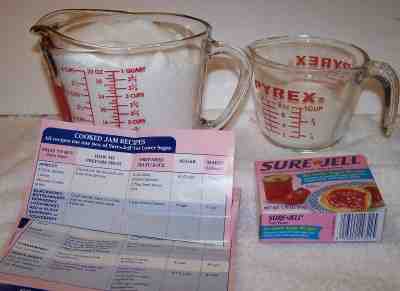
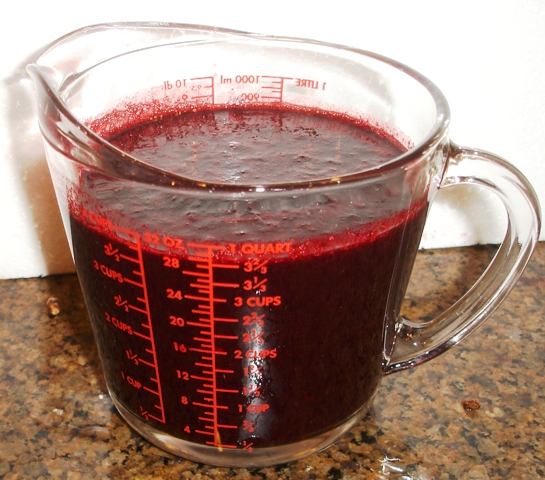 Depending upon which type of
jelly you're making (strawberry, blackberry, raspberry, apricot, peach, grape, etc.) you will need to use a different amount of sugar,
jelly and pectin. The precise measurements are found in each and every box of pectin sold. For most fruit; like berries, with the low sugar pectin, you will need 4 cups of sugar. With regular pectin, about 7 cups of sugar. Mix the dry pectin with about 1/4 cup of sugar and Keep this separate from the rest of the sugar. If you are not using sugar, you will just have to stir more vigorously to prevent the pectin from clumping. This helps to keep the pectin from clumping up and allows it to mix better!
Depending upon which type of
jelly you're making (strawberry, blackberry, raspberry, apricot, peach, grape, etc.) you will need to use a different amount of sugar,
jelly and pectin. The precise measurements are found in each and every box of pectin sold. For most fruit; like berries, with the low sugar pectin, you will need 4 cups of sugar. With regular pectin, about 7 cups of sugar. Mix the dry pectin with about 1/4 cup of sugar and Keep this separate from the rest of the sugar. If you are not using sugar, you will just have to stir more vigorously to prevent the pectin from clumping. This helps to keep the pectin from clumping up and allows it to mix better!
| Type of jelly |
Type of pectin to buy |
Sweetener |
| regular | no-sugar or regular | 7 cups of sugar |
| low sugar | no-sugar | 4.5 cups of sugar |
| lower sugar | no-sugar | 2 cups sugar and 2 cups of Stevia (in a prepared form like Truvia, it measures same as sugar; if you use another form, you will need do your own conversion) - or Splenda, if you prefer, |
| no sugar | no-sugar | 4 cups of Stevia (in a prepared form like Truvia, it measures same as sugar; if you use another form, you will need do your own conversion) - or Splenda, if you prefer, |
| natural | no-sugar | 3 cups fruit juice (grape, peach, apple or mixed) |
Step 6 - Heat the berries to help free the juice
Here's why jellies are more challenging than jams: we need to separate the juice from the pulp and seeds. In order to do that, we need to warm the berries (not bring them to a boil) just enough so we can easily mash them and filter or strain them.
So, heat the mushed up berries just until they start to get very warm and become more free flowing.
Step 7 - Straining
I now pour the warmed up, mushed berries through a fine sieve. The resultant juice is clear enough for my home-made jam, retains pulp and has a lot of flavor. I go to step 9.
But, if you like a very clear jelly and have time and patience... go on to step 8 to polish the juice!
Step 8 - Polishing (optional)
If you want a very clear, polished jelly, you can either put the soft cooked blackberries through a jelly strainer (about $9.00, see ordering below) which results in the most clear jelly and is easiest to use, or pour them through cheesecloth in a colander. Or if you don't mind chunky jelly, just let the juice stand for 20 minutes, and Decant (pour off) the clear liquid to use and leave the solids behind. Return the liquid to the pot and return to a boil.
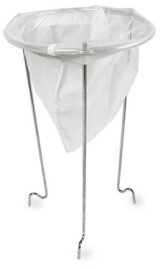 See here for related tools, equipment, supplies on Amazon
|
If you need a stopping point and want to finish up the next day, this is a good place. Sometimes, jelly gets crystals, called tartrate crystals, forming in the jelly. They're not harmful and don't affect the taste, but some people don't like the appearance. I rarely even see them! But if you do, let juice stand in a cool place overnight, then strain through two thicknesses of damp cheesecloth to remove any crystals that have formed.
Step 9 - Mix the berries with the pectin and cook to a full boil
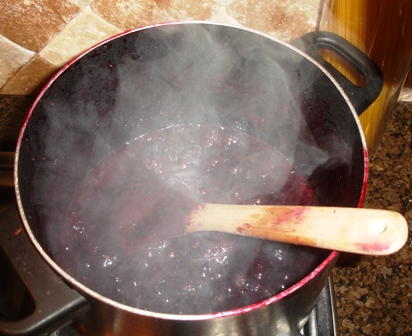 Stir the pectin into the berries and put the mix in a big pot on the stove over medium to high heat (stir often enough to prevent burning). It should take about 5 to 10 minutes to get it to a full boil (the kind that cannot be stirred away).
Why use pectin? You may run into grandmotherly types who sniff "I never used pectin!" at you. Well, sure, and their generation took a horse and buggy to work, died of smallpox and ate canned meat and green beans that tastes like wet newspapers. Old fashioned ways are not always better nor healthier. Pectin, which occurs naturally in fruit, is what makes the jelly "set" or thicken. The pectin you buy is just natural apple pectin, more concentrated. Using pectin dramatically reduces the cooking time, which helps to preserve the vitamins and flavor of the fruit, and uses much less added sugar. But, hey, if you want to stand there and stir for hours, cooking the flavor away, who am I to stop you! :) Having said that, there are some fruits that have naturally high amounts of pectin (see this page for a list) and they simply don't need much or even any padded pectin.
Notes about pectin: I usually add about 25% - 30% more pectin (just open another pack and add a little) or else the jelly is runnier than I like. With a little practice, you will find out exactly how much pectin to get the thickness you like.
Another tip: use the lower sugar or no-sugar pectin. You can add sugar to either and it cuts the amount of sugar you need from 7 cups per batch to 4 cups or less! And it tastes even better! On the other hand; I have never had success with the No-sugar pectin without adding ANY sugar. It always turned out runny and bland. You might want to try using the low sugar or no-sugar recipe with a mixture of sugar and Stevia (in a prepared form like Truvia, it measures same as sugar; if you use another form, you will need do your own conversion) - or Splenda, if you prefer, ; sugar and white grape juice, or just white grape juice - that will cut down the sugar, but still preserve the flavor.
Get canning jars, rings, lids and pectin deliverd:
Step 10 - Get the lids warming in hot (but not boiling) water
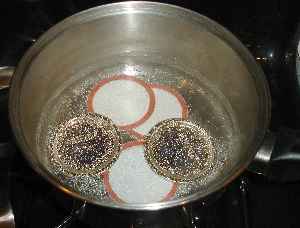 Lids: put the lids into a pan of hot water for at least several minutes; to soften up the gummed surface and clean the lids.
Step 11 - Add the remaining sugar and bring to a boil again for 1 minute
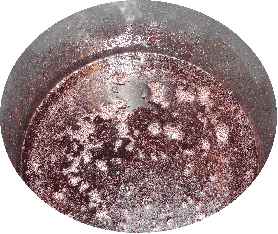 When the berry-pectin mix has reached a full boil, add the rest of the sugar (about 4 cups of sugar per 6 cup batch of berries)
or other sweetener, and then bring it back to a boil and boil hard for 1
minute... If you bring it back to a full boil fairly slowly (on medium heat rather than high) that will help reduce foaming.
When the berry-pectin mix has reached a full boil, add the rest of the sugar (about 4 cups of sugar per 6 cup batch of berries)
or other sweetener, and then bring it back to a boil and boil hard for 1
minute... If you bring it back to a full boil fairly slowly (on medium heat rather than high) that will help reduce foaming.
Remove from the heat.
Step 12 - Skim any excessive foam
Foam...
What is it? Just jelly with a lot of air from the boiling. 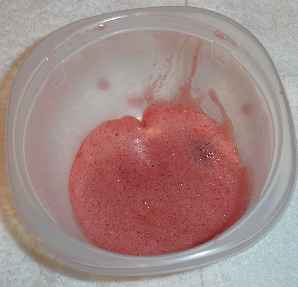 But it
tastes more like, well, foam, that jelly, so most people remove it. It is
harmless,
though. Some people add 1 teaspoon of butter or margarine to the mix in
step 6 to reduce foaming, but food experts debate whether that may contribute to
earlier spoilage, so I usually omit it and skim.
But it
tastes more like, well, foam, that jelly, so most people remove it. It is
harmless,
though. Some people add 1 teaspoon of butter or margarine to the mix in
step 6 to reduce foaming, but food experts debate whether that may contribute to
earlier spoilage, so I usually omit it and skim.
But save the skimmed foam! You can recover jelly from it to use fresh! See this page for directions!
Step 13 - Testing for "jell" (thickness)
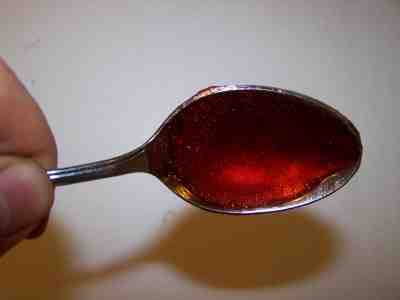 I keep a metal tablespoon sitting in a glass of ice water, then take a half spoonful of the mix and let it cool to room temperature on the spoon. If it thickens up to the consistency I like, then I know the
jelly is ready. If not, I mix in a little more pectin (about 1/4 to 1/2 of another package) and bring it to a boil again for 1 minute.
I keep a metal tablespoon sitting in a glass of ice water, then take a half spoonful of the mix and let it cool to room temperature on the spoon. If it thickens up to the consistency I like, then I know the
jelly is ready. If not, I mix in a little more pectin (about 1/4 to 1/2 of another package) and bring it to a boil again for 1 minute.
Notes about "set" (thickening or jell): It takes 3 ingredients for jams and jellies to set: pectin, sugar and acidity. The amount of pectin that is naturally occurring in the fruit varies from one type of fruit to another and by ripeness (counter intuitively, unripe contains more pectin). See this page for more about pectin in fruit. It takes the right balance, and sufficient amounts of each of pectin, sugar and acidity to result in a firm jam or jelly. Lastly, it takes a brief period (1 minute) of a hard boil, to provide enough heat to bring the three together. Generally speaking, if your jelly doesn't firm up, you were short in pectin, sugar or acidity or didn't get a hard boil. That's ok - you can "remake' the jelly; see this page!
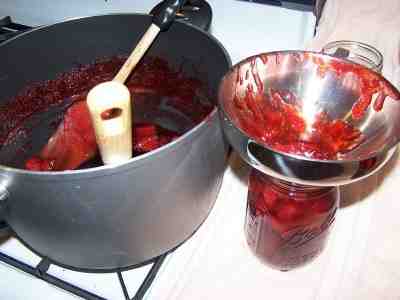 Step 14 - Fill the jars and put the lid and rings on
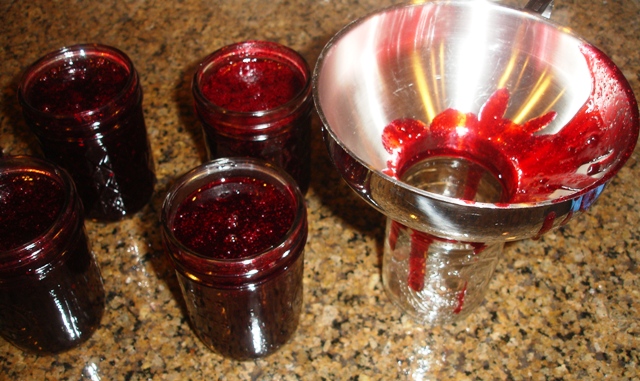 Fill them to within 1/4-inch of the top, wipe any spilled
jelly off the top, seat the lid and tighten the ring around them. Then put the filled jars into the canner!
Fill them to within 1/4-inch of the top, wipe any spilled
jelly off the top, seat the lid and tighten the ring around them. Then put the filled jars into the canner!
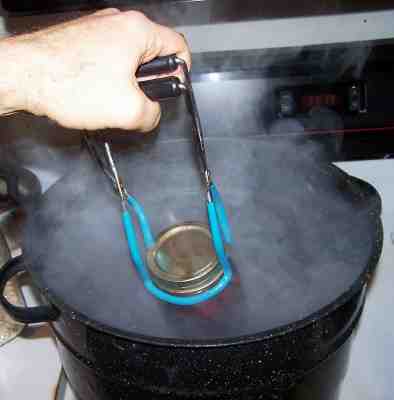
This is where the jar tongs come in really handy!
Step 15 - Process the jars in the boiling water bath
Keep the jars covered with at least 2 inches of water. Keep the water boiling. In general, boil them for 10 minutes, which is what SureJell (the makers of the pectin) recommend. I say "in general" because you have to
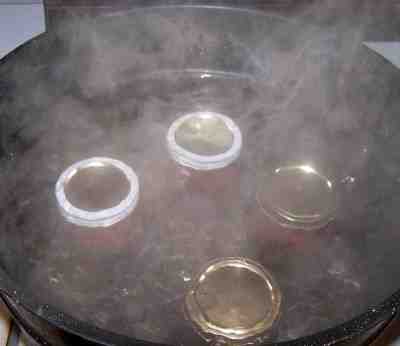 process (boil) them longer at higher altitudes than sea level, or if you use larger jars, or if you did not sanitize the jars and lids right before using them. The directions inside every box of pectin will tell you exactly. The directions on the pectin tend to be pretty conservative. Clemson University says you only need to process them for 5 minutes. I usually hedge my bets and start pulling them out after 5 minutes, and the last jars were probably in for 10. I rarely have a jar spoil, so it must work. But you don't want to process them too long, or the
jelly will turn dark and get runny. See the chart below for altitude adjustment to processing times, if you are not in the sea level to 1,000ft above sea level range.
process (boil) them longer at higher altitudes than sea level, or if you use larger jars, or if you did not sanitize the jars and lids right before using them. The directions inside every box of pectin will tell you exactly. The directions on the pectin tend to be pretty conservative. Clemson University says you only need to process them for 5 minutes. I usually hedge my bets and start pulling them out after 5 minutes, and the last jars were probably in for 10. I rarely have a jar spoil, so it must work. But you don't want to process them too long, or the
jelly will turn dark and get runny. See the chart below for altitude adjustment to processing times, if you are not in the sea level to 1,000ft above sea level range.
Note: Some people don't even boil the jars; they just ladle it hot into hot jars, put the lids and rings on and invert them, but putting the jars in the boiling water bath REALLY helps to reduce spoilage! To me, it makes little sense to put all the working into making the jelly and then not to process the jars to be sure they don't spoil!
|
Recommended process time for jellies in a boiling water canner. | ||||
| Process Time at Altitudes of | ||||
| Style of Pack | Jar Size | 0 - 1,000 ft | 1,001 - 6,000 ft | Above 6,000 ft |
| Hot | Half-pints or Pints |
5 min | 10 | 15 |
Step 16 - Remove and cool the jars - Done!
Lift the jars out of the water with your jar lifter tongs and let them cool without touching or bumping them in a draft-free place (usually takes overnight) You can then remove the rings if you like, but if you leave them on, at least loosen them quite a bit, so they don't rust in place due to trapped moisture. Once the jars are cool, you can check that they are sealed verifying that the lid has been sucked down. Just press in the center, gently, with your finger. If it pops up and down (often making a popping sound), it is not sealed. If you put the jar in the refrigerator right away, you can still use it. Some people replace the lid and reprocess the jar, then that's a bit iffy. If you heat the contents back up, re-jar them (with a new lid) and the full time in the canner, it's usually ok.
Once cooled, they're ready to store. I find they last up to 12 months. But after about 6 to 8 months, they get darker in color and start to get runny. They still are safe to eat, but the flavor and texture aren't as good. So eat them in the first 6 months after you prepare them! Another trick is to keep the uncooked berries or other fruit in the freezer and make and can the jelly as needed, so it's always fresh.
Summary - Cost of Making Homemade Jelly - makes 8 jars, 8 oz each** |
||||
| Item | Quantity | Cost in 2025 | Source | Subtotal |
| Berries (blackberries) | 1 gallon | $10.00/gallon | Pick your own | $10.00 |
| Canning jars (8 oz size), includes lids and rings | 18 jars | $11/dozen 8 oz jars or $0.92/jar |
Grocery stores, like Public, Kroger, Safeway and sometimes, Big Lots, local hardware stores and big box stores | $13.50 |
| Sweetener - see step 4 | 6 cups | $2.50 | Grocery stores, like Public, Kroger, Safeway and sometimes, Big Lots, local hardware stores and big box stores | $2.50 |
| Pectin (no-sugar, low sugar or regular, dry) | 1 and a third boxes * | $2.88 per box |
Publix, Kroger |
$3.83 |
| Total | $29.83 total or about $3.73 per jar |
|||
| * pectin use varies - blackberry
jelly needs very little, raspberry a little more, strawberry the most.
** - This assumes you already have the pots, pans, ladles,, and reusable equipment. Note that you can reuse the jars! abcxyz123. |
||||
Can't find the equipment? We ship to all 50 states!
Use our Feedback form!
FAQs - Answers to Common Questions
-
As my jars are cooling after i take them out of the canner, they sometimes make a popping or hissing noise. Is this normal and safe?
Yes, the lids are designed to flex and that's actually a key selling point. You can tell if a jar hasn't sealed properly (after it has cooled completely) if the lid flexes and makes a popping sound when you press the center of the lid with your finger. The popping sounds while it is cooling is the lid being sucked down by the vacuum that is forming inside the jar - which a normal part of the sealing process. Hissing sounds are usually just escaping steam or hot water evaporating on hot surfaces, also normal! -
Why should cooked jelly be made in small batches?
If a larger quantity of juice is used, it will be necessary to boil it longer thus causing loss of flavor, darkening of jelly, and toughening of jelly. It really doesn't work. Trust me; I've tried many times! -
Can I use frozen berries instead of fresh?
Yep! Raspberries can be particularly hard to find fresh and are expensive! Frozen berries work just fine, and measure the same. Just be sure to get the loose, frozen whole fruit; not those that have been mushed up or frozen in a sugar syrup! -
Should jelly be boiled slowly or rapidly?
It should be boiled rapidly since long, slow boiling destroys the pectin in the fruit juice. -
What do I do if there's mold on my jam, jelly or preserves?
Discard jams and jellies with mold on them. The mold could be producing a mycotoxin (poisonous substance that can make you sick). USDA and microbiologists recommend against scooping out the mold and using the remaining jam or jelly. See this page from the US Food Safety and Inspection Service for more information. (and this page for a pdf version) -
Why did my jellied fruit product ferment, and what do I do?
Jellied fruit products may ferment because of yeast growth. This can occur if the product is improperly processed and sealed, or if the sugar content is low. Fermented fruit products have a disagreeable taste. Discard them. -
What happens if my jam or jelly doesn't gel?
Remaking cooked runny jam or jelly instructions can be found on this page - Could you tell me why my JAM is thicker then the store bought?
The natural pectin content of fresh fruit varies, so it is possible the the variety of fruit that you used has more natural pectin, making it thicker. But there's an easy answer - just add less pectin next time. You will have to experiment to find how much pectin makes the consistency you like. Most people seem to like their jam thick, so you may to need to only use 3/4 of a pack of pectin per batch. - Must I use a water bath method to make jam? Can I use my pressure
canner or is it not really necessary?
Yes, you should use a water bath method; it cuts the spoilage rate down to almost zero. There are people who don't, by just inverting the jars, but unless your are absolutely scrupulously clean, you will get spoilage, and there is still a risk of food poisoning, albeit it smaller than with other canned products. Jams only need 5 minutes in the water bath anyway, thanks to the very high sugar content combined with the acidity.
Either water bath or pressure method works. For making jam, the water bath is easier and much faster. You needn't buy a water bath canner, if you already have a Pressure Canner, since you can use your pressure canner as a water bath canner, by simply not sealing it (allowing the vents to remain open, not putting the weight on it). - What is the best way to de-seed berries for jam? I heard a few different
ways. A food mill, a ricer, and cheese cloth.
Electric juicers are the easiest (and most expensive) way. For large seeds (blackberries, apples, and larger) I find a Foley Food Mill works best - it's certainly faster and easier than the other methods. Raspberry and smaller seeds are a real pain. They get stuck in (and clog) or pass through a food mill. The Villaware mill has a smaller screen that works great for them! See this page for more information about both strainers. Cheesecloth and jelly strainers are messy, take forever and you lose most of the pulp. For these, I find a metal sieve or colander (with small enough holes) and a spatula to help mush them and push the pulp through, is best. Also, heating the mushed up berries almost to boiling really helps to separate the seeds and pulp. - Do you have a recipe for strawberry-rhubarb jam using honey for
sweetener and using pectin as a thickener?
I haven't tried it, but it ought to be possible, as the primary sugars in honey are fructose and glucose. With a no-sugar pectin, it should work well, using the usual honey-to-sugar substitution ratios that you use elsewhere. I'd estimate, that with a no-sugar pectin, you could use 2 cups of honey per batch (of 6 cups of mashed fruit) and get a pretty good result. If anyone makes jam with honey and has any tips, write me, and I'll share them here. - Click here to see our complete list of frequently asked questions on this page!

Looking for canning equipment and supplies?
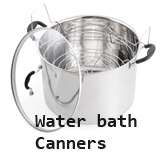
Water bath canner with a jar rack
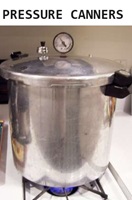
Pressure canners for gas, electric and induction stoves: Presto 23Qt or T-fal 22Qt
Canning scoop (this one is PERFECT)
Ball Blue book (most recent version)
Jars: 8oz canning jars for jams
Find Other types of farms:
Farm markets and roadside stands
Road trips and camping resources
Local Honey, apiaries, beekeepers
Consumer fraud and scams information
Home canning supplies at the best prices on the internet!
Maple Syrup Farms, sugarworks, maple syrup festivals
Environmental information and resources
Farms For Your Event for birthday parties, weddings, receptions, business meetings, retreats, etc.
Festivals - local fruit and vegetable festivals
Get the
most recent version of
the Ball Blue Book