Making and Canning Homemade Tomato Salsa from Fresh Tomatoes!
Making and Canning Homemade Tomato Salsa
from Fresh Tomatoes!
Click here for a PDF print version!
Making and canning your own salsa is something families remember years later. No store bought salsa, even if it is shipped from Texas, compares with the taste of that made from your own tomatoes from your garden or fresh-picked from a local farm! In the middle of the winter, you can have tortilla chips and your salsa and taste the summer flavor of fresh tomatoes. If you like cilantro in your salsa, see this recipe instead.
Here's how to do it, in easy steps and completely illustrated. This method is so easy, ANYONE can do this! It's a great thing to do with your kids!
Ingredients
- Tomatoes - about 15 lbs (yes, quite a few - you remove the skins, seeds and a lot of the water, so it takes a lot to start.) You will need about 3 quarts of prepared chopped tomatoes. This makes about 8 pints of salsa! If you only want to make a single jar, see this page instead!
- Salsa mix or your own seasonings. The Ball salsa mix sells for about $2.00 to $4.00 per packet. A packet will make about a 7 pint jars. See step 7 below for seasonings.
- 2 cups Lemon or lime juice (if you make your own seasoning) or
vinegar (if you use the Ball or Mrs. Wages mixes)
If you don't like the taste of lemon juice, you may find that lime juice's flavor blends better with salsa. There are other recipes online that use less lemon juice - the USDA home canning experts say those are dangerous. see this page: National Center for Home Food Preservation
Equipment
- 1 water bath canner (a huge pot to sanitize the jars after filling (about $30 to $35 - $30 at mall kitchen stores and local "big box" stores. Note: we sell canners, supplies and kits through our affiliates: click here or see the bottom of this page) Tomatoes are on the border between the high-acid fruits that can be preserved in a boiling-water bath and the low-acid fruits, vegetables and meats that need pressure canning.
- Pint (or smaller) canning jars (Ball or Kerr jars can be found at Publix, Kroger, Safeway and local "big box" stores - about $13 per dozen 8-ounce jars, more for quilted design or larger jars, including the lids and rings).
- Lids - thin, flat, round metal lids with a gum binder that seals them against the top of the jar. They may only be used once.
- Rings - metal bands that secure the lids to the jars. They may be reused many times.
- Jar grabber (to pick up the hot jars)
- Lid lifter (I like the lid rack that holds 12 lids or you can pull them out one at a time with the lid-lifter that has a magnet from the almost-boiling water where you sanitize them. ($4 at mall kitchen stores and local "big box" stores, but it's usually cheaper online from our affiliates)
- 1 large pot.
- Large spoons and ladles,
- Jar funnel ($3-Grocery stores, like Publix, Kroger and Safeway and local "big box" stores; sometimes even hardware stores)
Process - How to Make Salsa from Fresh Tomatoes
Step 1 - Selecting the tomatoes
 It's fun to go pick your own and you can obviously get better quality
tomatoes!
It's fun to go pick your own and you can obviously get better quality
tomatoes!
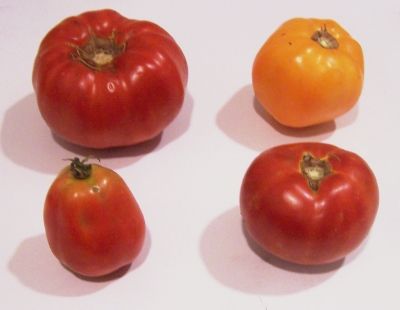
At right is a picture of tomatoes from my garden - they are so much better than anything from the grocery store. And if you don't have enough, a pick-your-own farm is the pace to go! At right are 4 common varieties that will work:
| Top left: Beefsteak | Top right: Lemon Boy, yellow |
| Bottom left: Roma, paste-type | Bottom right: Better Boy |
 The picture
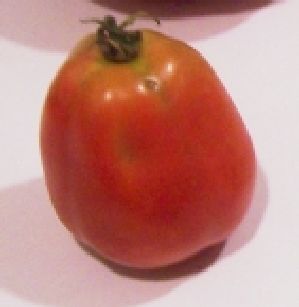
at left shows the best variety of tomato to use: Roma; also called paste
tomatoes. they have fewer sides, thicker, meatier walls, and less
water.
The picture
at left shows the best variety of tomato to use: Roma; also called paste
tomatoes. they have fewer sides, thicker, meatier walls, and less
water.
Also, you don't want mushy, bruised or rotten tomatoes!
Step 2 - Removing the tomato skins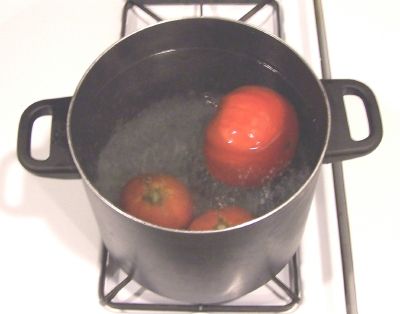
Here's a trick you may not know: put the tomatoes, a few at a time in a large pot of boiling water for no more than 1 minute (30 - 45 seconds is usually enough)
then....
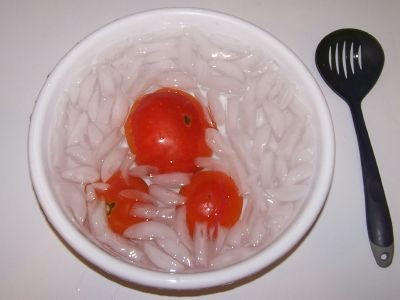
Plunge them into a waiting bowl of ice water.
This makes the skins slide right off of the tomatoes! If you leave the skins in, they become tough and chewy in the sauce, not very pleasant.
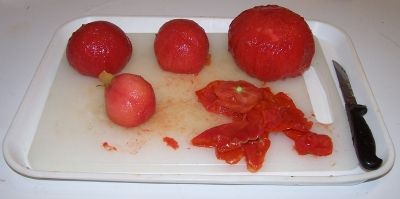 Step 3 - Removing seeds and water
After you have peeled the skins off the tomatoes, cut the tomatoes in half. Now we need to remove the seeds and excess water.
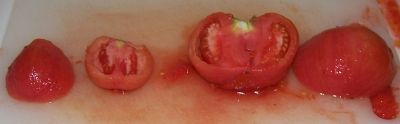 Step 4 - Squeeze of the seeds and water
Just like it sounds: wash your hands then squeeze each tomato and use
your finger or a spoon to scoop and shake out most of the seeds. You
don't need to get fanatical about it; removing just most will do. Another
way to do it is to cut each tomato in half, across it, instead of
lengthwise. Then just shake the seeds and juice out.
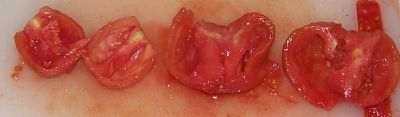
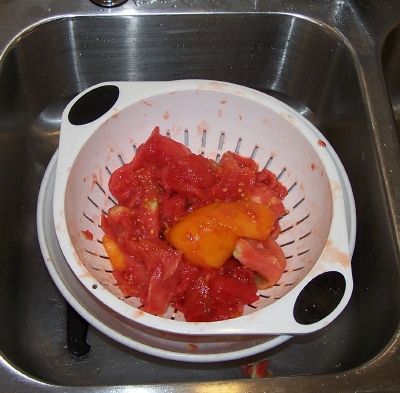 Step 5 - Drain and dice the tomatoes
Toss the squeezed (Squozen? :) tomatoes into a colander or drainer, while you work on others. This helps more of the water to drain off. You may want to save the liquid: if you then pass it through a sieve, screen or cheesecloth, you have fresh tomato juice; great to drink cold or use in cooking!
Next chop them up - I like 1/2 inch size cubes. You will need about 3 quarts of peeled, cored, chopped tomatoes
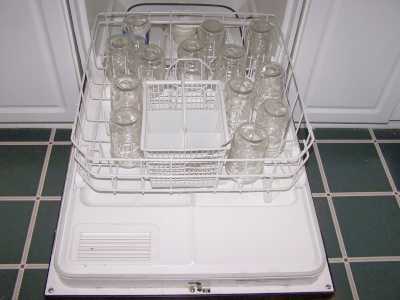 Step 6 - Get the jars and lids sanitizing
The dishwasher is fine for the jars; especially if it has a "sanitize" cycle. I get that going while I'm preparing everything else, so it's done by the time I'm ready to fill the jars.
Be sure to let it go through the rinse cycle to get rid of any soap!
Lids: Put the very hot (but not quite boiling; around 180 F,
steaming water is fine)
water for at least
several minutes. 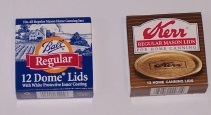
Note: everything gets sanitized in the water bath (step 7) anyway, so this just helps to ensure there is no spoilage later!)
Step 7. Pre-packaged mix or Make your own seasoning?
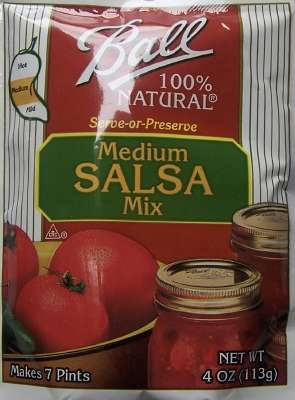 Either works equally well. The salsa mix for canning has the
advantage of being tested and easy. It's basically corn starch, onion
powder, salt and seasoning. It doesn't have any preservative to improve
the canning, so the advantage is only that it is easier. However, I
like my custom-made from fresh seasonings better, so here is the recipe
for that:
Either works equally well. The salsa mix for canning has the
advantage of being tested and easy. It's basically corn starch, onion
powder, salt and seasoning. It doesn't have any preservative to improve
the canning, so the advantage is only that it is easier. However, I
like my custom-made from fresh seasonings better, so here is the recipe
for that:
I use an electric chopper (food processor) to dice the seasonings fairly fine, about 1/8 inch cubes.
- 3 cups chopped onions
- 6 jalapeno peppers, seeded, finely chopped
-
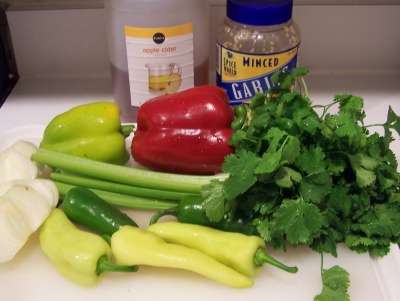 4 cloves garlic, finely chopped
 - 2 six-ounce cans tomato paste (adds body and thickens)
- 2 cups bottled lemon or lime juice or lemon juice (see this page for an explanation) (if you are using a mix, be sure to follow their recipe; the packet mixes often use vinegar instead of lemon juice). See this study comparing all 3.
- 1 tablespoon salt (optional)
- 1 tablespoon sugar (optional - you use Stevia (in a prepared form like Truvia, it measures same as sugar; if you use another form, you will need do your own conversion) - or Splenda, if you prefer, if you are on a sugar-restricted diet, or simply omit the sugar)
- 1 teaspoon black pepper
- 1 tablespoon ground cumin (optional)
- 2 tablespoons oregano leaves or chopped cilantro (optional)
Step 8 - Mix ingredients in the pot and bring the sauce to a gentle simmer
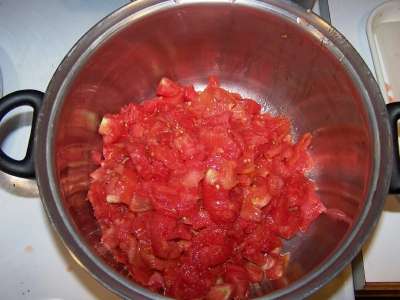 Start with the chopped tomatoes in the pot.
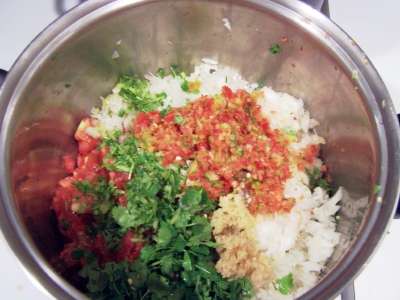 Add
the seasonings and bring to a gentle simmer, just to get it hot (180 F, if
you have a thermometer). Keeping it at 180 F for 30 minutes prior to water bath processing
kills any bacteria and
enzymes. Adjust the heat to maintain 180 F and simmer for 30 minutes, stirring occasionally.
Add
the seasonings and bring to a gentle simmer, just to get it hot (180 F, if
you have a thermometer). Keeping it at 180 F for 30 minutes prior to water bath processing
kills any bacteria and
enzymes. Adjust the heat to maintain 180 F and simmer for 30 minutes, stirring occasionally.
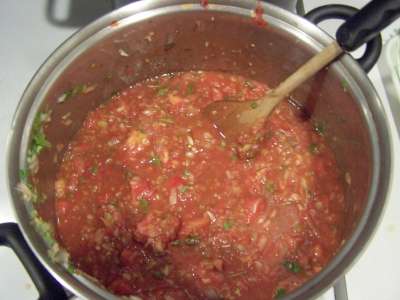 Taste it as it cooks. If you like the sauce hotter, add 1 teaspoon of
chili powder.
Taste it as it cooks. If you like the sauce hotter, add 1 teaspoon of
chili powder.
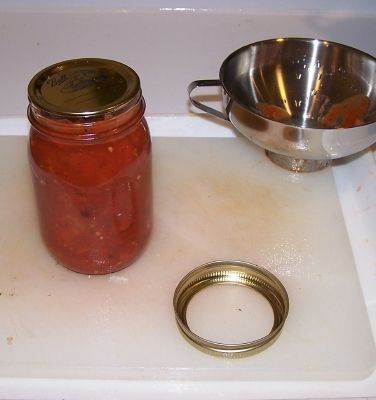 Step 9 - Fill the jars with sauces and put the lid and rings on
Fill them to within 1/4-inch of the top, seat the lid and hand-tighten the ring around them.
Be sure the contact surfaces (top of the jar and underside of the ring) are clean to get a good seal!
Step 10 - Process (boil) the jars in the canner
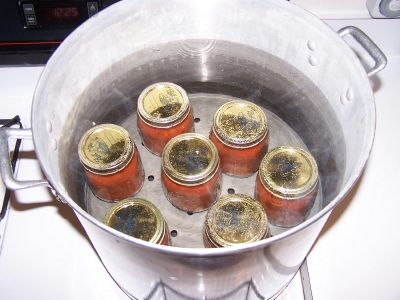 Put them in the canner and keep them covered with at least 1 to 2
inches of water. Keep the water boiling. Process the jars in a
boiling-water bath for:
Put them in the canner and keep them covered with at least 1 to 2
inches of water. Keep the water boiling. Process the jars in a
boiling-water bath for:
| Recommended process time for Tomato/Tomato Paste Salsa in a boiling-water canner. | ||||
| Process Time at Altitudes of | ||||
| Style of Pack | Jar Size | 0 - 1,000 ft | 1,001 - 6,000 ft | Above 6,000 ft |
| Hot | Pints or 8 oz jars | 15 min | 20 | 25 |
IMPORTANT:
The USDA says the only change you can safely make in this salsa recipe
is to change the amount of spices and herbs. Do not alter the
proportions of vegetables to acid and tomatoes because it might make the
salsa unsafe. Do not substitute vinegar for the lemon juice.
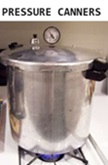
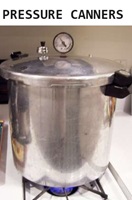
I prefer a Pressure Canner or a taller water bath canner, shown at right - To order one, see the bottom of this page or Canning supplies!
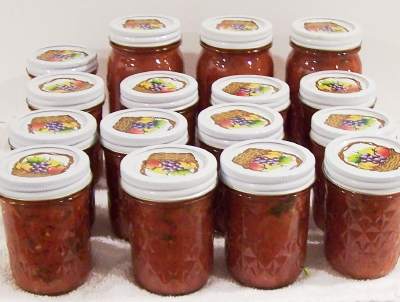 Step 9 - Done
Lift the jars out of the water and let them cool without touching or bumping them in a draft-free place (usually takes overnight) You can then remove the rings if you like, but if you leave them on, at least loosen them quite a bit, so they don't rust in place due to trapped moisture. Once the jars are cool, you can check that they are sealed verifying that the lid has been sucked down. Just press in the center, gently, with your finger. If it pops up and down (often making a popping sound), it is not sealed. If you put the jar in the refrigerator right away, you can still use it. Some people replace the lid and reprocess the jar, then that's a bit iffy. If you heat the contents back up, re-jar them (with a new lid) and the full time in the canner, it's usually ok.
Summary - Cost of Making Homemade Salsa - makes 9 pints |
||||
| Item | Quantity | Cost in 2025 | Source | Subtotal |
| Tomatoes | 15 to 20 lbs (to make about 12 cups (3 quarts) of prepared tomato) | free from the garden, or $0.50 cents at a PYO | Garden | $0.00 |
| Canning jars (pint size, wide mouth), includes lids and rings | 9 jars | $8.00/dozen | Grocery stores, like Publix, Kroger and Safeway and local "big box" stores; sometimes Big Lots and even hardware stores | $6.00 |
| seasonings | See step 7 | $2.00? | Grocery stores, like Publix, Kroger and Safeway and local "big box" stores | $2.00 |
| Salsa mix | 1 packet | $4.00 per package | Grocery stores, like Publix, Kroger and Safeway and local "big box" stores; sometimes Big Lots and even hardware stores | |
| Total | $8.00 total or about $0.95 per pint INCLUDING the jars - which you can reuse! |
|||
|
* - This assumes you already have the pots, pans, ladles,, and reusable equipment. Note that you can reuse the jars! Many products are sold in jars that will take the lids and rings for canning. For example, Classico spaghetti sauce is in quart sized jars that work with Ball and Kerr lids and rings |
||||
Answers to Common Questions
Q. Can I substitute ingredients and spices or change proportions?
Unless you have a degree in biochemistry or food science, that is risky. This page on the National Center for Home Food Preservation explains what you can safely do and what you should.
Q. What did I do wrong if my jars spoil?
Tomatoes are a borderline acid / low acid fruit (see this page about tomato acidity for more information) - adding lemon juice helps, processing according to the specified times (determined by the USDA) in the water bath canner almost eliminates spoilage. You should boost the acid level of the sauce, by adding 2 tablespoons of lemon juice or 1/2 teaspoon of citric acid per quart of sauce. (or half that, for pint jars)
Probably not. According to the USDA's National Center for Home Food Preservation:
"Salsas are usually mixtures of acid and low-acid ingredients; they are an example of an acidified food. The specific recipe, and sometimes preparation method, will determine if a salsa can be processed in a boiling water canner or a Pressure Canner. A process must be scientifically determined for each recipe. "
The USDA does accept that if you take an approved, tested recipe and make minor alterations to ingredients that does affect the preserving properties, that should be ok. But there are a lot of if's in that statement. For example, substituting 1 teaspoon of ground chili spice for 1/2 teaspoon of ground black pepper is probably fine, but substituting 1 cup of apple juice for 1 cup of lemon juice would not be. Unless you really know what you're doing, you should probably stick to the approved recipes. The preserving recipes I publish, like the one above, are all from the USDA, universities or established canning authorities. Granny probably never did lab cultures and bacteria counts to test that her recipe was safe; you were her test guinea pig, and that's not as reliable as a culture (next time you might get sick)
Here are some Salsa Guidelines from Penn State University:
- Do not substitute vinegar for lemon juice, but you can substitute lemon juice for vinegar. Lemon juice is more acidic.
- Do not reduce the amount of lemon juice or tomatoes.
- Do not add extra peppers, onions, or garlic. You can reduce the amount of peppers, onions, or garlic.
- Canned chilies may be used in place of fresh.
- You can substitute one type of pepper for another. For example, hot jalapeno peppers, bell peppers, yellow peppers, banana peppers, chili peppers and cubinal peppers may all be susbtituted 1 for 1.
- The key is not not increasing the amount of low acid ingredients in relation to the amount of high acid ingredients
Q. My question is about salsa. I was going to borrow a pressure cooker to
make salsa this year (for the first time). My grandma told me that I didn't
need the pressure cooker, I could just make salsa using the "inversion" method
like I did the blueberry jam. Can I do this?
A. Well, Grandma may be sweet, but a lot of her generation died of cancer from smoking, heart attacks from eating too much saturated fat... And food poisoning! :) Jam should get 5 minutes in the boiling water bath, too.
Tomatoes have enough acid to require only a water bath for processing; but by the time you add the other ingredients which have no acidity, you've got a food that can spoil easily. That's why most salsa recipes include a couple of cups of vinegar or lemon juice (both very acidic).
Even so, a Pressure Canner affords greater safety that a boiling water bath, and is more versatile. But if you follow my recipe and use vinegar or lemon juice as stated in the recipe, the boiling water bath will work fine.
And let Grandma make the cookies rather than the preserves! :)
Q. Do you know how long that will be good for once it is canned? All your other recipes have expiration dates - well, at date ranges. I'm trying to be careful with the labeling so I don't have problems in March like, 'Was this bottled last year or three years ago?' (I'm ashamed to say, it has happened...)
A. Yes, salsa, tends to be at peak quality for about 6 months, then ok for another 6 months. After that, the USDA says it is still safe to eat as long as the seal is intact, but it darkens and becomes mushier than most people would like! So, if you have an older jar, and there's no leakage, a good seal, and everything looks ok, open it and try!
Coments and feedback
Comments from a visitor on September 15, 2011: "I made your salsa recipe last
night and we LOVED it! I look forward to canning some for the winter! Thank you
for sharing! (I never removed tomato seeds/water when I make spaghetti sauce
until reading your site. It cut my cooking time and I can't wait to taste the
new, thicker sauce!) "

Looking for canning equipment and supplies?
Water bath canner with a jar rack
Pressure canners for gas, electric and induction stoves: Presto 23Qt or T-fal 22Qt
Canning scoop (this one is PERFECT)
Ball Blue book (most recent version)
Jars: 8oz canning jars for jams
Find Other types of farms:
Farm markets and roadside stands
Road trips and camping resources
Local Honey, apiaries, beekeepers
Consumer fraud and scams information
Home canning supplies at the best prices on the internet!
Maple Syrup Farms, sugarworks, maple syrup festivals
Environmental information and resources
Farms For Your Event for birthday parties, weddings, receptions, business meetings, retreats, etc.
Festivals - local fruit and vegetable festivals
Get the
most recent version of
the Ball Blue Book