How to Can Mushrooms at Home - Easily! With Step-by-step Directions, Photos, Ingredients, Recipe and Costs
Yield: any quantity
Making and canning your own is easy and safe. All you need is a pressure canner and canning jars,!
Ingredients
- Mushrooms - An average of 14-1/2 pounds of mushrooms are needed per canner load of 9 pints; an average of 7-1/2 pounds is needed per canner load of 9 half-pints - an average of 2 pounds per pint.
- ascorbic acid powder, or a 500-milligram tablet of vitamin C or Fruit Fresh.
- Table salt
Equipment
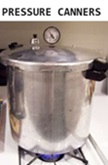
- Pressure canner
- Pint of half-pint (8 ounce) canning jars)
- Saucepan or pot
Directions - Step by Step
Canning Mushrooms - Whole or Sliced
Step 1 - Choose and wash the mushrooms.
Select only brightly colored, small to medium-size domestic mushrooms with short stems, tight veils (unopened caps), and no discoloration. Caution: Do not can wild mushrooms. Trim stems and discolored parts. Soak in cold water for 10 minutes to remove dirt. Wash in clean water.
Step 2 - Cut larger mushrooms
Leave small mushrooms whole; cut large ones.
Step 3 - Cook for 5 minutes
Cover with water in a saucepan and boil 5 minutes.
Step 4 - Fill the jars
Fill the jars with hot mushrooms, leaving 1-inch headspace.
Step 5 - Add salt and Vitamin C
Add 1/2 teaspoon of salt per pint to the jar, if desired. For better color, add 1/8 teaspoon of ascorbic acid powder, or a 500-milligram tablet of vitamin C.
Step 6 - Top with hot water to 1 inch of headspace
Add fresh hot water, if needed, being sure to leave 1-inch of headspace.
Step 7 - Seal the jars and process in the pressure canner
Adjust lids and process following the recommendations in Table 1 or Table 2 according to the type of canner and canning method you will use:
Table 1. Recommended process time for Mushrooms in a dial-gauge pressure canner. |
||||||
| Canner Pressure (PSI) at Altitudes of | ||||||
| Style of Pack | Jar Size | Process Time | 0 - 2,000 ft | 2,001 - 4,000 ft | 4,001 - 6,000 ft | 6,001 - 8,000 ft |
| Hot | Half-pints or Pints | 45 min | 11 lb | 12 lb | 13 lb | 14 lb |
Table 2. Recommended process time for Mushrooms in a weighted-gauge pressure canner. |
||||
| Canner Pressure (PSI) at Altitudes of | ||||
| Style of Pack | Jar Size | Process Time | 0 - 1,000 ft | Above 1,000 ft |
| Hot | Half-pints or Pints | 45 min | 10 lb | 15 lb |
Step 8 - Turn off the heat and let it cool down
When the processing time from the chart above is up, turn off the heat, and allow the pressure canner to cool and the pressure to drop to zero before opening the canner. Let the jars cool without being jostled. After the pressure drops to zero (usually, you can tell but the "click" sound of the safety release vents opening, as well as but the gauge. Let the pressure in the canner drop to zero by itself. This may take 45 minutes in a 16-quart canner filled with jars and almost an hour in a 22-quart canner. If the vent is opened before the pressure drops to zero OR if the cooling is rushed by running cold water over the canner, liquid will be lost from the jars. Too rapid cooling causes loss of liquid in the jars!
Step 9 - Remove the jars
Lift the jars out of the water and let them cool on a wooden cutting
board or a towel, without touching or
bumping them in a draft-free place (usually takes overnight), here they
won't be bumped. You can then remove the rings if you like, but if you leave them on, at least loosen them quite a bit, so they don't rust in place due to trapped moisture. Once the jars are cool, you can check that they are sealed verifying that the lid has been sucked down. Just press in the center, gently, with your finger. If it pops up and down (often making a popping sound), it is not sealed. If you put the jar in the refrigerator right away, you can still use it. Some people replace the lid and reprocess the jar, then that's a bit iffy. If you heat the contents back up, re-jar them (with a new lid) and the full time in the canner, it's usually ok. You're done!
This document was adapted from the "Complete Guide to Home Canning,"
Agriculture Information Bulletin No. 539, USDA, revised 2006.
Reviewed May 2009.
Illustrated Canning, Freezing, Jam Instructions and Recipes
[ Easy Home Canning Directions] [FAQs - Answers to common questions and problems] [Recommended books about home canning, jam making, drying and preserving!] [Free canning publications to download and print]

Looking for canning equipment and supplies?
Water bath canner with a jar rack
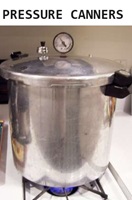
Pressure canners for gas, electric and induction stoves: Presto 23Qt or T-fal 22Qt
Canning scoop (this one is PERFECT)
Ball Blue book (most recent version)
Jars: 8oz canning jars for jams
Find Other types of farms:
Farm markets and roadside stands
Road trips and camping resources
Local Honey, apiaries, beekeepers
Consumer fraud and scams information
Home canning supplies at the best prices on the internet!
Maple Syrup Farms, sugarworks, maple syrup festivals
Environmental information and resources
Farms For Your Event for birthday parties, weddings, receptions, business meetings, retreats, etc.
Festivals - local fruit and vegetable festivals
Get the
most recent version of
the Ball Blue Book