
Canning Methods That Are Unsafe and Not Recommended: Inversion Canning, Steam Canners, Microwave Canning, Oven Canning and Others
Canners and home canning methods that are unsafe and NOT recommended for home use
People occasionally ask, "why use a water bath method or a pressure canner?" adding:
- "my grandmother just filled the jars with hot fruit, vegetables or jam then just sealed and inverted the jars"; or
- "I have a steam canner that my grandmother used and she never got ill!" or
- My family just uses a water bath canner,to can vegetables like beans and corn. What's wrong with that?" or
- "We use the oven to heat the filled jars, it gets plenty hot and the jars seal" or
- "Why can't I just use the microwave to blanch or heat the food then quickly seal the jars?" or even
- I've used the dishwasher to process the filled jars and that's always worked fine for me!"
As preposterous as the "dishwasher method" may seem, all of these methods are unsafe. And it may be true, that no one in their family has died (yet) from their canned food, just as there are occasionally smokers who live to 100 or children who play in the street and don't get hit by a car, it's hardly something a rational person does (yes, for the record, I AM saying that smokers are behaving irrationally or are in addicted denial) . Botulism food poisoning is nothing to mess with! See this page for detailed information about botulism food poisoning.
But no rational person would recommend these either.. (note: don't take MY word for it - click here to see this list of references from major universities and US government, all saying the same.)
Now, for those of you non-smokers who are still reading (the smokers are now busy writing me hate mail, or by now need a nicotine break, so they've gone outside); here are detailed explanations and references from authoritative sources:
- Open Kettle Canning (aka, inversion canning)
The open-kettle method means placing hot food in jars and sealing with no
further heat treatment. This is the method that many grandma's used in which
granny fills a jar (sanitized or not) with hot fruit, pickles, etc., puts
the lid and ring on, then turns it upside down. The jar will cool and seal,
BUT it is NOT sterile, as the contents were exposed to the air (and airborne
bacteria) just before sealing. From the moment the jars were filled, the
contents started cooling, so airborne bacteria contacting the cooling
surfaces will still be viable. They were not exposed to a heat high enough,
nor long enough to destroy them. Then granny gives the jars away, playing
Russian Roulette. Maybe you will get sick, maybe not. Again, this method is
NOT recommended for home canning because the amount of heat applied may not
be sufficient to destroy bacteria and the product may spoil quickly or cause
illness when consumed.
The USDA and many, many universities have warnings against the use of this method (see the bottom of this page for references). Here's a typical statement, from the University of Georgia:
"An old out-dated method of canning - the open-kettle method - is now considered unsafe. In this method, foods were heated in a kettle, then poured into jars, and a lid was placed on the jar. No processing was done. With this method there was often spoilage, because bacteria, yeasts, and molds that contaminated the food when the jars were filled were not killed by further processing. The growth of these microorganisms, in addition to spoiling the food, often caused lids that did seal to later come unsealed. This method resulted in a very real danger of botulism."
- Steam Canners The atmospheric steam canner (ASC) was designed as a means to
process foods using steam without the aid of pressure. The manufacturer
claims this process uses less water, saves time and energy, and recommends
identical processing times as those required for boiling-water bath treatments.
Recent studies say (see University of Montana Extension ): "Atmospheric steam canning (ASC) is a research-tested method for effectively and safely preserving high acid foods (Willmore, Etzel, Andress, & Ingham, 2015). ASC can only be used in canning acidic foods. High-acid foods (pH 4.6 or lower) include most fruits, jams/jellies, pickled products and some properly acidified tomato products. Low-acid foods are not safe to can in the ASC. "
This modifies older guidance from to the National Home Food Preservation Center (USDA / U.Ga.):
"Steam canning is not recommended at this time for either acid or low acid foods. Processing times for use with current models have not been adequately researched. Today's steam canner looks like an upside-down boiling water canner. The base is a shallow pan with a rack that is covered with a high dome lid. After the jars of foods are placed on the canner's base, a small amount of water in the base is brought to a boil and the dome fills with steam. The jars and foods in them are heated by the steam surrounding them. However, steam canners do not heat foods in jars exactly the same as boiling water canning does. Low acid foods are potentially deadly because Clostridium botulinum bacteria could survive the steam canning and produce the poison that causes botulism. Acid foods may also be underprocessed and therefore could spoil."
Some studies have concluded that:
- Atmospheric steam canners result in significantly lower product temperatures at the beginning and end of the scheduled process when compared to water-bath canning.
- Use of steam canners as instructed by the manufacturer would result in under processing and considerable economic spoilage.
- Because steam canners may not heat foods in the same manner as boiling water canners, using boiling-water process times with steam canners may result in spoilage. There is no tested nor approved conversion factor.
- Micro-Dome Food Preserver - Micro-Dome Food Preserver Recalled Washington, DC--The U.S. Consumer Product Safety Commission (CPSC) in cooperation with Micro-Dome of San Ramon, CA, has warned consumers of certain safety hazards associated with the use of the "Micro-Dome Food Preserver" manufactured by Micro-Dome and sold and distributed to consumers after August 1987. The CPSC has also urged consumers to destroy all food that has been preserved using a Micro-Dome Food Preserver
- Solar Canning The heat generated from captured sunlight is not a reliable method to process acid foods and should never be used to can low-acid foods.
- Oven Canning Oven-canning is extremely hazardous.
The oven canning method involves placing jars in an oven and heating. In
oven canning, product temperatures never exceed the boiling point, and
uniform heat penetration cannot be assured. It is, therefore, not considered
safe to use for home canning.
Because this process fails to destroy the many bacteria, including the
spores of Clostridium botulinum, it can cause the food to become toxic
during storage. Also, canning jars are not designed for intense dry heat and
may explode resulting in serious cuts or burns. Of "oven canning",
the USDA says:
"This also is not 'canning'. There is not sufficient, research-based documentation to support that 'canning' any food in a dry oven as described on this web page or any page that proposes oven canning is even sufficient heating to destroy bacteria of concern, let alone enough to produce a proper seal with today's home canning lids. " - Microwave Processing Microwave oven cannot be used for home canning. Microwaved food reaches 212 F but heating is not uniform. There is also a danger of explosion of the jars within the microwave oven or as food is being removed from the oven.
- Dishwashing Processing Processing canned foods in a dishwater cycle is dangerous. The temperature of the water during the cleaning and rinsing cycle is far below that required to kill harmful microorganisms. Thus the product will be underprocessed and unsafe to eat. Note that it is fine to use the dishwasher to clean and sanitize the empty jars, especially if your dishwasher has a "sanitize" setting - the empty jars will get hot enough.
- Aspirin / Salicylic acid - So-called canning powders are useless as preservatives and do not replace the need for proper heat processing. You may have heard of someone's grandmother canning corn by boiling the corn, adding aspirin or salicylic acid from the drugstore, then sealing the corn in jars with no further processing. According to the University of Illinois, a recipe circulated several years ago, using aspirin to acidify tomatoes and beans for canning. Aspirin is not recommended for canning. While it contains salicylic acid, it does not sufficiently acidify low acid foods like tomatoes or beans for safe hot water bath canning. Low acid foods (without added acids) should only be processed safely in a Pressure Canner. Lemon juice or vinegar is recommended to acidify tomato products for safe water bath processing. You can also see an article in JAMA (the Journal of the American Medical Association, Vol. 289 No. 13, April 2, 2003, titled "Is salicylic acid as a food preservative harmful?"; from which the abstract states: "salicylic acid, in the ways in which it is used in the preparation of food products, is not only not harmful, but is a preservative to health, inasmuch as the process of decomposition which it prevents would be far more dangerous."
- Using Paraffin or other wax to seal jars, like jams, preserves and
jellies: This is an outdated
method from 50 years or more ago, that is considered unsafe. The lid and
ring method with a boiling water bath (usually on 5 minutes for jams and
jellies) is much safer. The USDA says:
Because of possible mold contamination, paraffin or wax seals are no longer recommended for. any sweet spread, including jellies.The University of Minnesota's Extension says:
Note. Jelly jars and paraffin are no longer recommended. An incomplete seal with paraffin and the absence of a heat treatment may result in mold growth and toxin production in the jelly. Persons continuing to use the paraffin / no water bath method should be aware of the potential health risk.
See this page for why you should use a canner and how to choose one.
Equipment Not Recommended
In addition to the methods above being considered unsafe, some, particular outdated equipment has also been found to be unsafe:
- Jars with wire bails and glass caps make attractive antiques or storage containers for dry food ingredients but are not recommended for use in canning.
- One-piece zinc porcelain-lined caps are also no longer recommended. Both glass and zinc caps use flat rubber rings for sealing jars, but too often fail to seal properly.
- Pressure saucepans (which are much smaller than a Pressure Canner), because of poor temperature control and risk of inadequate heat processing, are not recommended.
- Devices for canning food in microwave ovens are not recommended because of incomplete destruction of bacteria due to non-uniform heating.
Reference: University of Minnesota
Temperatures and Food Safety
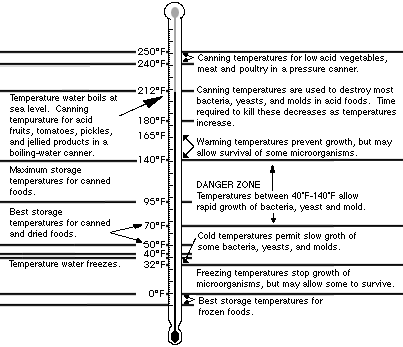
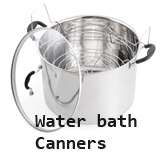
See this page for water bath canners and see below for prices, descriptions and ordering options for pressure canners. For water bath canners and other supplies, see this page! If you have a glass top radiant stove, see Canners for glass top stovers?
References for Unsafe Canning Methods
This is just a small sampling of the many authorities who concur that the only safe home canning methods are the water bath canner (for jams and acidic fruits and vegetables) and the pressure canner (for low acid fruits and vegetables, meats, and dairy). Click on the links to see their articles.
- University of Illinois
- Montana State University
- NC State University
- North Dakota State University
- Penn State University and this page and this page.
- University of Tennessee
- Utah State University
- University of Wisconsin and this page
- United States government: USDA, FDA FoodSafety website
- Iowa State University - Answer Line
- University of Tennessee Agricultural Extension Service - Methods of Canning (PDF)
For other supplies:
- Books on canning, freezing, drying, preserving and jam making
- Strainers, pit removers, seed-skin-stem removers, jelly strainers, etc. All types, makes and prices (from $19 to $350)
- Vacuum Foodsealers for freezing, dried foods, and refrigerated foods - the FoodSaver line
- Canning Lids and Rings,
- Canning jars,
- Canning mixes, pectin, etc.
- And just for fun, the history of the canning jar
You can also find free information from the USDA in this PDF file (it will take a while to load!) about selecting and using canners here!
For more information, and NO obligation to buy, just click on the links in the boxes on the left!
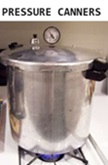
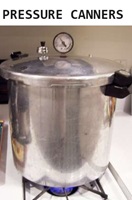
Pressure canners!If you want to can low-acid foods such as red meats, sea food, poultry, milk, and all fresh vegetables with the exception of most tomatoes, you will need a Pressure Canner. These foods fit into the low acid group since they have an acidity, or pH level, of 4.6 or greater. The temperature which must be reached and maintained (for a specified amount of time) to kill the bacteria is 240 F. Pressure canning is the only canning method recommended safe by the U.S.D.A. for low-acid foods such as vegetables, meats, and fish. Ordinary water bath canners can only reach 212 F and cannot to kill the types of bacteria that will grow in low acid foods. This temperature can be reached only by creating steam under pressure as achieved in quality pressure canners. There are several manufacturers of pressure canners. The two leading ones are Presto and All American (Wisconsin Aluminum). They are more expensive than water bath canners, but extremely well built - I bought mine in 1988 and it still looks and works like new! |
|
|
Presto 01781 23-Quart Pressure Cooker/CannerThis is one of the least expensive but reliable pressure canners available. I've been using mine for 30 years! There is also a 16 quart version for even less. . Click on the links at left or above for more info and current pricing. Click on the box at left for more information. See the seller's website for features, pricing and user reviews!
|

Looking for canning equipment and supplies?
Water bath canner with a jar rack
Pressure canners for gas, electric and induction stoves: Presto 23Qt or T-fal 22Qt
Canning scoop (this one is PERFECT)
Ball Blue book (most recent version)
Jars: 8oz canning jars for jams
Find Other types of farms:
Farm markets and roadside stands
Road trips and camping resources
Local Honey, apiaries, beekeepers
Consumer fraud and scams information
Home canning supplies at the best prices on the internet!
Maple Syrup Farms, sugarworks, maple syrup festivals
Environmental information and resources
Farms For Your Event for birthday parties, weddings, receptions, business meetings, retreats, etc.
Festivals - local fruit and vegetable festivals
Get the
most recent version of
the Ball Blue Book
