Looking for Canning on Glass Stoves and Ceramic-Top Stoves and Choosing a Canner for Them in 2025? Scroll down this page and follow the links.
And if you bring home some fruit or vegetables and want to can, freeze, make
jam, salsa or pickles, see this
page for simple, reliable, illustrated canning, freezing or preserving
directions. There are plenty of other related resources, click on the resources dropdown above. If you are having a hard time
finding
canning lids, I've used these, and they're a great price &
ship in 2 days.
If you have questions or feedback, please let me know! There
are affiliate links on this page. Read our disclosure policy to learn more.
Canning on Glass Stoves and Ceramic-Top Stoves and Choosing a Canner for Them
Looking for a canner that can be used on your glass or ceramic
stovetop or cooker? Read below to find out why you can't find one, and
what the alternatives are! Scroll down this page for more information,
and with NO obligation to buy, just click on the links in the boxes on
the left!
Canning on Glass Stovetops and Canners for Glass and
Ceramic Stoves
- updated for 2025
If you have a glass or ceramic stovetop, you may have heard that you
should use a flat-bottomed canner, but you have been unable to find one! Or,
you may have heard that you are not supposed to can on a glass or ceramic
stove top. Here's what I've found out from the manufacturers:
One of my suppliers asked a stove manufacturer as to why they were unable to
find one. The stove manufacturer told they that on a glass/ceramic stove
there is a sensor so that the heat (in the glass) cannot go above a certain
point thus breaking the top.
This sensor does not allow the burner to maintain an even temperature
high enough for certain canners (those without flat bottoms, or otherwise
not recommended by the manufacturer of the stove) to work safely. By
fluctuating the temperature the bacteria is not eliminated in the canning
process. Unfortunately this is not something the salesmen will tell the
customer when they are buying the stove and probably many of them are
unaware of this.
A flat-bottomed canner alone would not solve this problem
for all stovetops. If yours has the sensor, the heat will still
fluctuate and it won't get hot enough to get the big canner full of water to
a full boil. If can can confirm with your stove's maker or the store where
you bought it that a flat-bottomed canner is okay, there here's a great one,
made of stainless steel, so it should last a lifetime - it would also make a
great pot to cook applesauce.
Specific issues and tips:
- The pot must not be more than 1 inch wider that the heating
element. Another problem is that canners that exceed the burner
diameter by more than 1 inch can trap and reflect heat to surfaces of
the stove that are not intended to get that hot, and thus crack the
stove top. The damage can range from discoloration of white tops to
actual burner damage to cracking of the glass tops to fusion of the
metal to the glass top. FYI, the typical canner has a bottom diameter
of 12 inches.
- Avoid dragging. Scratching of the stove surface can
occur if the canner is slid or pulled across the cooktop. This often
happens with large, heavy filled canners, so people need to be careful.
- Auto-shutoffs prevent sufficient heating with
non-flat-bottomed pots and canners . As mentioned above, many
of these cooktops have automatic cut-offs on their burners when heat in
the glass gets excessive. If that option is built in, and the burner
under a canner shuts off during the process time, then the product will
be underprocessed and cannot be salvaged as a canned food. This is more
of a problem with pots that do not have flat bottoms. The process time
must be continuous at the intended temperature, or microorganisms may
survive. Also, if the pressure drops quickly, most likely liquid and
maybe even food will be lost from the jar (it will spill over from the
area of higher pressure inside the jar to the lower pressure now in the
canner around the jar).
- Use flat-bottomed canners. Even if boiling water
canning is approved by the manufacturer, it may be necessary to fashion
your own canner out of a very large flat-bottomed (smooth) stockpot with
a bottom rack inserted. Many canners do not have flat enough bottoms to
work well on a smooth cooktop to be able to maintain a full boil over
the tops of the jars. The pot used as a canner must also be large enough
to have lots of water boiling freely around the jars, and at least 1
inch over the tops of jars. If the canner is too small, then it starts
boiling faster than expected and the total required heat the jars
receive in the canner even before the process time begins can be too
short.
- Check your stoves manual and directions - Each
manufacturer has different conditions for canning. It may be possible
on your stove, or it may void the warranty. See the guidance specific to certain stoves!
- Guidance from Presto: Although Presto believes that current Presto pressure canners are acceptable for use on glass top stoves we recommend
that you check with the owner's manual for your range or the manufacturer before using. Please be mindful of the following tips for successful use of
the canner on your glass top range:
• Use the largest element, making sure that the surface of the canner bottom contacting the element does not
extend more than one inch outside the element.
• Do not place the canner on two heated elements at the same time.
• Make sure that the canner does
not boil dry.
• Do not use the canner on the elements for several hours at a time.
• To prevent scratches to the glass top make sure that the
bottom of the canner does not have scratches or areas that are rough, and do not slide or rotate the canner on the smooth top range.
• Clean the
cooking surface with a ceramic cook top cleaner prior to and after using the canner.
In summary, some smooth cooktop manufacturers
say do not can on them, while others who say it is okay add stipulations on
the diameter of the canner compared to the diameter of the burner. Boiling
water or pressure canners may not be available that meet the maximum
diameter pot they allow. All agree that the canners must be flat bottomed.
If you have a ceramic or glass stovetop and still have the
manual, look it up there. If you will write me with the make, model
and and specific warnings in the manual about canning, I'll add that to the
bottom of this page, as a resource.
This smooth-bottomed canner (below) is recommended for many glass and
ceramic stovetops (click on the box to see the reviews online).
NOTE: See this page if you are looking for
Canners That Work on Induction Stoves
What to do?
Now, having said all this, not ALL glass and ceramic stoves are identical
in every respect, so it is always possible that yours is designed
differently or behaves differently from the description above. But there are
enough stories of cracked stovetops to suggest that regardless, an
alternative might be prudent, unless you're sure it is compatible with your
stove!
So, what can you do? Here is a simple solution: buy a simple and
inexpensive propane campstove, an electric burner (shown below) or use an
outdoor propane burner and you can use ANY canner with it. Plus, the
propane burners may come in handy when you have a lot of cooking to do,
during a power outage or when you need and extra burner! One big
advantage to using a gas stove outside, is: there's no mess to clean up!
I also just received this tip from a visitor: she puts a wire rack (like
a cookie rack) on the stove and sets her canner on that. That prevent
glass stovetop form heating up too much that it shuts itself off.
See this page
for more information.
Standalone electric canner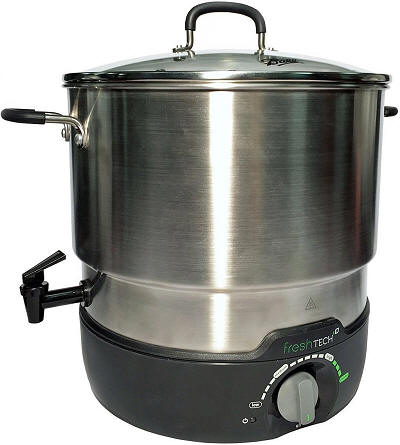
Ball now sells an electric canner that does not require a stove.
Ball FreshTech Electric Water Bath Canner, Silver
Sold online on the big store you all know.
21 Quart Pot Holds 8 Pints or 7 Quarts Detachable Base with
Nesting Design for Ease of Cleaning and Storage Efficiency
Electric burners
How to choose an electric burner? I look for a robust design and the
highest wattage I can find. A single 1000 watt burner doesn't do it. A
canner holds around 16 quarts of water, so it takes a lot of heat to get
that boiling. I've found that one 1300 watt burner will get the
average canner boiling,
but it takes a while. So... to speed it
up, I got a second burner, put it on the counter, right next to the first
and put the canner on top, straddling both burns - and THAT worked like a
charm!
Gas camp stoves
Gas grills, turkey fryers, large camping stoves all make excellent
outdoor alternatives. Of course there are two keys: make sure it has
enough oomph (measured in BTU's) and that it is stable and won't tip over.
I've found any turkey fryer, most gas grills and the camping stoves below
work fine. Of course, most of those must be use outside. On rainy days I use
the camping stove indoors (after taking precautions to open some windows,
locate it on a flameproof surface (granite counter top, away from anything
flammable, where children can't reach it, never leave it unattended, etc.)
The Cam Stoves, like the Camp Chef Explorer 2 (see photo at right and box below) and similar propane camp stoves are perfect for canning. They produce plenty of heat,
are
waist high, have two burners so you can run two canners or 1 Water Bath Canner and cook
on the other! I have one and use it for all my canning. It leaves my stove
in the kitchen free for cooking, so I can do twice as much canning in half
the time with two canners going. It produces SO much heat, that it can
easily keep two canners at a full boil in any weather. And here's how you
sell it to your hubby: The legs are removable, so you can easily put it in
the trunk of your car and use it for camping and tailgate parties before the
football game, or use it as a tabletop stove! And it is perfect for cooking
when there is a power outage! I've been using mine for 3 years now.
 I've seen the 3 burner version is being sold in April - June in Costco.
See below for some camping stoves I've tried and used for canning.
Recommendations:
Here's a summary of what definitely works, in my order of preference:
- The outdoor gas stoves - great in nice weather, or in bad
weather, in an open,
but roofed area, like screen porch, open garage, etc.! Examples: Bayou Classic Single Gas Burner
(click here or scroll down the page)
Or the Camp Chef Explorer (click here
or see above or click the photo at right) which has legs, so there is no bending over.
- The Coleman camping stove (Coleman 2 Burner Propane Grill /Stove,
click here)
is perfect for supervised indoor use! It can heat a canner in no time, and folds up neatly for
storage. The canner fits easily on the grill portion. This is, in my
opinion, the BEST solution. And, of course you can use it for camping
and tailgating parties! Scoll down the page to see it.
- A gas camping burner or countertop propane stoves
(click here) with a low,
stable profile can be a great spare high-power burner. But if you do a
lot of canning, the outdoor cooker (see #1 above) would be cheaper to operate, unless
you use the converter to hook up tp a 20 lb tank..
- One double burner unit. Click here to see one. Lots of power, but it can be tricky
to get some canners (the tall narrow ones) to balance and be stable on
them) See examples further down the page.
- Two 1300 watt burners - if you want to stay indoors - two of
these, side by side will work! Click here to see some!
- Two 1000 watt or greater burners, side by side - since you
can move them around it is both a plus and a negative - you can position
them to be stable, but perhaps not a close together as the double unit.
And you can find a wide variety of
water bath canners and other
canning supplies on this page
Comments from a visitor on July 16,
2011:
"My solution to canning on a ceramic stove top: I have a clad cuisinart
stock pot that heats well on the stove. I purchased a sheet of metal with a
design in it (so there are holes), cut it with tin snips to fit the pot,
lined the bottom of the stock put with canning rings (to give elevation) and
then placed the metal on the rings. This made a nice canning rack to use in
a pot I knew would boil on the range top. The only problem is I can only can
1/2 pints because the pot isn't not tall enough. I know you have to cover
jars with 1" of water, but to do you have to keep the lid on the "canner"
while processing
Canning stove alternatives
To find out more about a stove (with no obligation to buy), just click on
any of the links in the sellers picture boxes below:
| |
|
|
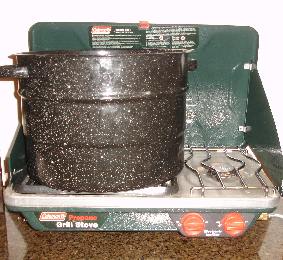
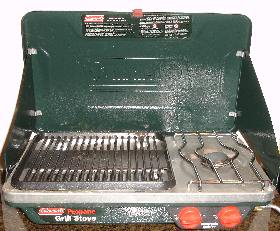 Coleman camp stove
Find this burner on Amazon here. |
This works very well You will need 2 or 3 of the small green
cylinders for a day's canning (see left).
Blake: I have an earlier version of this, and as you can see from the
photos at left. All versions easily accommodates a large water bath
canner OR a Pressure Canner. I use it for canning, camping, and when the
power goes out! Each model puts out 10,000 btu per burner (20,000,
total per stove). I recommend the versions withOUT the griddle, as you will
be sure the burners are the same height! |
|
Find this burner on Amazon here
|
Mr.Heater 12-Foot Hose and LP Regulator
Make Portable Propane Equipment Easier to Use
This extension hose with regulator makes it easy to connect your portable
propane stove to a 20 lb propane tank (the same one your outdoor gas grill
uses. This makes it MUCH cheaper to use your camping stove as an
auxiliary stove to speed your canning!
|
|
Find this burner on Amazon heren
|
STANSPORT 5 Foot Propane Hose and
Regulator Assembly
This allows you to connect a 20 lb propane tank to the portable propane
stoves so you can keep the canner going wiithout interruption.
|
|
Find this item (B071ZM8YVC) on Amazon
|
Click here to see it on Amazon
Perfect for canning! It's ideal! It has IMMENSE power, up to 200,000 BTU. And of course, you can use it
for a crawfish boil, a turkey fryer and, if you get a 55 gallon drum,
cooking your mother-in-law*
(* - the last option void where prohibited by law)
- This one has an additional use: I put a standard Weber charcoal
smoker on top of it (omitting the smoker's base) and use it as a
gas-fired smoker - makes smoking and BBQ EASY! And of course, you
can put a large pot on it and use it as a canner, turkey fryer,
outdoor stew pot, crawfish boil, etc.
- Hooks up to any standard propane tank.
|
|
Find this burner on Amazon here
|
Waring Pro Burner
I still think you'd want two of these, side by side, under the
canner. One alone would not produce enough heat to get and keep a canner
boiling hard.
|
|
Find this burner on Amazon here
|
'Alpha' 13" Propane Stove Cook Top - 30,000 BTU - Electric Start
I'm going to get one of these to try - it looks perfect for those long
canning days or when you have a lot of cooking to do and not enough burners
on your stove.
|
Find this burner on Amazon here
Find this burner on Amazon here
|
Portable Propane Gas Stove 1 Single
Burner Range BBQ
Both of these get great reviews and have plenty of oomph, over 15,000 BTU
|
|
Find this burner on Amazon here
|
Portable Propane Gas Stove 2 Double
Burner Range BBQ
It's a Double Head Burner, propane gas stove
|
|
Find this burner on Amazon here
|
I haven't tried this one, but it looks like the
single unit above, 1800 W plus a smaller 500 watt burner close by it. They look
closer together than the Rival double unit below.
|
|
Find this burner on Amazon here
|
Cuisinart CB-60 Cast-Iron Double Burner, Stainless Steel
It has 2 burners.
|
|
Find this burner on Amazon here |
Secura 9100MC 1800W Portable Induction Cooktop Countertop Burner,
Black
Perfect for Duxtop and other induction cookware |
|
Find this burner on AMazon heren |
Proctor-Silex Fifth Burner
|
|
Find this burner on AMazon heren |
Professional Single Burner Range
1500 Watts for loads of power
|
Books
|
|
Canning & Preserving For Dummies in Paperback
|
Canning books
Canning & Preserving for Dummies by Karen Ward
Get Canning
and Preserving For Dummies
|
|
The Ball Blue Book of Home Canning
|
The All New Ball Book Of Canning And Preserving: Over 350 of the Best Canned, Jammed, Pickled, and Preserved Recipes Paperback
This is THE book on canning! My grandmother used this book when I
was a child. It tells you in simple instructions how to can almost
anything; complete with recipes for jam, jellies, pickles, sauces, canning
vegetables, meats, etc. If it can be canned, this book likely tells
you how! Click on the link below for more information and / or to buy (no
obligation to buy) Click here for more information about the Ball Blue Book of Preserving
|
These are submitted by visitors, so I can't independently verify them, but I
have no reason to doubt them. Here they are:
- Amana: A visitor tells me that her Amana manual says "Canning is
NOT recommended with any of the Amana smoothtop ranges or cooktops due to
the intense heat and large cookware required to can. The heat generated by
the canning cookware overheats the elements and the smoothtop of the range.
This can cause the smoothtop to crack, cause failure of the heating
elements, and can cause damage to the backguard. Damage incurred by canning
or attempting to can, using the smoothtop cooktop is not covered under the
warranty."
- Electrolux - A visitor sent this email that he received
from Electrolux:
"Thank you for contacting Electrolux Major Appliances
with your question. The safety switch circuit can easily handle more than
the 240 degrees that the water will achieve. Just think about when you deep
fry on your range top. The oil temperature reaches 350 or above most of the
time. The safety switch will engage sooner if there is air space between the
glass and cooking pot because the heat being generated by the element itself
will not be transferred into the utensil and food. This is why you want
cooking pans and utensils that are absolutely flat and smooth on the bottom
, so they can transfer the heat into the food instead of overheating the
glass."
The rep is correct. I have used pots to heat oil for deep frying
on my smooth top range at temperatures of 350 to 370 degrees. I hope this
puts to bed the concern about reflected heat tripping the safety sensor and
producing questionable canning results.
- Frigidaire - "I emailed you about my Frigidaire glass
top stove. I got a response from the company so thought it might help others
out.
A smooth top range can be used for canning food. Here are some
tips to help you obtain the best results when canning on a glass cooktop:
*Always use flat surface bottomed cookware - medium (gauge) weight is
best.
*Always start with hot water and a lid on top of the pan. It will take
less time for the water to come to a boil. The larger and heavier the pan
is, the longer it will take your water to come to a boil.
*Use the
largest surface element possible.
*Make sure the diameter of your pan
does not extend over an inch of the surface element.
*The maximum weight
of the canner and it's contents should not exceed 50 pounds. It is
recommended not to use your surface elements continually all day for
canning. There is a built-in limiter which allows the element to cycle on
and off to keep the glass from getting too hot and causing damage to the
cooktop. There are smooth tops on the market today with a variety of element
dimensions such as 9 to 12 inches. Also, higher wattage elements are being
used for faster boil times. Please let us know if you need any further
information or assistance. Thank you for choosing Frigidaire products for
your home. Doug Couts Electrolux Technical Assistance "
- GE flat top range Model JS998B0H1BB - (the ending BB is
for black exterior, SS is for stainless steel exterior, W for white, etc)
Serial DG284018Q.
The manual says the same thing as the Kenmore model on
your web page. You can use large flat bottom canners on it because the
boiling water temp will not harm the surrounding cooktop surface. Do not use
a large diameter pot (overhangs the burner surface by more than an inch) to
boil anything but water though!!!"
- GE Models JBP60, 65, 75, 76, 77, & 78 - Comments from a visitor on April 07, 2010: "(Glass-top) Can on cooktop only. Pots that extend
boyond 1" of the surface unit circle are not recommended for most surface
cooking, However, when canning with water-bath or pressure canner,
larger-diameter pots may be used. This is because boiling water temperatures
(even under pressure) are not harmful to the cooktop surfaces surrounding
the surface units. There is a caution to not use these larger pans for
frying of boiling anything other than water. They also note that
flat-bottomed canners must be used. Thank you for your site!! I was going to
buy myself a flat-bottom canner to use on my glass-top stove but may rethink
that and go for the propane camp stove instead. I like the idea of being
able to set up on the brick patio where there is shade rather than my
kitchen which tends to bake in the summer sun."
- GE PP945BM3BB: "My cooktop is GE PP945BM3BB purchased Nov.
2012.The manual says this about canning: Observe the Following Points in
Canning When canning with water-bath or pressure canner, larger-diameter
pots may be used. This is because boiling water temperatures(even under
pressure) are not harmful to the cooktop surfaces surrounding the surface
elements. HOWEVER, DO NOT USE LARGE-DIAMETER CANNERS OR OTHER LARGE-DIAMETER
POTS FOR FRYING OR BOILING FOODS OTHER THAN WATER. Most syrup or sauce
mixtures--and all types of fruit--cook at temperatures much higher than
boiling water. Such temperatures could eventually harm the glass cooktop
surfaces.
1. Be sure the canner fits over the center of the surface
element. If your cooktop or its location does not allow the canner to be
centered on the surface element, use smaller-diameter pots for good canning
results.
2. Flat-bottomed canners must be used. Do not use canners with
flanged or rippled bottoms(often fount in enamelware) because they don't
make enough contact with the surface elements and take a long time to boil
water.
3. When canning, use recipes and procedures from reputable
sources. Reliable recipes and procedures are available from the manufacturer
of your canner; manufacturers of glass jars for canning, such as Ball and
Kerr brand; and the United States Department of Agriculture Extension
Service.
4. Remember that canning is a process that generates large
amounts of steam. To avoid burns from steam or heat, be careful when
canning.
Note: If your house has low voltage, canning may take longer
than expected, even though directions have been carefully followed. The
process time will be shortened by: 1) using a Pressure Canner, and 2)
starting with HOT tap water for fastest heating of large quantities of
water. CAUTION: Safe canning requires that harmful microorganisms are
destroyed and that the jars are sealed completely.
*When canning foods
in a water-bath canner, a gentle but steady boil must be maintained for the
required time. When canning foods in a Pressure Canner, the pressure must be
maintained for the required time.
*After you have adjusted the controls,
it is very important to make sure the prescribed boil or pressure levels are
maintained for the required time.
*Since you must make sure to process
the canning jars for the prescribed time, with no interruption in processing
time, do not can on any cooktop surface element if your canner is not flat.
"
- GE range, model # JBP64BH2WH - Comments from a visitor: "Regarding using
water bath canners on glass and ceramic cooktops, I have a GE range, model #
JBP64BH2WH. The manual states: "Home Canning Tips: Be sure the canner is
centered over the surface unit. Make sure the canner is flat on the bottom.
To prevent burns from steam or heat, use caution when canning. Use recipes
and procedures from reputable sources. These are available from
manufacturers such as Ball and Kerr and the Department of Agriculture
Extension Service. Flat-bottomed canners are recommended. Use of water bath
canners with rippled bottoms may extend the time required to bring the water
to a boil."
- Kenmore glass-top stove, model #911.95361592. The
manual says: "Water-bath or pressure canners and large diameter pots
extending more than 1" beyond the edge of the cooktop zones may be used when
canning. This is because the temperature needed to boil water is not harmful
to the surfaces surrounding the cooktop zones. However, do not use large
diameter canners, pots or pans for anything other than boiling water.
OBSERVE THE FOLLOWING POINTS WHEN CANNING:
1. Be sure the canner is
centered over the zones.
2. Make sure the canner is flat on the bottom.
3. Use recipes and procedures from reputable sources. These are available
from manufacturers such as Ball and Kerr and the Department of Agriculture
Extension Service.
4. Use caution while canning, to prevent burns from
steam or heat.
- GE Induction stovetops, Comments from a visitor on November 06, 2012:
"When water bath canning, I use only flat bottom large kettles on my GE
induction glass top electric stove. Using a rack with at least 1/2 to 1 inch
clearance on the bottom and putting large screw lids around the jars when
processing is a cinch. No problem with keeping temperature or rolling boil
going. Do not exceed more than 1" than the burner size, also check the watts
on each burner. Mine all burn differently with intelligence. MUST use flat
bottomed vessels on this type of stove. Purchased through QVC, they have a
large selection of completely flat bottomed cookware. Works like a charm. My
choice for the large quart size is to use my Weber Genesis grill with a
13,000 watt side burner. It is terrific and outside. Using a traditional
large blue water bath canner. In conclusion, for canning 1/2 or 1 pint jars
on the stove top is very doable; quart jars should be canned on a powerful
gas burner. "
- Comments from a visitor on July 13, 2011: "Love your site! I've never
canned anything but I'm interested in trying. I have a glasstop stove and
read your info. Here's what my owner's manual says about canning (Manual
covers EER200, EER3000, JBP64, JBP65, JBP66, JBP67, JBP70, JBP78) "Be sure
the canner is centered over the surface unit. Make sure the canner is flat
on the bottom. Use recipes and procedures from reputable sources...such as
Ball and Kerr and Dept of Agruculture Extension Svc. To prevent burns from
steam or heat, use caution when canning." In another section is reads:
"Every radiant surface unit has a temperature limiter. The temperature
limiter protects the glass cooktop from getting too hot. The temperature
limiter may cycle the units off for a time if: -the pan boils dry, -the pan
bottom is not flat, -the pan is off center, -there is no pan on the unit" I
take this to mean to as long as none of these 4 reasons apply, it should
maintain the temperature. It does say "the surface unit will cycle on and
off to maintain your selected control setting." But this means to me that
the temperature shouldn't fluctuate, even if the unit cycles on and off. It
should come back on before the temperature drops. I've put everything the
manual says in "quotes". The rest is my interpretation. Thanks again for an
extremely informative site!"
- Kitchenaid flat glass stove - Comments from a visitor on October 12,
2009: "I have a KitchenAid flat glass stove and have been canning on it for
several years. Yes the heat does cycle on and off but that doesn't prevent
me from maintaining a full rolling boil in a large kettle. Mine is pretty
flat on the bottom, not a real "canner". I also use a Presto Pressure Canner
with little problem. It does need to be watched throughout the process to
make sure the pressure stays high enough but I think this would be true of
any electric stove. As long as I watch it and make slight adjustments
occasionally (2-3 times in a 20 minute canning process) it stays right on
pressure. Id look up the manual but I have an enormous drawer full of
appliance manuals so...there you go. I did get it at a Sears."
- Kuhn Rikon Duromatic - Comments from a visitor on February 05, 2011:
"For your page on canners for glass and ceramic-top stoves: Kuhn Rikon
Duromatic pressure cookers work on all cooking surfaces, including induction
cooktops. The brand is pricey, but this cookware will last forever. And they
clean so easily. I haven't used their pressure cooker, but their pots are
very well made flat-bottom stainless cookware and work great on glass-top
stoves. The pressure cooker
can be purchased here. Great website! Thanks for all the information.
Linda "
- LG Electric Range (glass top) model LRE30757sw/sb/st
According to the manual: Make sure canner is flat on the bottom. Base must
not be more than 1 inch larger than element.
- Maytag smooth top range, model# MER5775QAW - Comments from a visitor, "this is what the user's manual says about canning: Canning and
Oversize Cookware All canners and large pots must have flat bottoms and must
be made from heavy-gauge materials. This is critical on smoothtop surfaces,
The base must not be more than 1 inch larger than the element. When canners
and pots do not meet these standards, cooking times may be longer, and
cooktops may be damaged. Some canners are designed with smaller bases for
use on smoothtop surfaces. When canning, use the High heat setting only
until the water comes to a boil or pressure is reached in the canner. Reduce
to the lowest heat setting that maintains the boil or pressure, If the heat
is not turned down, the cooktop may be damaged. "
- Maytag, Model MER5770BAW Electric Range: - "Do not use
non-flat specialty items that are oversized or uneven such as round bottom
woks, rippled bottom and/or oversized canners and griddles." Baking rack
between the surface and the canner: "Never place a trivet or wok ring
between the surface and pan. These items can mark or etch the top." .
- Whirlpool glass top stove, model WFE361LVQ, Comments from a visitor on June 24, 2014: " Finally called Whirlpool
directly regarding using a water bath canner. They tell me that the stove
can be used for water bath canning. The canner cannot extend more than one
inch over the element. The store cannot be used with a Pressure Canner. AND
the water bath canner when full cannot exceed 30 pounds. So, after trying to
days to find out what I could or could not do, I finally have guidance
directly from the manufacturer. Will have to go to a smaller canner (of
course one with a flat bottom), but will be able to continue to can on this
darn stove."
- Whirlpool Gold GR399LXGB ceramic top range - Comments from a visitor on
August 11, 2009: "Regarding flat cooktops: I have yet to can on it. I
just received my Ball Basic Canning Kit and unfortunately, it has a ridged
bottom pan. The site I purchased it from didn't mention that. I may try it
anyway, just to see. Here is what my stove manual says about canning (note
the last section about having a "canning kit for coil models" installed):
Home canning information To protect your range: Use flat-bottomed canners
on all types of cooktops, especially ceramic glass. Canners with rippled or
ridged bottoms do not allow good contact with the surface. Center the
canner over the largest surface cooking area. Do not extend more than one
inch outside the surface cooking area. Large diameter canners/pans, if not
centered correctly, trap heat and can cause damage to the cooktop. Do not
place your canner on two surface cooking areas at the same time. The type
of material the canner is made of determines the length of heating time.
Refer to the Characteristics of cookware materials chart later in this
section for more information. When canning for long periods of time, allow
elements and the surrounding surfaces to cool down. 1" 1" Surface Pan
cooking area Alternate use of the surface cooking areas between batches or
prepare small batches at a time. Start with hot water, cover with a lid,
and bring to a boil; then reduce heat to maintain a boil or required
pressure levels in a Pressure Canner. On coil element model, keep your
reflector bowls clean so that they will always reflect heat well. For
up-to-date information on canning, contact your local U.S. Government
Agricultural Department Extension Office or companies who manufacture home
canning products. Optional canning kit (Coil element model) Most water-bath
or pressure canners have large diameters. If you do canning with them at
high heat settings for long periods of time, you can shorten the life of
regular coil elements. This can also damage the cooktop. If you plan to use
the cooktop for canning, we recommend the installation of a Canning Kit.
Order the kit (Part No. 242905) from your Whirlpool dealer or authorized
Whirlpool service company."
- Whirlpool Model #RF374PXDN1 - Comments from a visitor on September 02, 2010:
"This is what my user manual says for Whirlpool Model #RF374PXDN1 - Home
canning information Pan Surface unit l. Use the largest surface unit for
best results. Also, use a canner/pan which can be centered over the surface
unit. 2. Start with hot water. This reduces the time the control is set on
high. Reduce heat setting to lowest position needed to keep water boiling.
3. Refer to your canner manual for specific instructions. Cookware tips
l.Select a pan that is about the same size as the surface unit. NOTE: For
best results and greater energy efficiency, use only flat-bottomed cookware
that makes good contact with the surface units. Cookware with rounded,
warped, ribbed (such as some porcelain enamelware), or dented bottoms could
cause uneven heating and poor cooking results. You can, however, use the
newer cookware available with slightly indented bottoms or very small
expansion channels. This cookware is specially designed to provide the good
contact needed for best cooking results. Also, woks, canners, and teakettles
with flat bottoms suitable for use on your cooktop are now available in most
stores that sell housewares. 1. The pan should have straight sides and a
tight-fitting lid. 2. Choose medium to heavy gauge (thickness) pans that are
fairly lightweight. 3. The pan material (metal or glass) affects how fast
heat transfers from the surface unit through the pan material and how evenly
heat spreads over the pan bottom. Choose pans that provide the best cooking
results. 4. Handles should be made of sturdy, heat resistant material and be
securely attached to the pan. 5. With your hand, feel the bottom of your
pans while they are cool for nicks and scratches. Nicks and scratches on pan
bottoms will scratch the ceramic glass cooktop. 6. Make sure bottoms of pans
are clean and dry before using on cooktop. 7. Avoid spillovers on cooktop.
Use pans with tall sides. 8. Do not cook food directly on cooktop. NOTE: Do
not leave an empty utensil, or one which has boiled dry, on a hot surface
unit. The utensil could overheat and damage the utensil or surface unit. "
- Whirlpool with Electric Radiant Glass - Comments from a visitor on August 16, 2012: "RE: Glass top stoves. I
have a 30" Whirlpool with Electric Radiant Glass surface. The instruction
manual for this says:
Canning can be performed on a glass smooth top cooking
surface. When canning for long periods, alternate the use of surface cooking
areas or elements between batches. This allows time for the most recently
used areas to cool. Center the canner on the largest cooking area or
element. On electric cooktops, canners should not extend more than 1/2"
(1.3 cm) beyond the cooking area or element. Do not place
canner on 2 surface cooking areas or elements at the same time. On ceramic
glass models, use only flat-bottomed canners to avoid damage to the cooktop
and elements. For more information, contact your local agricultural
extension office, or refer to the USDA Home Canning Guides. Companies that
manufacture home canning products can also offer assistance.
Also, I know this will make you
laugh, but thank you so much for your website, especially the pages on how
to choose a canner, and the very basic how to as well. I kept thinking "If
I put the open jar in a water bath..." which made zero sense...Now I think I
can handle some of this. Okay, you can stop laughing now. "
Possible future options:
NEW: A German-made electric canner that does not
require a stove.
 |
|
Holds 7 quart jars, just like a regular water bath canner (or
even more smaller jars)
This Weck Electric Water Bath Canner. There is no way of
knowing when, or even if, this will be sold in the U.S. We're just waiting
for the distributor to confirm when they get it back in stock. Click on the
box at left to verify availability. Advantages:
operates on it's own, standalone on the countertop, does
not require a stove! Disadvantages:
very expensive (usually between $250 and $300, when it
is in stock, which it still isn't!)
|