Looking for How to Make and Can Your Own Home-made Hot Sauce (Tomato Hot Sauce, Like Tabasco Sauce) in 2025? Scroll down this page and follow the links. And if you bring home some fruit or vegetables and want to can, freeze, make jam, salsa or pickles, see this page for simple, reliable, illustrated canning, freezing or preserving directions. There are plenty of other related resources, click on the resources dropdown above. If you are having a hard time finding canning lids, I've used these, and they're a great price & ship in 2 days.
If you have questions or feedback, please let me know! There are affiliate links on this page. Read our disclosure policy to learn more.
How to Make and Can Your Own Home-made Hot Sauce (Tomato Hot Sauce, Like Tabasco Sauce)
 How
to Make and Can Your Own Home-made Hot Sauce (Tomato Hot Sauce, Like Tabasco
Sauce)
How
to Make and Can Your Own Home-made Hot Sauce (Tomato Hot Sauce, Like Tabasco
Sauce)
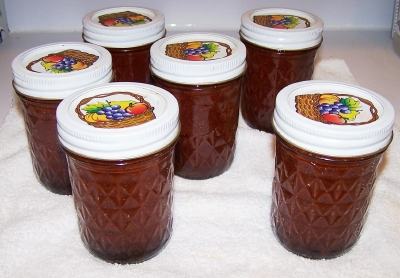
Making and canning your own tomato hot sauce, similar to Tabasco sauce, Ring of Fire, Louisiana hot sauce, etc. is quite easy. And you can make it as hot as you like, even add some other spice. It will better it will taste in the winter, with the flavor of home grown tomatoes! Just scroll down this page to see how to do it, in easy steps and completely illustrated.
Ingredients
Yield: About 7 to 8 half-pint jars
- 8 cups (64 ounces) diced tomatoes, (don't drain them, save the juice)
- Serrano peppers - enough to yield about 11/2 cups seeded, chopped (you can also use habanero, jalapeno or even hot chili peppers, in the same quantities)
- 4 cups distilled white vinegar (5% acidity)
- 2 teaspoons canning salt
- 2 tablespoons whole mixed pickling spices (Publix, Kroger and other grocery stores often carry them, next to the pectin and canning jars)
- Cheesecloth (6" by 6") or a spice bag
- Optional: 1 clove garlic, peeled and finely chopped
Equipment
- Water bath canner
- Large pot
Step 1 - Selecting the tomatoes
It's fun to go pick your own and you can obviously get better quality tomatoes!
Wash, remove stems, and trim off bruised or discolored portions of the tomatoes. You can also use canned, diced tomatoes.
Bulk? A bushel of tomatoes weighs 53 pounds.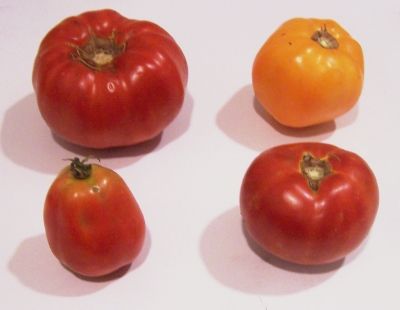
At right is a picture of tomatoes from my garden - they are so much better than anything from the grocery store. And if you don't have enough, a pick-your-own farm is the pace to go! At right are 4 common varieties that will work:
| Top left: Beefsteak | Top right: Lemon Boy, yellow |
| Bottom left: Roma, paste-type | Bottom right: Better Boy |
The picture at right shows the best variety of tomato to use: Roma;
also called paste tomatoes. They have fewer sides, thicker,
meatier walls, and less water.
And that means thicker sauce in less cooking time!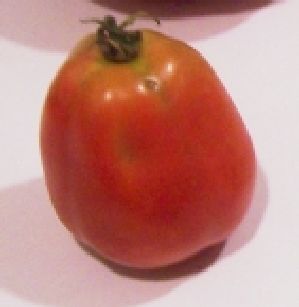
Also, you don't want mushy, bruised or rotten tomatoes!
Caution: Do not can tomatoes from dead or frost-killed vines. Green tomatoes are more acidic than ripened fruit and can be canned safely, also.
Step 2 - Wash the jars and lids
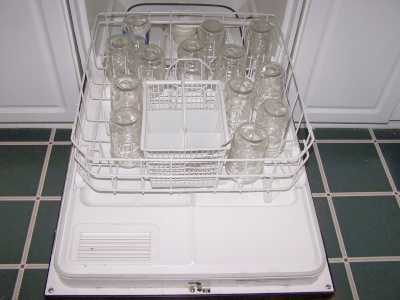 Now's
a good time to get the jars ready, so you won't be rushed later. The
dishwasher is fine for the jars; especially if it has a "sanitize"
cycle, the water bath processing will sanitize them as well as the
contents! If you don't have a dishwasher with a sanitize cycle, you
can wash the containers in hot, soapy water and rinse, then sanitize
the jars by boiling them 10 minutes, and keep the jars in hot water
until they are used.
Now's
a good time to get the jars ready, so you won't be rushed later. The
dishwasher is fine for the jars; especially if it has a "sanitize"
cycle, the water bath processing will sanitize them as well as the
contents! If you don't have a dishwasher with a sanitize cycle, you
can wash the containers in hot, soapy water and rinse, then sanitize
the jars by boiling them 10 minutes, and keep the jars in hot water
until they are used.
NOTE: If a canning recipe calls for 10 minutes or more of process time in the canner, then the jars do not need to be "sanitized" before filling them. But really, sanitizing them first is just good hygeine and common sense! See this page for more detail about cleaning and sanitizing jars and lids.
Put the lids into a pan of hot, but not quite boiling water (that's what the manufacturer's recommend) for 10 minutes, and use the magnetic "lid lifter wand" to pull them out. Leave the jars in the dishwasher on "heated dry" until you are ready to use them. Keeping them hot will prevent the jars from breaking when you fill them with the hot jam.
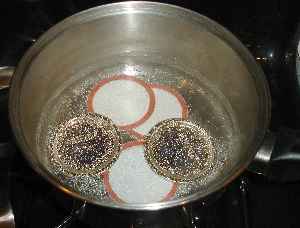 Lids:
put the lids into a pan of hot water for at least several minutes;
to soften up the gummed surface and clean the lids.
Lids:
put the lids into a pan of hot water for at least several minutes;
to soften up the gummed surface and clean the lids.

Need lids, rings and replacement jars?
Get them all here, delivered direct to your home, at the best prices on the internet!
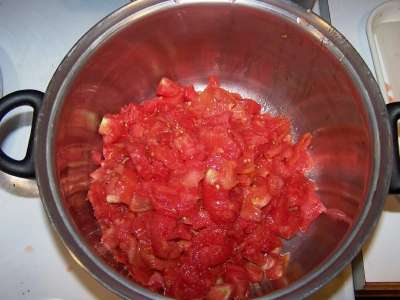
Step 3 - Chop the tomatoes
Chop up the tomatoes (I go to 1/2 inch cubes). You could use a chopper or food processor. You don't need to remove the skins because the food mill (later) will remove the skins and seeds)
Step 4 - Chop the hot peppers
Your want to produce 11/2 cups of seeded, finely chopped Serrano peppers. You can use other similar hot peppers. You may want to use a chopper, food processor or blender. Caution: Wear plastic or rubber gloves when handling, cutting and seeding hot peppers or wash hands thoroughly with soap and water before touching your face or eyes.
Step 5 - Prepare the pickling space bag
Place mixed pickling spices in a spice bag and tie the ends firmly.
Step 6 - Bring all ingredients to a boil
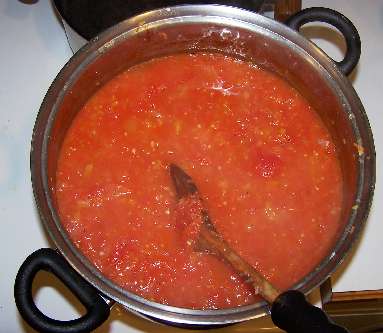
Mix all ingredients together in a Dutch oven or large saucepot. Bring to a boil, stirring occasionally. Simmer another 20 minutes, until the tomatoes are soft.
Step 7 - Run the mix through a food mill
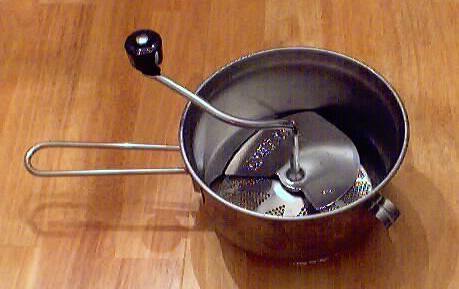
Press mixture through a food mill. This purees the mix and separates skins, seeds, steps and other hard bits. You can also use other mill/sieve combinations like the Villaware.
ASIDE: Here's the Foley food mill (below) .They cost about $25.
See here for related tools, equipment, supplies on Amazon
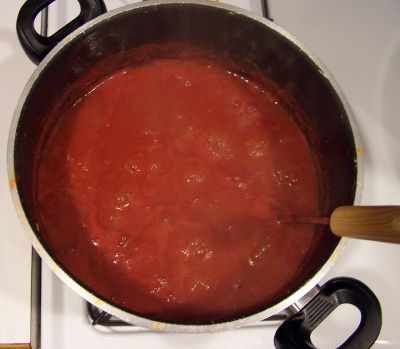
You can also use other mill/sieve combinations like the Villaware (below) See here for related tools, equipment, supplies on Amazon
Step 8 - Heat the strained liquid
Return the strained liquid to the stockpot, heat to boiling and then boil for another 15 minutes.
Step 9 - Fill the jars
 Fill
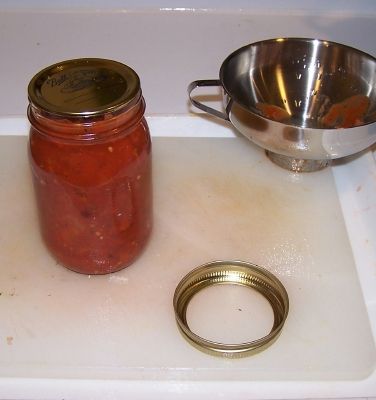
hot sauce into clean, hot half-pint jars, leaving 1/4-inch headspace.
Remove air bubbles and adjust headspace if needed. Wipe rims of jars
with a dampened clean paper towel; apply two-piece metal canning lids.
Fill
hot sauce into clean, hot half-pint jars, leaving 1/4-inch headspace.
Remove air bubbles and adjust headspace if needed. Wipe rims of jars
with a dampened clean paper towel; apply two-piece metal canning lids.
Step 10 - Process in a water bath canner
Process in a boiling water canner according to the recommendations in
the table below. (You can also use a Pressure Canner, if you prefer -
but follow the manual in the pressure canner for the time)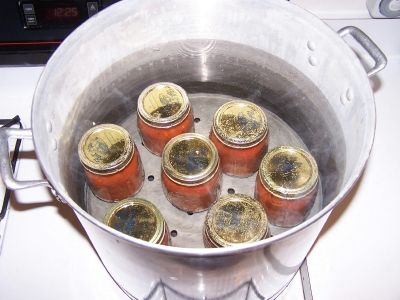
| Recommended process time for Easy Hot Sauce in a boiling water canner. | |||
| Hot pack | Process Time at Altitudes of | ||
| Jar Size | 0 - 1,000 ft | 1,001 - 6,000 ft | Above 6,000 ft |
| Half-pints (8 oz) or smaller | 10 min | 15 min | 20 min |
Step 11 - Cool and store
Let
cool, undisturbed, 12-24 hours and check for seals.
Hot sauce improves with age (up to about 6 months
to a year). Wait at least one week prior to using it. The
longer the sauce ages, the more complex the flavor will become.
Properly packed hot sauce will last about 1 year, if kept in a cool,
dark area.
Developed at The University of Georgia, Athens, for the National Center for Home Food Preservation. Released by Elizabeth L. Andress, Ph.D., Department of Foods and Nutrition, College of Family and Consumer Sciences. March 2003; revised February 2009.

Looking for canning equipment and supplies?
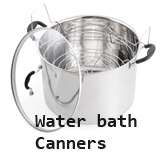
Water bath canner with a jar rack
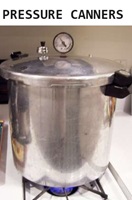
Pressure canners for gas, electric and induction stoves: Presto 23Qt or T-fal 22Qt
Canning scoop (this one is PERFECT)
Ball Blue book (most recent version)
Jars: 8oz canning jars for jams
Find Other types of farms:
Farm markets and roadside stands
Road trips and camping resources
Local Honey, apiaries, beekeepers
Consumer fraud and scams information
Home canning supplies at the best prices on the internet!
Maple Syrup Farms, sugarworks, maple syrup festivals
Environmental information and resources
Farms For Your Event for birthday parties, weddings, receptions, business meetings, retreats, etc.
Festivals - local fruit and vegetable festivals
Get the
most recent version of
the Ball Blue Book