PickYourOwn.org
Where you can find a pick-your-own farm near you!
Do I Need to Use a Canner for my jam and other home produce? Why? Answered Here!
Click here to add this page to your favorites list! - Updated daily!
This month's notes: May 2008: Spring is here!: strawberries are starting in the deep South and are peaking or fading in California, Texas and Florida!  Organic farms are still not common, but any that are, have the word ORGANIC by their name! Check out my easy canning directions, and canning equipment or How to make ice cream and ice cream making equipment and manuals
Please tell the farms you found them here - and ask them to update their information!!!

Why do I need to Use a Canner?


People occasionally ask, "why use a water bath method or a pressure canner. My grandmother used and she never got ill!" That may be true, just as there are occasionally smokers who live to 100 or people who cross the street without looking and don't get hit by a car.  But no rational person would recommend these either...

The US Department of Agriculture and many major universities (Clemson, University of Georgia, University of Illinois, University of Wisconsin, University of Minnesota, to name a few; a quick Google search on "open kettle method safety university" will find the credible links) l have each extensively studied food safety and home canning.  To summarize their findings; all of them state that if you are canning at home, including making jams and jellies, you must use a water bath or pressure canner, if you want to avoid food poisoning.  By food poisoning they are referring to varieties of bacteria, such as botulism, that grow in a sealed environment.  Without hyperbole, death is one of the outcomes of such poisoning. 

Some recipes, particularly old family recipes and many floating around on the internet don't call for processing.  The food is cooked in an ordinary pot or kettle, then packed into hot jars and sealed without processing (this is called the "open kettle method").. The temperatures obtained in open kettle canning are not high enough to destroy all spoilage and food poisoning organisms that may be in the food. Also, microorganisms can enter the food when it is transferred from the kettle to jar and cause spoilage. These are obsolete and may be dangerous.  According to the USDA;

"Canning recipes prior to 1990 should not be used. Many old recipes do not include instructions for processing foods. The foods are canned by the open kettle method, sealed and stored. This method for canning, the open kettle method, is not recommended for it presents a serious food safety hazard. All high acid foods should be processed in a water bath canner and all low acid foods in a pressure canner. "

Grandma says I don't need to use a water bath, just fill and seal the jars! Explain it to me, again, slowly...

Were he alive, Louis Pasteur would tell you that at the time you sealed the jars, the temperature of the contents had already dropped way below 212 F.  Meanwhile, the jars were exposed to the air (temp 70f to 90 F) which is not a sterile environment and does contain floating spores of Clostidium Botulism and other harmful bacteria. Therefore, the sealed jars now contain small amounts of live lethal bacteria.

Over time, those spores would grow. How fast and to what extent, is subject to many variables, but how many of us want to play Russian roulette with our health and food?

Water bath processing would kill the vast majority of those spores, creating a sealed sterile environment. Does this help explain it in terms that even Grandma would grasp? :)

OK, I need a canner?  Why types are there?

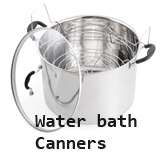
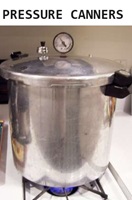
Equipment for heat-processing home-canned food is of two main types--boiling-water canners and pressure canners. There are many other types which are NOT recommended by the authorities (see this page for more about obsolete and unsafe canning methods)

Most are designed to hold seven quart jars or eight to nine pints. Small pressure canners hold four quart jars; some large pressure canners hold 18 pint jars in two layers, but hold only seven quart jars. Pressure saucepans with smaller volume capacities are not recommended for use in canning. Small capacity pressure canners are treated in a similar manner as standard larger canners, and should be vented using the typical venting procedures.

Low-acid foods must be processed in a pressure canner to be free of botulism risks.  Low-acid foods include meats, dairy, sea food, poultry, vegetables and many fruits. 

Higher acid foods (and those which have been acidified and tested) that may be safely canned in a boiling water bath canner include jams, jellies, pickles, applesauce, apple butter, peaches, peach butter, pears, pear butter, spaghetti sauce without meat, tomatoes, ketchup and tomatoes.

Which Type of Canner Should I Get

There are advantages and disadvantages of Pressure and Boiling Water Bath Canners.  Which is best for you depends upon what you want to can and your budget.

Water bath canners are faster for higher acid foods

Although pressure canners may also be used for processing higher acid foods, boiling-water canners are recommended for this purpose because they are faster. A pressure canner would require from 55 to 100 minutes to process a load of jars; while the total time for processing most acid foods in boiling water varies from 25 to 60 minutes. A boiling-water canner loaded with filled jars requires about 20 to 30 minutes of heating before its water begins to boil.

A loaded pressure canner requires about

  • 12 to 15 minutes of heating before it begins to vent;
  • another 10 minutes to vent the canner;
  • another 5 minutes to pressurize the canner;
  • another 8 to 10 minutes to process the acid food; and, finally,
  • another 20 to 60 minutes to cool the canner before removing jars.

But Water Bath Canners cannot be used for meats, dairy, sea food, poultry, vegetables and many fruits.

And the food quality and storage time is better with a pressure canner.  Because they get hotter (240F vs 180F-212F) pressure canners result in a better flavor and the ability for to store for a longer time.

A pressure canner can be used as a boiling water bath canner, just remove the gauge and weight.  That way you have 2 canners in one! 

Conclusion: Pressure canners cost more to buy, but ultimately, you can "can" more foods in them, store the foods longer, and use the same canner as a pressure canner or without sealing the lid, as a boiling water bath canner. 

See this page for a selection of pressure canners at excellent prices, and this link for boiling water bath canners

You can also find free information about canners from the USDA in this PDF file (it will take a while to load!) about selecting and using canners here!


Related Questions and Answers

Q. I have never been able to get a straight answer about whether adding lemon juice or vinegar is necessary if canning salsa in a pressure canner. It would seem to me that you would not need to add the vinegar or lemon juice because you would be bringing up the temperature and maintaining it at high points that would kill off any botulism spores. This would seem to me to be similar to what you do when you safely can your own tuna in a pressure cooker. Can you please provide an answer to this question?

A. Yes, it is necessary! It's more complicated than that!! No process, of any kind, kills ALL spores, so part of the equation is; to what extent is the population of spores diminished, and what will be the replication rate of those that survive? Pressure canning, using high temperatures destroys more spores than water bath canning, and commercial conning equipment destroys a far, far greater percentage of the resident spores than any home method. The addition of acid inhibits the remaining spores growth, keeping the levels of bacteria (which are always present) to a level that is effectively, undetectable and not a threat.  Of course, if you store ANY canned food (home or commercial) long enough, it WILL spoil!  That's why they're stamped with expiration dates!


See this page for more Answers to Common Questions About Home Canning, Freezing and Making Jams!

Who Invented the Canning Jar?  Does Ball still make jars? - See:

A Brief History of the Home Canning Jar: From Mason to Kerr to Ball and More

top ^

Free Resources About Storing

top ^

Canning books

Canning & Preserving for Dummies
by Karen Ward
Average Customer Review: 5.0 out of 5 stars
Usually ships in 24 hours

Price:   $11.89
You Save:   $5.10 (30%)

The Ball Blue Book of Preserving

This is THE book on canning!  My grandmother used this book when I was a child.  It tells you in simple instructions how to can almost anything; complete with recipes for jam, jellies, pickles, sauces, canning vegetables, meats, etc.  If it can be canned, this book likely tells you how! Click on the link below for more information and / or to buy (no obligation to buy)

Price $8.95  

Home Canning Kits

This is the same type of  standard canner that my grandmother used to make everything from applesauce to jams and jellies to tomato and spaghetti sauce!. This complete kit includes everything you need and lasts for years: the canner, jar rack, jar grabber tongs, lid lifting wand, a plastic funnel, labels, bubble freer, and the bible of canning, the Ball Blue Book. It's much cheaper than buying the items separately. You'll never need anything else except jars and lids (and the jars are reusable). To see more canners, of different styles, makes and prices, click here!
 

Average Customer Review: 5.0 out of 5 stars
Usually ships in 1-2 business days


Remember to ALWAYS call the farm or orchard BEFORE you go - weather, heavy picking and business conditions can always affect their hours and crops!

PYO Farms in Other Countries: [ Australia ] [ Canada ] [ South Africa ] [ New Zealand ] [ United Kingdom ]

Our other free, informative sites you may like:

Questions, comments, corrections and suggestions or want to recommend a farm to add? 
Or write me at 

All images and text  Copyright ©
Benivia, LLC 2004,2005, 2006, 2007, 2008 All rights reserved.    Disclaimer
Permission is given to link to any page on www.pickyourown.org 

Looking for jobs on farms?

Farmers: If you'd like to advertise or have your own web page(s), click here!