Statistics and Demographics about Home Canning and Preserving
Whether you are a journalist writing an article, a student doing research or
just curious, the following research about who cans (preserves, bottles,
freezes, etc.) foods at home may interest you. The results come from several
surveys and were compiled by the USDA.
These surveys were performed between October 2000 and January 2001
using random telephone surveys.
Aside from the interesting aspects of who cans what, these studies
show changes in the amount and types of foods canned at home, as well as
methods used and of concern, the continued use of high-risk practices,
including some that could lead to botulism. Unfortunately, untrained
friends or relatives are the primary source of instructions for many of
today’s home canners (43.5% in the national survey, 55.1% in the Georgia
survey), rather than tested recipes from universities, the USDA and the
manufacturers of home canning equipment (note: all of the recipes for
home canning presented on pickyourown.org come from these sources,
unless specifically noted otherwise.
I can also provide photos of farm activities, fruits, vegetables, corn mazes,
etc. If you have additional questions or prefer a verbal discussion, or need an
appearance on a radio or tv program, feel free to use the
feedback form to contact me.
I hope the information below is helpful!
Table 1. Demographic Characteristics of Home
Canners
|
Characteristic |
USDA
Categories |
USDA
Sample |
NCHFP & GaPOLL Categories |
NCHFP Sample |
GaPOLL Sample |
|
Age |
Under 25 |
10 |
18-24 |
7 |
13 |
| 25-34 |
21 |
25-34 |
17 |
18 |
| 35-49 |
28 |
35-49 |
30 |
33 |
| 50-64 |
24 |
50-64 |
20 |
26 |
| 65 and over |
15 |
65 and over |
21 |
9 |
|
|
|
Education |
Grade school or
less |
17 |
Less than high school |
16 |
7 |
| High school or less |
18 |
High School
(GED) |
28 |
26 |
| High school
graduate |
36 |
Less than 4yr. degree |
25 |
33 |
| Vocational training |
5 |
Bachelor
degree |
21 |
20 |
| College or more |
22 |
Post Graduate |
7 |
15 |
|
|
|
Income |
Under $5,000 |
14 |
<$14,999 |
4 |
5 |
| $5,000-$12,499 |
30 |
$15,000-$24,999 |
6 |
6 |
| $12,500-$19,999 |
27 |
$25,000-$34,999 |
7 |
9 |
| $20,000 and over |
11 |
$35,000-$49,999 |
16 |
13 |
| Other* |
16 |
$50,000-$74,999 |
14 |
12 |
| |
|
$75,000 or more |
13 |
27 |
| |
|
Other* |
41 |
29 |
|
|
|
Total Sample Size |
|
901 |
135 |
179 |
| * Other responses include Don't
Know/Refused/Not Answered. |
- Approximately 50-58.5% of home canners were 35-64 years of age in
each survey. 28-33% were 35-49, while another 20-25.5% were 50-64 years
old.
- In the USDA
national sample, 39% were 50 years and older and 31% were under age 35.
In the NCHFP
national sample, there was a higher percentage (41.2) aged 50 years and
older and a smaller percentage (24.4) under age 35. The GaPOLL sample
had more canners in the younger age categories (under age 65) than the
NCHFP
sample.
- The numbers of home canners with at least a high school education
were higher in the
NCHFP
(81.5%) and GaPOLL (93.1%) than in the 1975
USDA
study (63%). In addition, the number of home canners with formal
education beyond high school was also much higher in the more recent
surveys (53.3%
NCHFP
and 67.3% GaPOLL versus 27%
USDA).
- The high levels of missing information on income in the
NCHFP
(40.7%) and GaPOLL (29.1%) surveys make it difficult to describe the
true income distribution of those participating in home canning. Of
those choosing to report their income, 16.3% and 19.3% (NCHFP
and GaPOLL respectively) have household incomes of less than
$35,000/year; 43% and 51.6% (NCHFP
and GaPOLL respectively) have incomes of more than $35,000.
Table 2. Percentage of Households Canning Varous Products
| |
SURVEY |
| PRODUCT |
USDA |
NCHFP |
GaPOLL |
|
Tomatoes |
73.0 |
60.0 |
34.3 |
|
Fruits |
56.0 |
47.4 |
31.5 |
|
Vegetables |
51.0/18.0* |
71.1 |
47.8 |
|
Jams/Jellies |
41.0/41.0 |
Not asked |
26.4 |
|
Pickles |
48.0 |
Not asked |
12.4 |
| * Percent canning low acid
vegetables/vegetable mixtures (separate questions in the
USDA
survey). |
- In 1975, tomatoes were being canned by 73% of the households
surveyed. Today the percentage canning tomatoes has decreased (60% and
34.3% NCHFP
and GaPOLL respectively) and vegetables (71.1% and 47.8%
NCHFP
and GaPOLL respectively) are now the most frequently canned product.
- The increase in the percentage of households canning vegetables
focuses concern on the use of improper methods for canning vegetables,
which require a pressure processing method.
- The percentage of households canning fruits has decreased slightly
from 1975.
Table 3. Percentage of Home Canners Using
Various Sources for Instructions.
| |
SURVEY |
| SOURCE |
USDA |
NCHFP |
GaPOLL |
|
USDA
Publications |
9.0 |
3.2 |
1.9 |
|
Extension Publications |
11.0 |
0.8 |
3.1 |
|
Cookbook |
42.6 |
16.8 |
15.8 |
|
Magazines or Newspapers |
12.2 |
0.8 |
3.8 |
|
Friends or Relatives |
60.4 |
43.5 |
55.1 |
|
Manufacturers* |
9.8 |
11.5 |
7.6 |
|
Other |
No Data |
21.5 |
15.8 |
| * Manufacturer's cookbook. |
- As in 1975, the most often cited source of instructions in the
NCHFP
and GaPOLL surveys is friends or relatives (43.5% and 55.1%
respectively).
- The percentage of home canners using the recommended
USDA
and Extension Service Publications in 1975 was very small but today that
percentage has decreased even more.
- In 1975, 42.6% of home canners were using cookbooks as their source
of instruction, but today that number has decreased (16.8% and 15.8%
NCHFP
and GaPOLL respectively).
Table 4. Percentages Using Various Methods
for Canning Acid and Low Acid Foods.
| |
Survey |
| |
USDA |
NCHFP |
GaPOLL |
| METHODS |
Fruits & Tomatoes* |
Vegetables** |
Fruits & Tomatoes |
Vegetables |
Fruits & Tomatoes |
Vegetables |
|
Boiling Water |
52.8/51.5 |
39.2/27.9 |
55.0 |
34.4 |
56.4 |
46.3 |
|
Pressure Cooker |
4.0/3.9 |
10.0/5.1 |
16.0 |
16.1 |
29.0 |
24.5 |
|
Pressure Canner |
14.9/20.8 |
46.6/38.0 |
11.0 |
28.1 |
22.5 |
8.3 |
|
Oven |
Less
than 1% |
Less
than 1% |
2.0 |
3.3 |
8.8 |
7.4 |
|
Open Kettle |
43.6/35.1 |
13.5/24.8 |
14.0 |
13.0 |
21.7 |
15.8 |
|
Other Responses*** |
No
Data |
No
Data |
2.0 |
4.4 |
12.8 |
19.4 |
* Percent canning fruits/tomatoes
(separate questions in the
USDA
survey).
** Percent canning low-acid vegetables/vegetable mixtures
(separate questions in the
USDA
survey).
*** Other Responses includes Don't Know, Refused/Not
Answered. |
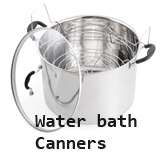
- The usual
USDA recommended processing method for canning fruits and
tomatoes is boiling water canning, so one would expect a majority of
home canners to be using this method. Recommended pressure processes are
available as alternatives to the boiling water canner. Oven and open
kettle canning have not been recommended by
USDA
as methods for fruits and tomatoes since 1943. Table 5 contains the
methods that home canners report using for the acid-food categories of
fruits and tomatoes.
- The percentage of home canners using boiling water canning for
fruits and tomatoes has not increased much since 1975. However, the
percentage using the open kettle method (no processing of the filled
jar) has decreased from 43.6/35.1 (fruits/tomatoes) to 14-22 (NCHFP-GaPOLL).
- More people are using a pressure cooker for processing fruits
and tomatoes now than in 1975. A smaller percentage of the
NCHFP
respondents reported using a pressure canner than in either
USDA’s
1975 survey or the GaPOLL.
- The
NCHFP and GaPOLL surveys both indicated similar
percentages using the boiling water canner for processing fruits and
tomatoes. The percentages using all other methods were not
consistent in these two surveys.
- Recommended
USDA processing procedures for home canning of vegetables
other than tomatoes have only included pressure processes since 1943.
Furthermore, boiling water, oven and open kettle canning have been
described as unsafe for low-acid foods since that time. Beginning in
1957, USDA
Home and Garden Bulletins included a statement to add 20 minutes to
processing times used for pressure canners when using a pressure cooker.
Therefore, in 1975,
USDA
did recommend a method for processing vegetables in a pressure cooker
(saucepan). However, this endorsement was removed from their
recommendations in 1988 with the publishing of the Complete Guide to
Home Canning. This latter bulletin stated that recommended small
pressure canners hold four quart-size jars; pressure saucepans with
smaller volume capacities are not recommended for use in canning. The
methods home canners report using for low-acid vegetables are shown in
Table 5.
- In 1975, slightly more than half of home canners were using
either a pressure canner or cooker for vegetables (56.6 combined),
as recommended. A smaller percentage (43.1 combined) reported using
either of these methods for vegetable mixtures. Less than half of
home canners in the
NCHFP
(44.2 %) and GaPOLL (32.8 %) surveys reported using either
pressure-based method.
- The number of home canners using no processing (the open kettle
method) for vegetables was high enough to cause concern in 1975.
Unfortunately, today there appears to be little decrease in the
percentage of home canners who choose to follow this very risky
practice.
- The percentages of home canners today (3.3 and 7.4,
NCHFP
and GaPOLL respectively) also reporting the use of oven canning
methods are of concern.
Table 5. Percentages of Home Canners Using
Various Methods.
| |
SURVEY* |
| Methods |
USDA** |
GaPOLL |
|
Boiling Water Canner |
12.6/9.5% |
48.8% |
|
Pressure*** |
3.9/5.1 |
7.0 |
|
Oven |
Less than 1% |
9.3 |
|
Open Kettle |
85.1/87.0 |
34.9 |
|
Other Responses**** |
No data |
9.3 |
* No data available from
NCHFP Survey.
** Percent Canning Jams/jellies (separate questions in the
USDA
survey).
*** Includes responses of pressure canner and pressure
cooker, combined.
**** Other Responses includes Don't Know, Refused/Not
Answered. |
- Prior to 1978, paraffin was recommended in
USDA
publications for sealing jellies and jams. Then in a 1978
USDA
bulletin, a 5-minute boiling water process was recommended for sealed
jars of jellies, jams, conserves, marmalades, and preserves for those
residing in warm or humid climates; the use of paraffin was restricted
as an option for jelly only.
USDA
has recommended only a boiling water process for all jams and jellies
since 1988.
- The GaPOLL results indicate that the number of home canners using a
boiling water process for jellies and jams has increased since 1975.
However, less than half of home canners today (48.8 percent) are
following this practice, while 35% report using open kettle methods, 9%
oven canning and 7% pressure canning. In 1975, 85/87% (for jams/jellies)
used the open kettle method, while 12.6/9.5 and 3.9/5.1 used boiling
water and pressure methods, respectively.
Conclusions
- Current surveys reveal that greater adoption of science-based home
canning techniques is needed, a finding similar to the 1975 national
USDA
survey.
- One finding of greatest concern is the lack of pressure-based
processing methods for vegetables. A large percentage of home canners
are at high risk for foodborne illness, including botulism.
- Findings document risky practices and knowledge that should be
targeted in educational programs and publications.
- Ongoing analyses indicate interactive effects for age and education
with choices of processing methods and sources of instruction.
References and Methods
Two telephone surveys were conducted in 2000-2001 by the National Center
for Home Food Preservation (NCHFP)
at the University of Georgia (UGA)
in conjunction with the Survey Research Center (SRC),
UGA. Structuring and
supervision in an interviewer’s work is essential in order to gather data in
a controlled and standardized fashion (4).
Thus, interviewers trained in survey research and telephone-interviewing
technology by the SRC were
used for the interviewing in both surveys. Appropriate supervision during
interviews provided quality control. Probability analyses estimated that the
number of interviews conducted were more than sufficient to achieve the
target levels of precision and accuracy in drawing conclusions on population
responses based on sample estimates (1).
Between October 2000 and January 2001, 135 telephone interviews from
households randomly selected throughout the U.S. were completed as part of a
national survey. A 42-item survey instrument that included 16 open-ended
questions was developed by the
NCHFP
and refined with the assistance of the
SRC. 1244 eligible
respondents were contacted; these yielded the 501 complete interviews of
people canning and/or freezing food at home, for a cooperation rate of
40.3%. Of the 501 in the study, 135 (27%) canned food at home during 1999.
Then in November 2001, 179 Georgians answered a series of 10 home canning
questions in another state telephone survey, the Georgia Poll. The Georgia
Poll is conducted routinely in a random sampling of adult residents for the
purpose of learning the attitudes and opinions of respondents towards
several key sets of questions, as well as information about local and
national affairs. The home canning interviews were a subset of 427 completed
telephone interviews in the Georgia Poll. The cooperation rate for the
overall study was 40.5%.
Data from these two UGA
surveys were compared to the results of a 1976 national survey conducted by
USDA (2).
The methodologies for each of these studies are summarized in
Table 1.
Table 6. Comparison of Canning Surveys
|
Study |
Brief Study Description |
Study Dates |
Code* |
| Davis and Page, 1979 |
- National study of home canners; surveyed canning
practices used in 1975.
- 979 questionnaires were obtained from 1,031 home canners
identified in an initial screening to locate home canners.
The initial sampling resulted from a statistically valid
sample drawn to represent all private households in the
conterminous U.S. consistent with census data. 901 completed
questionnaires were used in analyses.
|
1976 |
USDA |
| Andress, et al., unpublished |
- National Center for Home Food Preservation survey of
individuals primarily responsible for household food
preparation to determine activity level of home canning and
freezing and use of critical safety practices.
- Interviews completed by the Survey Research Center at
the University of Georgia between October 24, 2000 and
January 10, 2001.
- Eligibility of respondents was determined by asking, if
in 1999, anyone in the household either canned foods or
froze foods other than foods that were purchased in the
supermarket. Sample of home canners consisted of 135
interviews.
|
2000-2001 |
NCHFP |
| Andress, et al., unpublished |
- National Center for Home Food Preservation placed 10
home canning questions in a statewide telephone survey (the
Georgia Poll, a survey about local and national affairs).
- Interviews were completed by the Survey Research Center
at the University of Georgia in November 2001. Respondents
were a random representative sample of the adult population.
- In Fall 2001, respondents were asked about their canning
practices during the “past year.”
|
2001 |
GaPOLL |
| * This acronym will be used
throughout this paper to represent the study under
consideration. Source page:
http://www.uga.edu/nchfp/papers/2002/sneposter.html |