Looking for Canning Elderberries - Easily! With Step-by-step Directions, Photos, Ingredients, Recipe and Costs in 2024? Scroll down this page and follow the links. And if you bring home some fruit or vegetables and want to can, freeze, make jam, salsa or pickles, see this page for simple, reliable, illustrated canning, freezing or preserving directions. There are plenty of other related resources, click on the resources dropdown above. If you are having a hard time finding canning lids, I've used these, and they're a great price & ship in 2 days.
If you have questions or feedback, please let me know! There are affiliate links on this page. Read our disclosure policy to learn more.
Canning Elderberries - Easily! With Step-by-step Directions, Photos, Ingredients, Recipe and Costs
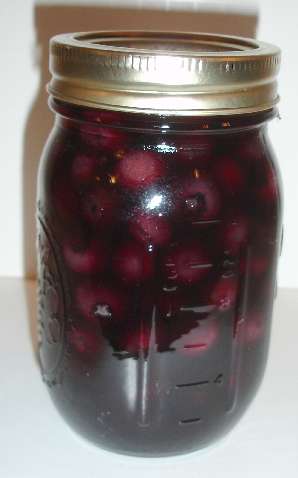 How to Can Elderberries
Yield: 7 to 9 pint jars
Click here for a PDF print version
Canning your own elderberries is also quite easy. Here's how to make it, in 12 easy steps and completely illustrated. These directions work equally well for regular sugar, low sugar, fruit juice-sweetened and Stevia (in a prepared form like Truvia, it measures same as sugar; if you use another form, you will need do your own conversion) - or Splenda, if you prefer, -sweetened jam.For more information about elderberries, see Elderberries.
Ingredients
- Fruit - fresh elderberries - any quantity - the crunch
down some, so you will need about 1 and 1/4 pints raw per pint jar
finished.
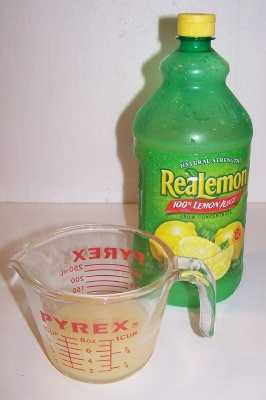
- Lemon juice - either fresh squeezed or bottled. Alternatively, Citric acid (brand name, fruit fresh).
- Sugar - About 3 cups of dry, granulated (table) sugar. See step 6. It is possible to make low-sugar, fruit juice-sweetened, or Stevia (in a prepared form like Truvia, it measures same as sugar; if you use another form, you will need do your own conversion) - or Splenda, if you prefer, -sweetened fig jam; I'll point out the differences below.
Equipment
- Jar grabber (to pick up the hot jars)- Big box stores and grocery stores sometimes carry them; and it is available online - see this page. It's a tremendously useful to put jars in the canner and
take the hot jars out (without scalding yourself!). The kit sold
below has everything you need, and at a pretty good price:
- 1 large pot; I prefer 16 to 20 quart Nonstick ceramic coated pots for easy cleanup.
- Large spoons and ladles,
- 1 Water Bath Canner (a huge pot to sanitize the jars after filling (about $30 to $35 at mall kitchen stores, sometimes at big box stores and grocery stores.). Note: we sell canners and supplies here, too - at excellent prices - and it helps support this web site!
- Half pint canning jars (Grocery stores, like Publix, Kroger, Safeway carry them, as do some big box stores - about $7.50 per dozen pint ounce jars including the lids and rings)
- Jar funnel ($5 at Target, other big box stores, and often grocery stores; and available online - see this page) or order it as part of the kit with the Jar grabber .
- Lids - thin, flat, round metal lids with a gum binder that seals them against the top of the jar. They may only be used once.
- Rings - metal bands that secure the lids to the jars. They may be reused many times.
Optional stuff:
- Lid lifter (has a magnet to pick the lids out of the almost-boiling water where you sanitize them. ($4 at big box stores or it comes in the kit at left)
Directions - Step by Step
This example shows you how to make canned elderberries. The yield from this recipe is about 7 pint jars per 9 pints of raw berries.
Step 1 - Pick the elderberries! (or buy them already
picked)
It's fun to go pick your own and you can obviously get better quality ones!
I prefer to grow my own; which is really easy, don't require pesticides and they make beautiful landscaping plants with red/gold leaves in the Autumn - but that does take some space and time.
As mentioned in the Ingredients section; you may use frozen elderberries (those without syrup or added sugar); which is especially useful if you want to make some jam in December to give away at Christmas!
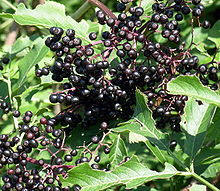
Choose ripe, sweet berries with uniform color. At left are elderberries almost ripe! If you want to pick your own, here is a list and links to the pick your own farms.
Step 2 - How much fruit?
Canned elderberries can be made in large or small batches - you can can one jar at a time if that's all you have.
 Step
3 - Wash the jars and lids
Step
3 - Wash the jars and lids
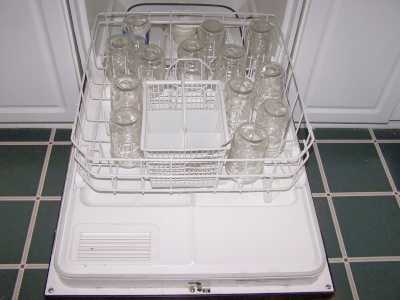
Now's a good time to get the jars ready, so you won't be rushed later. The dishwasher is fine for the jars; especially if it has a "sanitize" cycle, the water bath processing will sanitize them as well as the contents! If you don't have a dishwasher with a sanitize cycle, you can wash the containers in hot, soapy water and rinse, then sanitize the jars by boiling them 10 minutes, and keep the jars in hot water until they are used.
NOTE: If a canning recipe calls for 10 minutes or more of process time in the canner, then the jars do not need to be "sanitized" before filling them. But really, sanitizing them first is just good hygeine and common sense! See this page for more detail about cleaning and sanitizing jars and lids.
Leave the jars in the dishwasher on "heated dry" until you are ready to use them. Keeping them hot will prevent the jars from breaking when you fill them with the hot jam. Some newer dishwashers even have a "sanitize" setting.
Step 4 - Get the lids warming in hot (but not boiling) water
Lids: put the very hot (but not quite boiling; around 180 F, steaming water is fine)
water (or on the stove in a pot of water on low heat) for at least several minutes; to soften up the gummed surface
and clean and sanitize the lids.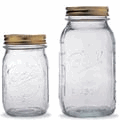
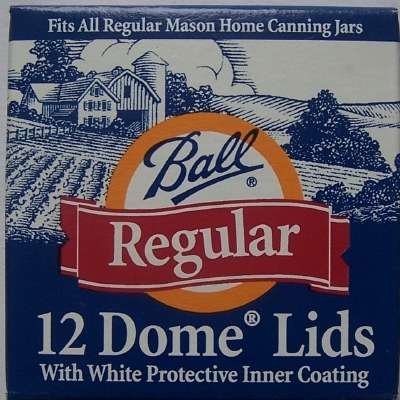
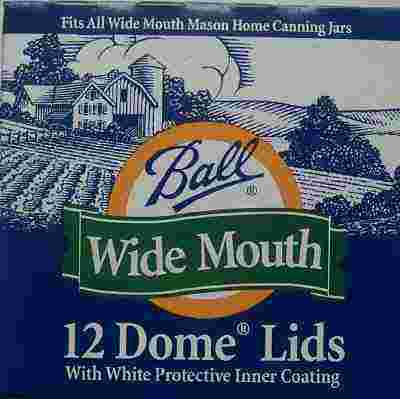 Need lids, rings and replacement jars?
Get them all here, delivered direct to your home, at the best prices on the internet!
Step 5 -Wash the berries and sort!
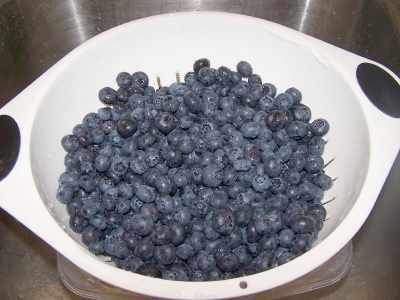 I'm sure you can figure out how to wash the fruit in a
colander of plain
cold water. (yes, these are pictures of blueberries; my camera died when I
canned the elderberry)
I'm sure you can figure out how to wash the fruit in a
colander of plain
cold water. (yes, these are pictures of blueberries; my camera died when I
canned the elderberry)
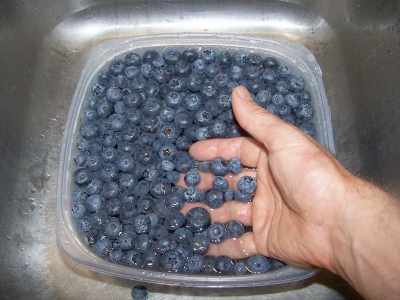 Then you need to pick out and remove any bits of stems, leaves and soft
or mushy berries. It is easiest to do this in a large bowl of water and
gently run your hands through the berries as they float. With your
fingers slightly apart, you will easily feel any soft or mushy berries
get caught in your fingers.
Then you need to pick out and remove any bits of stems, leaves and soft
or mushy berries. It is easiest to do this in a large bowl of water and
gently run your hands through the berries as they float. With your
fingers slightly apart, you will easily feel any soft or mushy berries
get caught in your fingers.
Then just drain off the water!
Step 6 - Make and heat the syrup
Depending upon which type of sweetener you want to use (sugar, no-sugar, Stevia (but you will have to experiment with amount, each brand of Stevia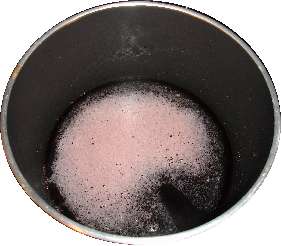 is a different concentration), or Splenda, or a mix of sugar and Stevia (or Splenda) or fruit juice) you will need to use a different
syrup from below.
is a different concentration), or Splenda, or a mix of sugar and Stevia (or Splenda) or fruit juice) you will need to use a different
syrup from below.
Adding syrup to canned fruit helps to retain its flavor,
 color, and shape. It does not prevent spoilage of these foods. Heat the
syrup to near boiling in a pot.
color, and shape. It does not prevent spoilage of these foods. Heat the
syrup to near boiling in a pot.
Most people prefer the medium syrup (highlighted) or elderberry juice with added sugar!
|
Sugar syrup proportions for 7 to 9-pint jars of elderberries (double it for 9 quart jars) |
|||||
| Type of
syrup (Choose ONE) |
Water (cups) |
Fruit juice (cups) |
Sugar (cups) |
Powdered Stevia (in a prepared form like Truvia, it measures same as sugar; if you use another form, you will need do your own conversion) - or Splenda, if you prefer it | |
|---|---|---|---|---|---|
| 1 | Plain water | 7 | 0 | 0 | 0 |
| 2 | no calorie sweetener | 7 | 0 | 0 | 1/4 cup |
| 3 | Fruit juice (white grape or peach juice works well) | 0 | 7 | 0 | |
| 4 | Reduce calorie / fruit juice | 4 | 3 | 0 | |
| 5 | Fruit juice and Stevia (in a prepared form like Truvia, it measures same as sugar; if you use another form, you will need do your own conversion) - or Splenda, if you prefer, | 0 | 7 | 0 | 1/2 cup |
| 6 | very low calorie | 7 | 0 | 1/4 | 1/4 cup |
| 7 | very light (10% sugar) | 7 | 0 | 1 | 0 |
| 8 | light (20% sugar) | 6 | 0 | 2 | 0 |
| 9 | medium (30% sugar) | 6 | 0 | 3 | 0 |
- Nutrasweet (aspartame) will NOT work - it breaks down during heating).
- Stevia (in a prepared form like Truvia, it measures same as sugar; if you use another form, you will need do your own conversion) - or Splenda, if you prefer, (sucralose) substitutes exactly with sugar BUT even the manufacturers of Splenda will tell you that you get best results if you just use a 50-50 mix; half regular sugar and half Stevia (in a prepared form like Truvia, it measures same as sugar; if you use another form, you will need do your own conversion) - or Splenda, if you prefer, .
- Sugar not only affects the sweetness, but also the color and flavor. It does not affect the preserving or spoilage properties - that has to do with acid and the processing method.
- you can use "no sugar" pectin in place of "low sugar" pectin - you can still add sugar or other sweeteners.
Step 7 - Add the natural preservative to the jars
Add 2 tablespoons bottled lemon juice per quart jar or 1 tablespoon per pint jar to each of the jars. Alternatively, you may add 1/2 teaspoon citric acid (also goes under the brand name "fruit fresh") per quart or 1/4 teaspoon per pint to the jars. This is to increase the acidity and help prevent discoloration and spoilage.
Step 8 - Fill the jars with elderberries
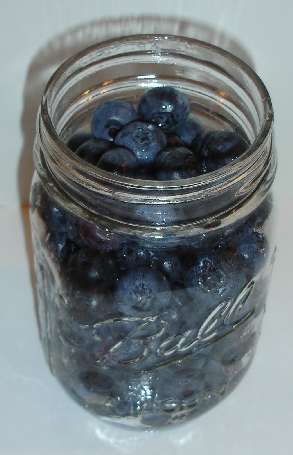 Fill
jars with elderberries, gently tapping the bottom of the jar on the
countertop to help pack the elderberries down gently (tapping does it without
breaking the elderberries).
Fill
jars with elderberries, gently tapping the bottom of the jar on the
countertop to help pack the elderberries down gently (tapping does it without
breaking the elderberries).
Note about "hot packing" vs. "raw packing". You may have noticed that some recipes or canning directions call for the berries to be heated in a pot of boiling water for 30 seconds to several minutes before filling the jars. That is the 'hot pack" method. We're using the "raw pack" method (no preheating) because most berries are delicate and would be adversely affected by the preheating, and being small, it isn't needed to ensure uniform heating in the canner!
Step 9 - Fill the airspace in the jars with syrup
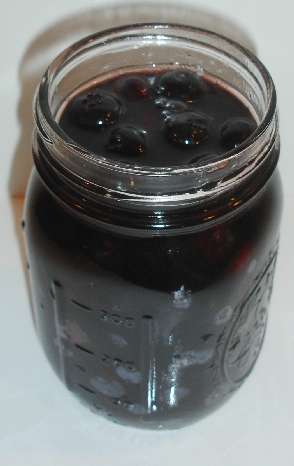 Add the hot syrup from step 6, leaving 1/4 to 1/2-inch headspace. Wipe any
spills jam off the rim of the jar.
Add the hot syrup from step 6, leaving 1/4 to 1/2-inch headspace. Wipe any
spills jam off the rim of the jar.
Step 10 - Put the lid /rings on and put in the canner
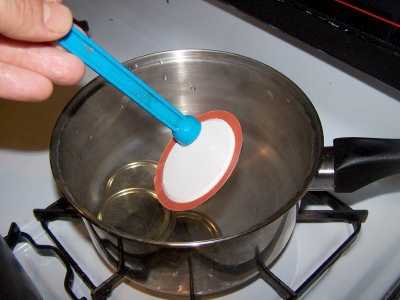 Seat
the lid and tighten the ring around them. This is where the jar
tongs and lid lifter come in really handy! Place them into the canner
Seat
the lid and tighten the ring around them. This is where the jar
tongs and lid lifter come in really handy! Place them into the canner
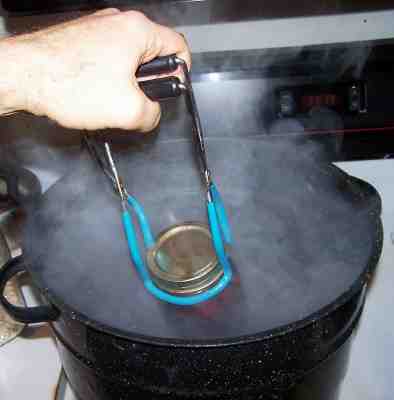 Step 13 - Process the jars in the
canner (either boiling
water bath or pressure canner)
Step 13 - Process the jars in the
canner (either boiling
water bath or pressure canner)
You can use either a water bath canner or a Pressure Canner, since there is sufficient acidity in berries. In the water bath canner, keep the jars covered with at least 2 inches of water. Keep the water boiling.
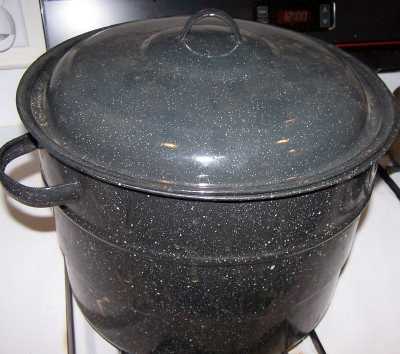 The
processing times are shown for each type of canner in the tables below!
The
processing times are shown for each type of canner in the tables below!
To adjust, process according to the recommendations in the table below:
|
Recommended process time for raw pack Elderberries in a
|
||||
| Process Time at Altitudes of | ||||
| Jar Size | 0 - 1,000 ft | 1,001 - 3,000 ft | 3,001 - 6,000 ft | Above 6,000 ft |
| Pints | 15 min | 20 | 20 | 25 |
| Quarts | 20 min | 25 | 30 | 35 |
|
Recommended process time for raw pack Elderberries in a
|
|||
| Canner pressure (pounds of pressure) at altitudes of | |||
| Jar Size | Processing time | 0 - 1,000 ft | 1,001 and above |
| Pints | 8 min | 5 1b | 10 1b |
| Quarts | 10 min | 5 1b | 10 1b |
Step 14 - Remove and cool the jars - Done!
Lift the jars out of the water in the water bath canner (wait till
pressure is zero in a Pressure Canner) and let them cool without touching or
bumping them in a draft-free place (usually takes overnight) You can then remove the rings if you like, but if you leave them on, at least loosen them quite a bit, so they don't rust in place due to trapped moisture. Once the jars are cool, you can check that they are sealed verifying that the lid has been sucked down. Just press in the center, gently, with your finger. If it pops up and down (often making a popping sound), it is not sealed. If you put the jar in the refrigerator right away, you can still use it. Some people replace the lid and reprocess the jar, then that's a bit iffy. If you heat the contents back up, re-jar them (with a new lid) and the full time in the canner, it's usually ok.
Once cooled, they're ready to store. I find they last about 18 months. After that, the get darker in color and start to get runny. They still seem safe to eat, but the flavor is bland. So eat them in the first 12 to 18 months after you prepare them!
Summary - Cost of Making Home Canned Elderberries - makes 7 pint jars, 16 oz each** |
||||
| Item | Quantity | Cost in 2024 | Source | Subtotal |
| Elderberries | 11 lbs (about 2 gallon, or 4 dozen large elderberries) | $10.00/gallon | Pick your own | $10.00 |
| Canning jars (8 oz size), includes lids and rings | 7 jars | $11/dozen 8 oz jars or $0.92/jar |
Grocery stores, like Public, Kroger, Safeway and sometimes, Big Lots, local hardware stores and big box stores | $5.00 |
| Sugar | 3 cup | $2.00 | Grocery stores, like Public, Kroger, Safeway and sometimes, Big Lots, local hardware stores and big box stores | $2.00 |
| Total | $17.00 total or about $2.42 per pint jar |
|||
|
* - This assumes you already have the pots, pans, ladles,, and reusable equipment. Note that you can reuse the jars! If you already have jars or reuse them, just buy new lids (the rings are reusable, but the flat lids are not)! |
||||
Canning Books, Supplies and Accessories
These are my favorite essential canning tools, books and supplies. I've been using many of these for over 50 years of canning! The ones below on this page are just the sampling of. my preferred tools. but you can find much more detailed and extensive selections on the pages that are linked below.
- Vacuum Foodsealers for freezing, dried foods, and refrigerated foods - the FoodSaver line
- Selecting a KitchenAid mixer and attachments for home canning
- Steam Juicers
- Strainers, pit removers, seed-skin-stem removers, jelly strainers, etc. All types, makes and prices (from $19 to $350)
- Cherry pitters reviews, prices and ordering
- Food dehydrators - easy and fast to dry your own fruits, veggies, sun-dried tomatoes, etc.
The All New Ball Book Of Canning And Preserving: Over 350 of the Best Canned, Jammed, Pickled, and Preserved Recipes Paperback
This is THE book on canning! My grandmother used this book when I was a child.; It tells you in simple instructions how to can almost anything; complete with recipes for jam, jellies, pickles, sauces, canning vegetables, meats, etc.
If it can be canned, this book likely tells you how! Click on the link below for more information and / or to buy (no obligation to buy)The New Ball Blue Book of Canning and Preserving
Canning and Preserving for Dummies by Karen Ward
This is another popular canning book.
Click
here for more information, reviews, prices for Canning and Preserving For Dummies
Of course, you do not need to buy ANY canning book as I have about 500 canning, freezing, dehydrating and more recipes all online for free, just see Easy Home Canning Directions.
Home Canning Kits
I have several canners, and my favorite is the stainless steel one at right. It is easy to clean and seems like it will last forever. Mine is 10 years old and looks like new.
The black ones are the same type of standard canner that my grandmother used to make everything from applesauce to jams and jellies to tomato and spaghetti sauce.
This complete kit includes everything you need and lasts for years: the canner, jar rack, Jar grabber tongs, lid lifting wand, a plastic funnel, labels, bubble freer, It's much cheaper than buying the items separately. It's only missing the bible of canning, the Ball Blue Book.
You will never need anything else except jars & lids (and the jars are reusable)!
The complete list of canners is on these pages:
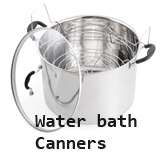
- Water bath canners - Good for acidic foods, like applesauce, pickles, salsa, jams, jellies, most fruits
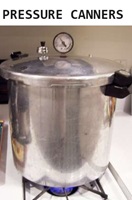
- Pressure canners - needed for low and non-acidic foods, like canned vegetables (corn, green beans, etc), and meats
- Canners for glass top stoves if you have a glass or ceramic stove
- Canners for induction stovetops
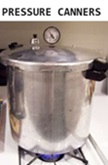
Pressure Canners
If you plan on canning non-acidic foods and low acid foods that are not pickled - this means: meats, seafood, soups, green beans corn, most vegetables, etc., then you ABSOLUTELY must use a Pressure Canner.
Of course, you can use a pressure canner as a water bath canner as well - just don't seal it up, so it does not pressurize. This means a Pressure Canner is a 2-in-1 device. With it, you can can almost ANYTHING.
There are also other supplies, accessories, tools and more canners, of different styles, makes and prices, click here!
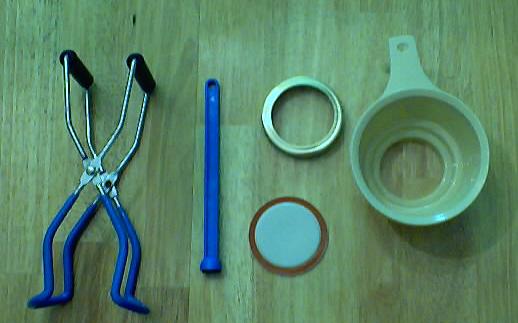
Basic Canning Accessories
From left to right:
- Jar lifting tongs to pick up hot jars
- Lid lifter - to remove lids from the pot of boiling water (sterilizing )
- Lids- disposable - you may only use them once
- Ring - holds the lids on the jar until after the jars cool - then you remove them, save them and reuse them
- Canning Jar funnel - to fill the jars
FREE Illustrated Canning, Freezing, Jam Instructions and Recipes
Don't spend money on books. that you don't need to. Almost everything you can find in some book sold online or in a store is on my website here for free. Start with theEasy Home Canning Directions below. That is a master list of canning directions which are all based upon the Ball Bblue book, the National Center for Home Food Preservation and other reputable lab tested recipes. Almost every recipe I present in addition to being lab tested com. is in a step by step format with photos for each step and complete. explanations. that tell you how to do it, where to get the supplies and pretty much everything you need to know. In addition, there almost always in a PDF format so you can print them out and use them while you cook.
[ Easy Home Canning Directions]
[FAQs - Answers to common questions and problems]
[Recommended books about home canning, jam making, drying and preserving!]

Looking for canning equipment and supplies?
Water bath canner with a jar rack
Pressure canners for gas, electric and induction stoves: Presto 23Qt or T-fal 22Qt
Canning scoop (this one is PERFECT)
Ball Blue book (most recent version)
Find Other types of farms:
- Easter egg hunts
- Children's consignment sales
- Farm markets and roadside stands
- Road trips and camping resources
- Local Honey, apiaries, beekeepers
- Local Meat, Milk and Eggs
- Consumer fraud and scams information
- Home canning supplies at the best prices on the internet!
- Maple Syrup Farms, sugarworks, maple syrup festivals
- Environmental information and resources
- Farms For Your Event for birthday parties, weddings, receptions, business meetings, retreats, etc.
- Festivals - local fruit and vegetable festivals
- Pumpkin patches and corn mazes
- Christmas Tree Farms and lots
Get the
most recent version of
the Ball Blue Book
Get the
most recent version of
the Ball Blue Book of Home Canning
Find other types of farms:
- Easter egg hunts
- Children's consignment sales
- Farm markets and roadside stands
- Local Honey
- Local Meat, Milk and Eggs
- Road trip and camping
- Pumpkin patches and corn mazes
- Christmas Tree Farms and lots
- Maple Syrup farms and sugarworks
Highly rated canning supplies:
- Regular Mouth Canning Lids with food-grade with BPA Free Silicone seals for Ball, Kerr Jars for Canning
- Canning accessories kit: funnel, jar tongs, lid lifter, etc
- Food Dehydrator, 400W Electric with 8 Trays, 48 hour Timer and Temperature Control 95-176℉, BPA-Free
- Water Bath Canner, 21 Qts with lid, Jar Rack, Speckled Black, cans 7 quart jars, 9 pint jars or 13 half-pint jars
- Air Fryer: Instant Pot Instant Vortex Plus XL 8QT Clear Windows, Custom Programming, 8-in-1 Functions that Crisps, Broils, Roasts, Dehydrates, Bakes, Reheats
- Pressure canner: All American 921, 21.5qt Pressure Cooker/Canner, never needs gaskets, Great for Gas, Electric or Flat Top Stoves - Made in the USA
- The Backyard Homestead:a guide to homesteading , on 1/4 acre, how to raise grains and vegetables; raise animals for meat, eggs, and dairy; and keep honey bees
- Smart silent HEPA Air Purifiers for Home, Large Rooms for Allergies, Smoke, Pets. Eliminates 99.97% of Dust, Pet Hair, Odors