
Looking for home canned Baked Beans With Tomato or Molasses Sauce - Easily! With Step-by-step Photos, Recipe, Directions, Ingredients in 2024? Scroll down this page and follow the links. And if you bring home some fruit or vegetables and want to can, freeze, make jam, salsa or pickles, see this page for simple, reliable, illustrated canning, freezing or preserving directions. There are plenty of other related resources, click on the resources dropdown above. If you are having a hard time finding canning lids, I've used these, and they're a great price & ship in 2 days.
If you have questions or feedback, please let me know! There are affiliate links on this page. Read our disclosure policy to learn more.
home canned Baked Beans With Tomato or Molasses Sauce - Easily! With Step-by-step Photos, Recipe, Directions, Ingredients
How to Make Homemade Vegetarian Canned Baked Beans With Tomato or Molasses Sauce
Kidney, navy and other varieties of dried beans are good candidates for making your own homemade canned baked beans. Make your dog will try to sell your secret recipe, too, like the Bush's Baked beans, dog. In your own home garden, leave the beans on the vine to mature. They will dry naturally.
In canning the dried beans, there is a key tip: Water plays an important part in the final quality of canned baked beans. The harder the water used for soaking and blanching, the harder and firmer the finished beans. Also, excessive alkalinity will cause the beans to disintegrate somewhat, becoming soft and mushy. However, this will not be seen until after canning them. there's not much you can do about this, but try to avoid "softened" water.
If you want to add pork, ham or bacon, see this page instead: How to Make Homemade Canned Baked Beans With Back, Pork or Ham and Tomato or Molasses Sauce.
The only other trick is, you really do need a Pressure Canner. Every university food science department and the government will tell you that it just is not safe to use the water bath bath method; it takes the higher temperatures of the pressure canner to kill the botulism bacteria.
See this FAQ for details: Can I use a water-bath canner instead of a Pressure Canner for low acid foods like green beans?
BUT, with a Pressure Canner it's easy. And although a Pressure Canner costs $100 to $200 (see this page for pressure canners models, makes and prices), they last a lifetime, and your children and grandchildren may be using it. You can also find free information from the USDA in this PDF file (it will take a while to load!) about selecting and using canners here!
Prepared this way, the jars have a shelf life of about 12 months, and aside from storing in a cool, dark place, require no special attention. If you'd rather freeze your fruit, see my page on how to freeze green beans. Even easier than canning and they will taste just like fresh.. but it does take up space in the freezer.
Directions for Making Canned Baked Beans
Ingredients
- Dried Beans or Peas (see step 1)
- Salt (optional - I don't use any)
- See step 6 for the ingredients for the sauce; it depends upon which type of sauce you want to make.
Equipment
- 1 Pressure Canner (a large pressure pot with a lifting rack to sanitize the jars after filling (about $75 to $200 at mall kitchen stores and "big box" stores, but it is cheaper online; see this page for more information). For low acid foods (most vegetables, you can't use an open water bath canner, it has to be a pressure canner to get the high temperatures to kill the bacteria. If you plan on canning every year, they're worth the investment.
- Jar grabber (to pick up the hot jars)
- Jar funnel ($4 at mall kitchen stores and local "big box" stores, but it's usually cheaper online from our affiliates)
- At least 1 large pot
- Large spoons and ladles,
- Canning jars (often called Ball jars, Mason jars or Kerr jars) (Publix, Kroger, other grocery stores and some "big box" stores carry them - now about $12 per dozen quart jars (up 50% in 2 years!) including the lids and rings)
Recipe and Directions
Step 1 - Selecting the dried beans
The most important step! You need dried beans that are FRESH - not old to begin with! Remove and discard any soft, diseased or spotted beans.
How many dried beans and where to get them
You can grow your own, pick your own, or buy them at the grocery store.
An average of 5 pounds of beans is needed per
canner load of 7 quarts; an average of 3 and 1/4 pounds is needed per canner
load of 9 pints - an average of 3/4
pounds per quart.
Step 2 -Wash the dried beans!
I'm sure you can figure out how to rinse the dried beans in a strainer or collander in the sink, under running plain cold or lukewarm water.
Step 3 - Soak to rehydrate the beans
Add 3 cups of water for each cup of dried beans or peas. Boil 2 minutes, remove from heat and let them stand and soak for 1 hour.
Drain and discard the water
 Step
4 - Prepare the jars and pressure canner
Step
4 - Prepare the jars and pressure canner
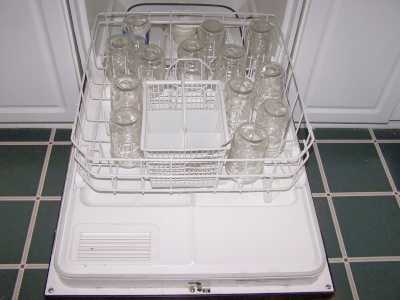
Wash the jars and lids
This is a good time to get the jars ready! The dishwasher is fine for the jars; especially if it has a "sanitize" cycle. Otherwise put the jars in boiling water for 10 minutes. I just put the lids in a small pot of almost boiling water for 5 minutes, and use the magnetic "lid lifter wand" (available from target, other big box stores, and often grocery stores; and available online - see this page) to pull them out.
Get a large pot of water boiling
We will use this water to pour over the beans and fill each jar with liquid, after we've packed them full of beans. I use the largest pot I have, so that there is plenty of clean, boiling water ready when I need it.
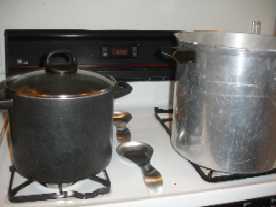
Get the pressure canner heating up
Rinse out your pressure canner, put the rack plate in the bottom, and fill it to a depth of 4 inches with hot tap water. (of course, follow the instruction that came with the canner, if they are different). Put it on the stove over low heat, with the lid OFF of it, just to get it heating up for later on.
Step 5 - Heat/cook the beans
Heat to boiling in fresh water, and save the liquid for making the sauce. You need only bring them to a boil; they do not need to cook for hours.
Step 6 - Make your Baked Bean Sauce!
Make your choice of one of the following sauces. Ingredients are per 3 cups of dried beans:
- Tomato Sauce: Either mix 1 quart tomato juice, 3 tablespoons
sugar, 2 teaspoons salt, 1 tablespoon chopped
onions, and 1/4 teaspoon each of ground cloves, allspice, mace, and cayenne
pepper;
or mix 1 cup tomato ketchup with 3 cups of cooking liquid from beans. Heat to boiling. Mix 1 cup tomato ketchup with 3 cups of cooking liquid from beans and heat to boiling. - Molasses Sauce: Mix 4 cups water or cooking liquid from beans, 3 tablespoons dark molasses, 1 tablespoon vinegar, 2 teaspoons salt, and 3/4 teaspoon powdered dry mustard. Heat to boiling.
Step 7 - Fill the jars 3/4 full with the beans
Fill jars three-fourths full with hot beans. Add a 3/4-inch cube of pork, ham, or bacon to each jar, if desired. If this is your first time, skip the meat - it is safer without meat.
Step 8 - Add the sauce to the jars
Next fill jars with heated sauce, leaving 1-inch headspace (1 inch from the top of the jar). That 1 inch space is called "headspace" and is needed for expansion during heading.
Step 9 - Put the lids and rings on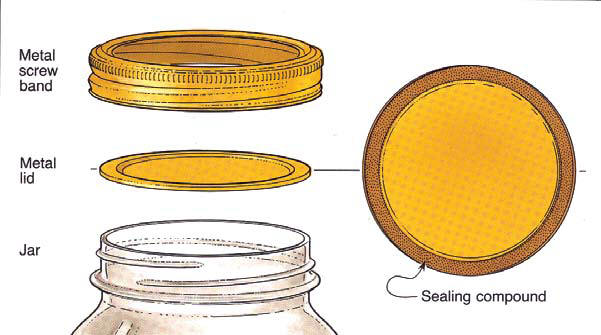
Put the lids on each jar and seal them by putting a ring on and
screwing it down snugly (but not with all your might, just "snug").
Step 10 - Put the jars in the canner and the lid on the canner (but still vented)
Using the jar tongs, put the jars on the rack in the canner. By now the water level has probably boiled down to 3 inches. If it is lower than that, add more hot tap water to the canner. When all the jars that the canner will hold are in, put on the lid and twist it into place, but leave the weight off (or valve open, if you have that type of pressure canner).
 Step
11 - Let the canner vent steam for 10 minutes
Step
11 - Let the canner vent steam for 10 minutes
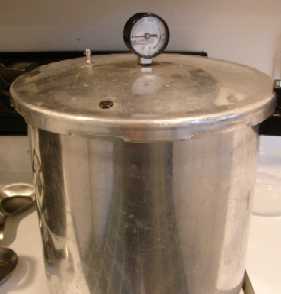
Put the heat on high and let the steam escape through the vent for 10 minutes to purge the airspace inside the canner.
Step 12 - Put the weight on and let the pressure build
After 10 minutes of venting, put the weight on and close any openings to allow the pressure to build to 11 to 13 pounds in a dial-type gauge canner - shown in the photos (or at 10 to 15 pounds pressure in a weighted gauge canner.
Step 13 - Process for the required time
Once the gauge hits 11 pounds (or 10 pounds in a weighted gauge type), start your timer going - for 65 minutes for pint jars and quarts for 75 minutes. Adjust the heat, as needed, to maintain pressure.
Pressure required depends on the altitude where canning is being done. Note: the chart below will help you determine the right processing time and pressure, if you are above sea level.
It is important to learn how to operate your pressure canner by reading the owner's manual that came with your particular canner. If you cannot find your owner's manual, you can obtain find one online: Here is where to find some common manufacturer's manuals:
or by contacting the company that made your canner. Give the model number to the manufacturer, and they will send you the right manual. Click here for more information about pressure canners and a variety of models you can order.
|
Recommended process time for Dried Beans in a dial-gauge pressure canner. |
|||||
| Minimum Canner Pressure (PSI) at Various Altitudes | |||||
| Jar Size | Process Time | 0 - 2,000 ft | 2,001 - 4,000 ft | 4,001 - 6,000 ft | 6,001 - 8,000 ft |
| Pints | 65 minutes | 11 lb | 12 lb | 13 lb | 14 lb |
| Quarts | 75 minutes | 11 lb | 12 | 13 | 14 |
|
Recommended process time for green beans in a weighted-gauge pressure canner. |
|||
| Minimum Canner Pressure (PSI) at Altitudes: | |||
| Jar Size | Process Time | 0 - 1,000 ft | Above 1,000 ft |
| Pints | 65 minutes | 10 lb | 15 lb |
| Quarts | 75 minutes | 10 | 15 |
Step 14 - Turn off the heat and let it cool down
When the processing time from the chart above is up, turn off the heat, and allow the pressure canner to cool and the pressure to drop to zero before opening the canner. Let the jars cool without being jostled. After the pressure drops to zero (usually, you can tell but the "click" sound of the safety release vents opening, as well as but the gauge. Let the pressure in the canner drop to zero by itself. This may take 45 minutes in a 16-quart canner filled with jars and almost an hour in a 22-quart canner. If the vent is opened before the pressure drops to zero OR if the cooling is rushed by running cold water over the canner, liquid will be lost from the jars. Too rapid cooling causes loss of liquid in the jars!
Step 15 - Remove the jars
Lift the jars out of the water and let them cool on a wooden cutting board or a towel, without touching or bumping them in a draft-free place (usually takes overnight), here they won't be bumped. You can then remove the rings if you like, but if you leave them on, at least loosen them quite a bit, so they don't rust in place due to trapped moisture. Once the jars are cool, you can check that they are sealed verifying that the lid has been sucked down. Just press in the center, gently, with your finger. If it pops up and down (often making a popping sound), it is not sealed. If you put the jar in the refrigerator right away, you can still use it. Some people replace the lid and reprocess the jar, then that's a bit iffy. If you heat the contents back up, re-jar them (with a new lid) and the full time in the canner, it's usually ok. You're done!
Other Equipment:
From left to right: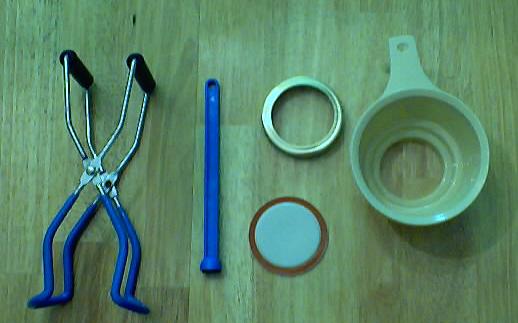
- Jar lifting tongs to pick up hot jars
- Lid lifter - to remove lids from the pot of boiling water (sterilizing )
- Lids- disposable - you may only use them once
- Ring - holds the lids on the jar until after the jars cool - then you remove them, save them and reuse them
- Canning Jar funnel - to fill the jars
Frequently Asked Questions
Q. Is it safe to can dried beans in a traditional water bath? If so how long do you do process them?
A. The answer, quite simply is no. Quoting from the Ohio State University Extension's Fact Sheet:
"Pressure canning is the only safe method for home canning vegetables. Clostridium botulinum is the bacterium that causes botulism food poisoning in low-acid foods, such as vegetables. The bacterial spores are destroyed only when the vegetables are processed in a Pressure Canner at 240 degrees Fahrenheit (F) for the correct amount of time.Clostridium botulinum is the bacterium commonly found in vegetables and meats. It is harmless until it finds itself in a moist, low-acid, oxygen-free environment or a partial vacuum. Under these conditions, the bacterium can grow and produce toxins dangerous to people and animals.
Do not process (low acid) vegetables using the boiling water bath because the botulinum bacteria can survive that method.
Can fruits and vegetables be canned without heating if aspirin is used? No. Aspirin should not be used in canning. It cannot be relied on to prevent spoilage or to give satisfactory products. Adequate heat treatment is the only safe procedure.Is it safe to can dried beans in a boiling water bath if vinegar is used? No. Recommended processing methods must be used to assure safety. Recommended processing times cannot be shortened if vinegar is used in canning fresh vegetables. (This does not refer to pickled vegetables.)
Salt and sugar are not preservatives for vegetables: they are added to stabilize and improve flavor, but will not prevent spoilage.
Salicylic acid is also NOT a preservative. The University of Illinois reports:
Using Aspirin for Canning
Several years ago, a recipe circulated using aspirin to acidify tomatoes and dried beans for canning. Aspirin is not recommended for canning. While it contains salicylic acid, it does not sufficiently acidify tomatoes or dried beans for safe hot water bath canning. dried beans are low acid foods and may only be processed safely in a pressure canner. Lemon juice or vinegar is recommended to acidify tomato products for safe water bath processing.
Think of it like smoking. We all know someone who smoke their entire life and lived to be 90. But the cemeteries are filled with the vast majority who didn't. You will hear people say "my grandmother did it that way for 20 years". But of course, the people who died from food poisoning aren't around and often didn't have descendants to tell their tale...
Comments and Feedback
Pressure canners!If you want to can low-acid foods such as red meats, sea food, poultry, milk, and all fresh vegetables with the exception of most tomatoes, you will need a Pressure Canner. These foods fit into the low acid group since they have an acidity, or pH level, of 4.6 or greater. The temperature which must be reached and maintained (for a specified amount of time) to kill the bacteria is 240 F. Pressure canning is the only canning method recommended safe by the U.S.D.A. for low-acid foods such as vegetables, meats, and fish. Ordinary water bath canners can only reach 212 F and cannot to kill the types of bacteria that will grow in low acid foods. This temperature can be reached only by creating steam under pressure as achieved in quality pressure canners. There are several manufacturers of pressure canners. The two leading ones are Presto and All American (Wisconsin Aluminum). They are more expensive than water bath canners, but extremely well built - I bought mine in 1988 and it still looks and works like new! |
|
|
Presto 01781 23-Quart Pressure Cooker/CannerThis is usually one of the best-priced pressure canners. They are reliable and inexpensive. I've had mine for 40 years. There is also a 16 quart version for even less. Click on the links at left or above for more info and current pricing. |
|
|
Shown at left is the Presto 23 quart pressure canner. Features below and
click here for more information or to purchase from Target.
 See the seller's website for more information, features, pricing and user reviews! |
| See here for related tools, equipment, supplies on Amazon See here for related tools, equipment, supplies on Amazon |
All American Pressure Canner and Cookers - In 3 sizesSee the seller's website for more information, features, pricing and user reviews! |
|
See here for related tools, equipment, supplies on Amazon
See here for related tools, equipment, supplies on Amazon
Click here to see this item or part on Amazon
In the UK, use this link: |